
 Bitten or stung?
 All animals
 Pick a continent
 Africa
 Asia
 Europe
 South America
 Australia & Oceania
 Antarctica
 Pacific Ocean
 Atlantic Ocean
 Indian Ocean
 Arctic Ocean
 Mediterranean Sea
 Red Sea
 Caribbean Sea
 Coral Sea
 South China Sea
 Philippine Sea
 Andaman Sea
 North Sea
 Timor & Arafura Sea
 Bay of Bengal
 Gulf of California
 Games
 Venom battle
 Animal race
 Field notebook
 Venom TOP lists
 Stay safe
 Surprise me

South American black widow
 Bites
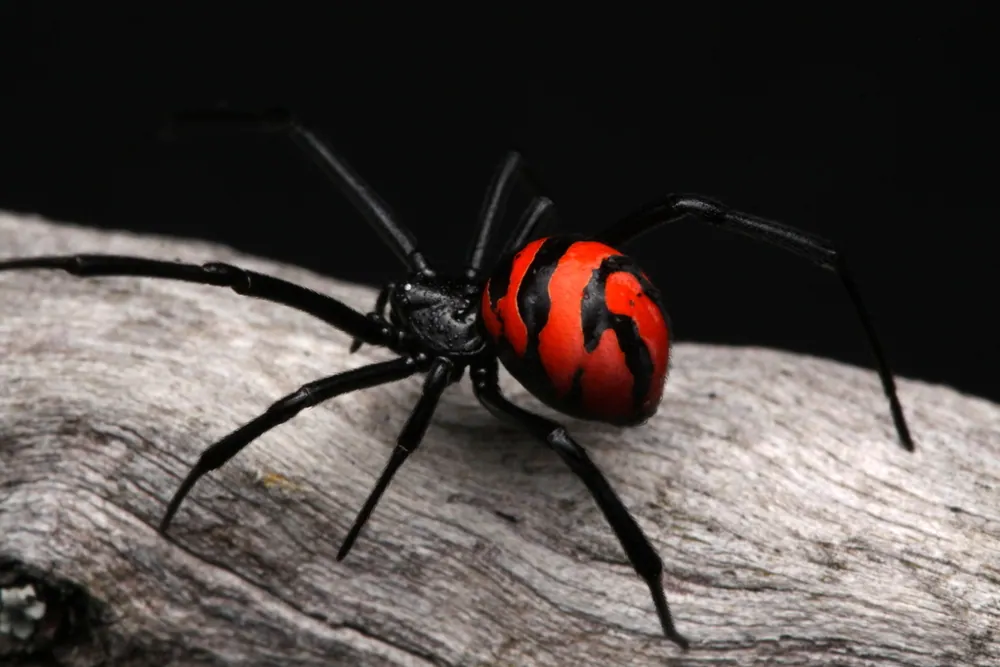
The South American black widow is a spider from the Lesser Antilles and South America. Females have a red and black pattern and a venomous bite. It is mainly active at night, and it is not aggressive towards people.1
 How to recognise it
Venom power
Venom comes out through its fangs or teeth when it bites.
What does its venom do?
The venom contains excitatory neurotoxins (alpha-latrotoxins), which overstimulate the nerves. Bites usually deliver only small amounts of venom. Symptoms can include intense pain at the bite, sweating, rapid breathing, a faster heart rate, swollen eyelids, salivation, stiff and painful abdominal muscles, nausea, vomiting and blurred sight. Some cases have also involved muscle spasms, fever and chills, which are common symptoms of latrodectism (the illness caused by black widow venom).1
How dangerous is it to people?
Danger to people: SeriousA bite needs a doctor. Deaths are very rare.Bites usually deliver only small amounts of venom, but they can cause dangerous symptoms, mostly in children, older people, and people with heart or breathing problems.1
 Good news: doctors have a medicine (antivenom) or a treatment for this.1
What does it do when it is scared?
It is not aggressive to humans, but females will attack to defend their egg sacs.1
 If it bites
Always call your emergency number first (for example 112 in Europe, 911 in North America, 000 in Australia).
- Call the emergency number at once. Wash the bite with soap and water and put a cold pack on it to ease the pain. Get medical help fast, especially for children, older people and anyone with heart or breathing problems.1
- Wash the bite and put an ice pack on it for the pain. Get medical help if the pain is strong, spreads or the person feels unwell.
This is general first aid guidance, not medical advice. Based on the first aid guidelines of the World Health Organization and the Australian Resuscitation Council. Facts come from public sources and may contain mistakes. When in doubt, always get medical help. First aid basics
 Stay safe
- Never touch, catch or tease a wild animal, even a small one, and even if it looks asleep or dead.
- Give it space. If you meet one, stay calm, step back slowly and let it go its own way.
- If one bites you: stay calm, keep still, call your emergency number (for example 112 in Europe, 911 in North America, 000 in Australia) or get to a hospital fast. Remember what it looked like, a photo helps.
It is not out to get you. It uses its venom to catch food or to protect itself, and it would much rather hide. More about staying safe
Where in the world?
How big is it?
How long is it?
 shorter than your little finger
How big is South American black widow compared to you?
Just maths in your browser. Nothing is saved or sent anywhere.
How fast is it?


Facts
Some reports describe priapism, a painful and prolonged erection in men, after a bite.1
In a case in the Brazilian state of Amazonas, the victim had muscle spasms, fever, chills and heavy sweating.1
Females are much bigger than males, which is common among black widow spiders.1
Males are easy to tell apart from females because of their long legs and white or brown colour.1
This spider is mainly active at night, so most encounters are likely after dark.1
Myth buster
Myth: Black widow spiders are aggressive and will attack people.
Truth: This species is not aggressive to humans. Females only attack when they are defending their egg sacs.1
Where the facts come from
- Latrodectus curacaviensis (Wikipedia (CC BY-SA 4.0))
- Latrodectus curacaviensis (iNaturalist): names and classification.
- Venom Wiki: the danger level, the typical size and the speed guess are our own. See how we work them out: How we rate danger.
Every fact on this page has a number that points to its source. If we got something wrong, sorry, we are animal fans, not a science journal. Tell us at [email protected] and we will fix it.
Get the Venom Wiki app
Every creature, every picture and the games in your pocket, even without internet.


 Support Venom Wiki Venom Wiki is a one-man project: free, with no ads and no cookies. A small tip helps keep it online.Feed the scorpion
 Brazilian wandering spider
 Brown recluse
 Southern black widow
 Amazon wandering spider
 Chilean recluse
 Northern black widow
 Terciopelo
 Eastern coral snake
 Eastern diamondback rattlesnake
 Timber rattlesnake
 Western diamondback rattlesnake
 Arizona bark scorpion