
 Bitten or stung?
 All animals
 Pick a continent
 Africa
 Asia
 Europe
 South America
 Australia & Oceania
 Antarctica
 Pacific Ocean
 Atlantic Ocean
 Indian Ocean
 Arctic Ocean
 Mediterranean Sea
 Red Sea
 Caribbean Sea
 Coral Sea
 South China Sea
 Philippine Sea
 Andaman Sea
 North Sea
 Timor & Arafura Sea
 Bay of Bengal
 Gulf of California
 Games
 Venom battle
 Animal race
 Field notebook
 Venom TOP lists
 Stay safe
 Surprise me

Yellow-bellied toad
 Poison in its skin
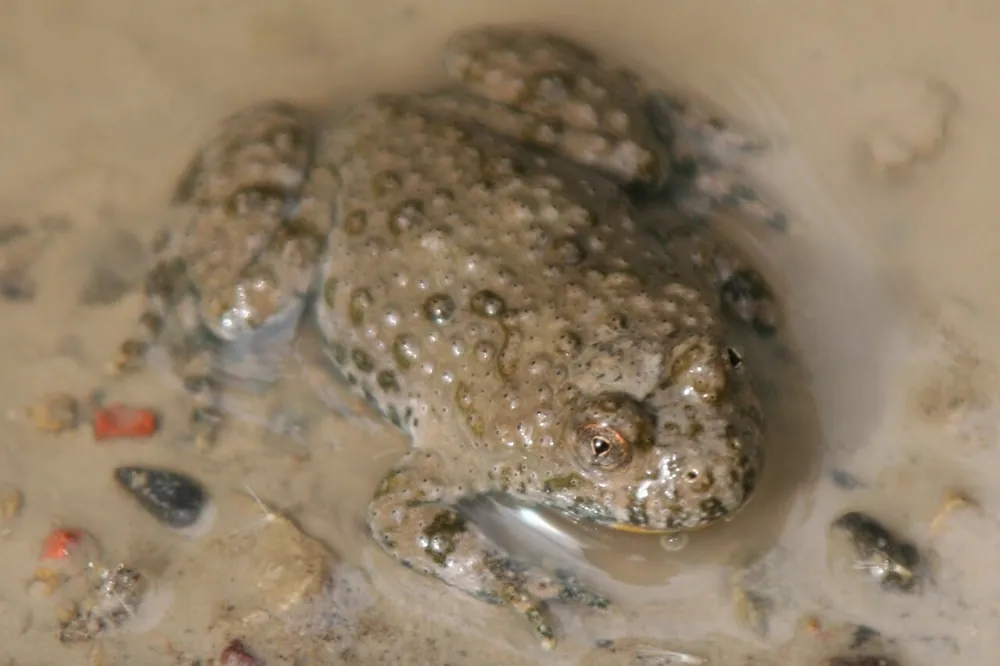
The yellow-bellied toad is a small toad with a bright yellow and black belly that it shows only when it feels threatened. It lives mainly in hilly and mountain areas of central and southern Europe. Its skin toxins are not fatal to people, but they can harm smaller animals.1
 How to recognise it
- Grey-brown or dark brown and green upper body, often with faded, bright spots1
- Bright yellow to orange patches on the underside, usually covering more than half of the belly1
- Underside is grey-blue to black-blue between the yellow patches1
- Compact body and a rounded snout1
- Heart-shaped pupils, with the eardrums not visible1
- Warty skin with raised swirls on the back1
Often confused with: The European fire-bellied toad (Bombina bombina) is a close relative and lives in the same region. The yellow-bellied toad has a more compact body that is not as flat.1
Poison power
Its skin is poisonous. It is dangerous to touch, lick or eat.
What does its poison do?
The toad has toxins in its skin, released through the warts on its back when it is threatened. The toxin is not fatal to humans, but it can cause significant discomfort to most animals and is fatal to smaller ones.1
How dangerous is it to people?
Danger to people: MildLike a bee sting or less. Basically harmless to people, unless the person is allergic.The toxin is not fatal to humans, although it can still cause discomfort to most animals.1
What does it do when it is scared?
It stays still and camouflaged most of the time, and when threatened it shows its yellow belly, puffs up its chest and releases toxins from its warts.1
 If someone touched or ate it
Call your emergency number at once if the person has trouble breathing, swelling of the face or throat, or feels faint.
- If someone touched one: wash the hands well and do not touch the eyes or mouth. If a child or pet licked or ate one: call your poison centre or emergency number.
This is general first aid guidance, not medical advice. Based on the first aid guidelines of the World Health Organization and the Australian Resuscitation Council. Facts come from public sources and may contain mistakes. When in doubt, always get medical help. First aid basics
 Stay safe
- Never touch, catch or tease a wild animal, even a small one, and even if it looks asleep or dead.
- Give it space. If you meet one, stay calm, step back slowly and let it go its own way.
- If you touched or ate it: do not rub your eyes or mouth, wash your hands and get medical help.
It is not out to get you. Its poison is only there so that nothing eats it. More about staying safe
Where in the world?
How big is it?
How long is it?
How heavy is it?
 shorter than your little finger
 so light you would not feel it on your hand
 could cover 100 metres in 180 seconds (the fastest human needs 9.6)
How big is Yellow-bellied toad compared to you?
Just maths in your browser. Nothing is saved or sent anywhere.
How fast is it?


Facts
When a male is threatened or wants to attract a female, he kicks his hind legs into a small pond to make a wave-like pattern. This marks his territory and only works in ponds of a certain depth.1
They can change the shade of their colour to suit lighter or darker surroundings by moving pigment within their cells.1
Yellow-bellied toads breed in unpredictable places, such as shallow pools that can disappear overnight. Within their family, they are the only species that chooses such sites.1
Their life span ranges from 5 to 23 years, and climate plays a large role in how long an individual lives.1
Males have longer forelimbs than females, which is thought to help them during mating and fights with other males.1
For venom experts
- Scientific name
- Bombina variegata
- Group
- Poison frogs, toads & newts
- Family
- Bombinatoridae2
- Order
- Anura
- Continents
- Europe
- Babies
- Females can lay over 200 eggs at one time, but typically lay about 40. Eggs are laid in ponds, and tadpoles develop rapidly.1
- How it is doing in the wild
- Endangered in Germany1
- Danger to people
- 1 / 5: Mild3
Where the facts come from
- Yellow-bellied toad (Wikipedia (CC BY-SA 4.0))
- Bombina variegata (iNaturalist): names and classification.
- Venom Wiki: the danger level, the typical size and the speed guess are our own. See how we work them out: How we rate danger.
Every fact on this page has a number that points to its source. If we got something wrong, sorry, we are animal fans, not a science journal. Tell us at [email protected] and we will fix it.
Get the Venom Wiki app
Every creature, every picture and the games in your pocket, even without internet.


 Support Venom Wiki Venom Wiki is a one-man project: free, with no ads and no cookies. A small tip helps keep it online.Feed the scorpion
More from the same group: Poison frogs, toads & newts
 Fire salamanderPoison frogs, toads & newtsPainfulDo not touch
 Common toadPoison frogs, toads & newtsMild
 European fire-bellied toadPoison frogs, toads & newtsMild
 Iberian ribbed newtPoison frogs, toads & newtsMild
 Natterjack toadPoison frogs, toads & newtsMild
 Alpine salamanderPoison frogs, toads & newtsMild
 Common European adder
 Spanish fly
 Common wasp
 European hornet
 Western honey bee
 Blunt-nosed viper
