
 Afrika
 Asien
Asien Europa
 Südamerika
 Australien & Ozeanien
 Antarktis
 Pazifischer Ozean
 Atlantischer Ozean
 Indischer Ozean
 Nordpolarmeer
 Mittelmeer
 Rotes Meer
 Karibisches Meer
 Korallenmeer
 Südchinesisches Meer
 Philippinensee
 Andamanensee
 Nordsee
 Timorsee & Arafurasee
 Golf von Bengalen
 Golf von Kalifornien
Blue-lined octopus
 Bisse
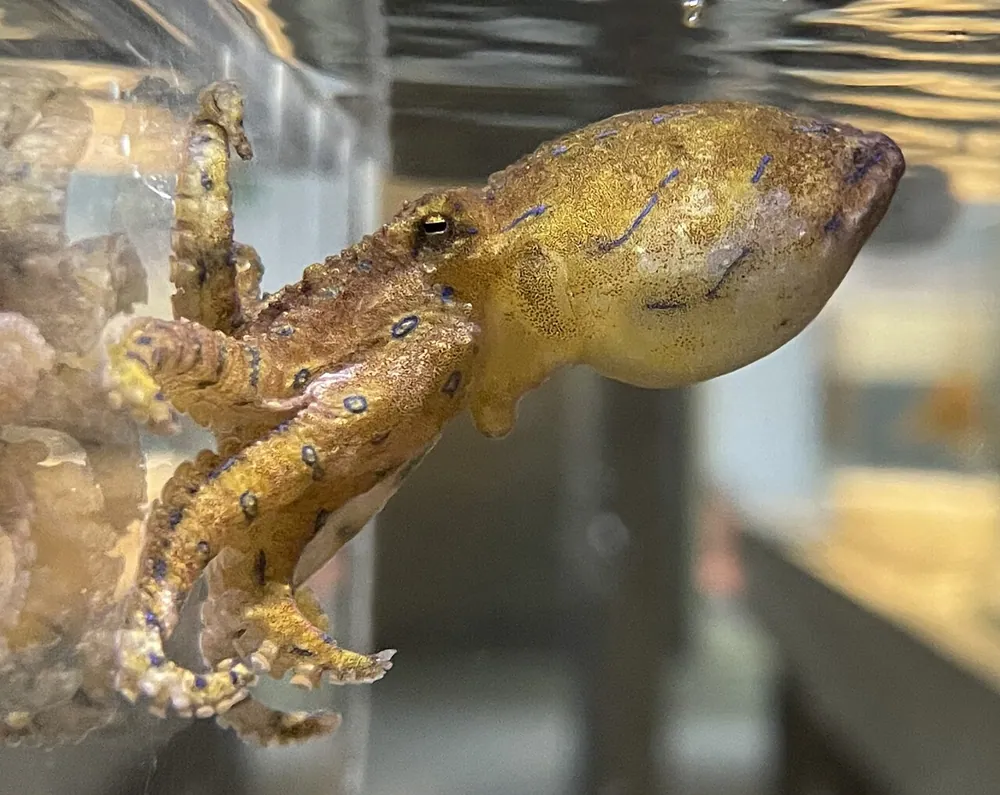
BisseThe blue-lined octopus is a small sea creature, about the size of a golf ball, that lives in shallow reefs and rock pools in the Pacific Ocean. It is one of the most dangerous animals in the sea, because its bite contains venom that can be fatal to people. It is shy and usually hides, but its bright blue lines are a clear warning to leave it alone.1
 So erkennst du es
- At rest, its body is mottled yellow-brown with dark blue or black streaks, and its underside is paler.1
- When it feels threatened, it shows bright, iridescent blue lines across its body.1
- It is small, with a mantle (main body) up to 45 mm long, about the size of a golf ball.1
- Its blue markings are lines, not rings.1
- The visceral hump (the bulge behind the head) is regularly pointed.1
Oft verwechselt mit: The greater blue-ringed octopus, southern blue-ringed octopus and blue-ringed octopus have circular blue rings rather than lines. The blue-lined octopus is also the smallest of the four species in its genus.1
Giftkraft
Das Gift kommt beim Beißen durch die Giftzähne oder Zähne heraus.
Was macht sein Gift, wenn es beißt oder sticht?
Its venom is tetrodotoxin (TTX), a neurotoxic venom, which attacks the nerves. A bite may not be felt at first. After some time, symptoms include loss of feeling in the tongue and lips, muscle weakness or paralysis, respiratory failure (breathing failure), and unconsciousness, which can lead to death.1
Wie gefährlich ist es für Menschen?
Gefahr für Menschen: TödlichEines der gefährlichsten Tiere der Welt.It is regarded as one of the most dangerous animals in the sea, and its venom can be fatal to humans. At least three human deaths have been reported. The greatest risk is to people who pick it up or touch it.1
Was macht es, wenn es Angst hat?
When threatened, it displays bright blue warning lines to predators, and it is more likely to flee and hide in shelter than to fight.1
 Wenn es beißt
- Druck-Immobilisation: Wickle eine feste elastische Binde über den Biss und dann über den ganzen Arm oder das ganze Bein, leg eine Schiene an und halte die Person völlig still, bis Hilfe kommt.
- Ein Blauring-Krake oder eine Kegelschnecke kann die Atmung eines Menschen stoppen, während er noch wach ist: Ruf Hilfe und sei bereit, Atemspende zu geben, bis der Rettungsdienst übernimmt.
Ruf immer zuerst deine Notrufnummer an (112, 000, 911). Das sind allgemeine Erste-Hilfe-Hinweise, keine ärztliche Beratung. Erste-Hilfe-Grundlagen
 Bleib sicher
- Fass ein wildes Tier niemals an, fang es nicht und ärgere es nicht, auch kein kleines, und auch nicht, wenn es schlafend aussieht oder tot.
- Halte Abstand. Wenn du einem begegnest, bleib ruhig, geh langsam zurück und lass es seiner Wege gehen.
- Wenn dich eines beißt: Bleib ruhig, halt still, ruf deine Notrufnummer an (112, 000, 911) oder fahr schnell in ein Krankenhaus. Merk dir, wie es aussah, ein Foto hilft.
Es hat es nicht auf dich abgesehen. Es benutzt sein Gift, um Futter zu fangen oder sich zu schützen, und versteckt sich viel lieber. Mehr über Sicherheit
Wo auf der Welt?
Wie groß ist es?
Wie lang ist es?
 kürzer als dein kleiner Finger
 könnte die Länge eines großen Schwimmbeckens (50 m) in 7,2 Sekunden schwimmen
Wie groß ist Blue-lined octopus im Vergleich zu DIR?
Nur Rechnen in deinem Browser. Nichts wird gespeichert oder irgendwohin geschickt.
Wie schnell ist es?


Fakten
A single 25-gram blue-lined octopus carries enough venom to kill about ten adults weighing 75 kilograms each, according to estimates.1
Male blue-lined octopuses bite the female's aorta during mating, injecting TTX. This paralyses her within about 8 minutes, which lets the male transfer his sperm packets safely.1
Hapalochlaena is the only octopus genus known to produce TTX, a toxin thought to have played an important role in the evolution of the species.1
The blue-lined octopus is the only one of the four blue-ringed species with lined blue markings instead of circular ones.1
Blue-lined octopuses are nocturnal hunters, while the greater blue-ringed octopus hunts during the day.1
Its range has been spreading across the Pacific. Warming ocean water may be shifting suitable habitat, and scientists monitor this for public health and safety.1
Mythen-Check
Mythos: Because it is so shy, the blue-lined octopus is not really dangerous.
Wahrheit: It is extremely shy and usually flees, but its venom can still be fatal to people, and at least three deaths have been reported.1
Für Giftexperten
- Wissenschaftlicher Name
- Hapalochlaena fasciata
- Gruppe
- Kegelschnecken & Kraken
- Familie
- Octopodidae2
- Ordnung
- Octopoda
- Kontinente
- Indischer Ozean, Pazifischer Ozean, Korallenmeer, Die Ozeane
- Babys
- A female lays 50 to 100 large eggs about 30 days after mating, hides them under her arms until they hatch, and then dies. The hatchlings take about two months to develop.1
- Gefahr für Menschen
- 5 / 5: Tödlich3
Woher die Fakten kommen
- Blue-lined octopus (Wikipedia (CC BY-SA 4.0))
- Hapalochlaena fasciata (iNaturalist): Namen und Klassifikation.
- Venom Wiki: die Gefahrenstufe, die typische Größe und die geschätzte Geschwindigkeit sind von uns. So berechnen wir sie: So bewerten wir die Gefahr.
Jeder Fakt auf dieser Seite hat eine Nummer, die auf seine Quelle zeigt. Wenn wir etwas falsch haben: Entschuldigung, wir sind Tierfans, keine Fachzeitschrift. Schreib uns an [email protected] und wir korrigieren es.
 Der Skorpion hat Hunger! Venom Wiki ist ein Ein-Mann-Projekt: kostenlos, ohne Werbung und ohne Tracker. Ein kleines Trinkgeld hilft, es online zu halten.Füttere den Skorpion
Mehr aus derselben Gruppe: Kegelschnecken & Kraken
 Geography coneKegelschnecken & KrakenTödlich
 Greater blue-ringed octopusKegelschnecken & KrakenTödlich
 Southern blue-ringed octopusKegelschnecken & KrakenTödlich
 Blue sea dragonKegelschnecken & KrakenTut nur weh
 Common octopusKegelschnecken & KrakenHarmlos
 Giant Pacific octopusKegelschnecken & KrakenHarmlos
Lebt auch in: Indischer Ozean
 Australian box jellyfishQuallen & Nesseltiere im MeerTödlichNicht anfassen
 Hawksbill sea turtleAndere passiv giftige TiereKann töten
 Irukandji jellyfishQuallen & Nesseltiere im MeerKann tötenNicht anfassen
 Reef stonefishGiftfischeKann tötenNicht anfassen
 Crown-of-thorns starfishSeeigel, Seesterne & WürmerBraucht einen ArztNicht anfassen
 Portuguese man o' warQuallen & Nesseltiere im MeerBraucht einen ArztNicht anfassen