
 Afrika
 Asien
Asien Europa
 Südamerika
 Australien & Ozeanien
 Antarktis
 Pazifischer Ozean
 Atlantischer Ozean
 Indischer Ozean
 Nordpolarmeer
 Mittelmeer
 Rotes Meer
 Karibisches Meer
 Korallenmeer
 Südchinesisches Meer
 Philippinensee
 Andamanensee
 Nordsee
 Timorsee & Arafurasee
 Golf von Bengalen
 Golf von Kalifornien
Bluespotted ribbontail ray
 Stiche
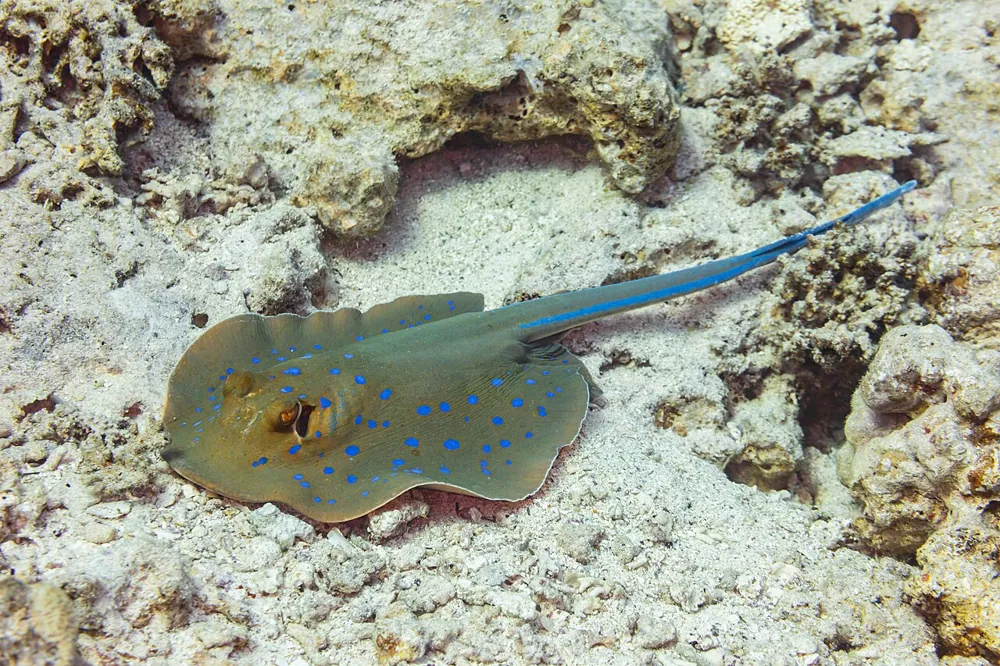
The bluespotted ribbontail ray is a small stingray with bright electric blue spots on its back. It lives on coral reefs and sandy flats across the tropical Indian and western Pacific Oceans. It can sting with its tail, but it is shy and usually flees when threatened.1



 So erkennst du es
- Numerous circular, neon blue spots on a yellowish brown or green back, with the spots smaller and denser towards the edge of the disc1
- Two stripes of the same blue running along the tail1
- Bright yellow eyes and a white belly1
- Oval, smooth-edged disc, with a thick tail about 1.5 times the length of the disc and one or two serrated spines near the base1
Giftkraft
Das Gift kommt durch einen Stachel heraus.
Was macht sein Gift, wenn es beißt oder sticht?
Its tail carries one or two serrated spines that deliver venom when it stings. The sting can cause an excruciating wound.1
Wie gefährlich ist es für Menschen?
Gefahr für Menschen: ErnstEin Stich gehört zum Arzt. Todesfälle sind sehr selten.It is timid and harmless towards people unless provoked, and it prefers to flee. It is capable of injuring people with its venomous tail spines.1
Was macht es, wenn es Angst hat?
When threatened, it flees at high speed in a zigzag pattern to throw off pursuers.1
 Wenn es sticht
- Leg die Wunde in heißes Wasser, so heiß, wie die Person es aushält, ohne sich zu verbrühen (prüf es mit deiner eigenen Hand), 30 bis 90 Minuten lang. Hol ärztliche Hilfe, besonders bei Steinfischen und Stachelrochen.
Ruf immer zuerst deine Notrufnummer an (112, 000, 911). Das sind allgemeine Erste-Hilfe-Hinweise, keine ärztliche Beratung. Erste-Hilfe-Grundlagen
 Bleib sicher
- Fass ein wildes Tier niemals an, fang es nicht und ärgere es nicht, auch kein kleines, und auch nicht, wenn es schlafend aussieht oder tot.
- Halte Abstand. Wenn du einem begegnest, bleib ruhig, geh langsam zurück und lass es seiner Wege gehen.
- Wenn dich eines sticht: Bleib ruhig, halt still, ruf deine Notrufnummer an (112, 000, 911) oder fahr schnell in ein Krankenhaus. Merk dir, wie es aussah, ein Foto hilft.
Es hat es nicht auf dich abgesehen. Es benutzt sein Gift, um Futter zu fangen oder sich zu schützen, und versteckt sich viel lieber. Mehr über Sicherheit
Wo auf der Welt?
Wie groß ist es?
Wie lang ist es?
Wie schwer ist es?
 so lang wie 1,5 Hauskatzen von Nase bis Schwanz
 so lang wie 4 Bananen hintereinanderetwa so schwer wie eine Hauskatze
 könnte die Länge eines großen Schwimmbeckens (50 m) in 11 Sekunden schwimmen
Wie groß ist Bluespotted ribbontail ray im Vergleich zu DIR?
Nur Rechnen in deinem Browser. Nichts wird gespeichert oder irgendwohin geschickt.
Wie schnell ist es?

Fakten
It has been seen raising the edges of its disc and pelvic fins to attract cleaning by the bluestreak cleaner wrasse.1
Goatfish often follow foraging rays to catch food the ray misses.1
Most specimens struggle in home aquariums, and many stop feeding or die for no clear reason, so public aquariums have had more success keeping them.1
Unlike many other stingrays, it seldom buries itself in sand.1
Für Giftexperten
- Wissenschaftlicher Name
- Taeniura lymma
- Gruppe
- Giftfische
- Familie
- Dasyatidae2
- Ordnung
- Myliobatiformes
- Kontinente
- Indischer Ozean, Pazifischer Ozean, Rotes Meer, Korallenmeer, Arabisches Meer & Persischer Golf, Timorsee & Arafurasee, Golf von Bengalen, Die Ozeane
- Babys
- It gives birth to live young. Females bear litters of up to seven pups, each about 13–14 cm across, a miniature version of the adult.1
- Wie es ihm in der Natur geht
- Least Concern (IUCN)1
- Gefahr für Menschen
- 3 / 5: Ernst3
Woher die Fakten kommen
- Bluespotted ribbontail ray (Wikipedia (CC BY-SA 4.0))
- Taeniura lymma (iNaturalist): Namen und Klassifikation.
- Venom Wiki: die Gefahrenstufe, die typische Größe und die geschätzte Geschwindigkeit sind von uns. So berechnen wir sie: So bewerten wir die Gefahr.
Jeder Fakt auf dieser Seite hat eine Nummer, die auf seine Quelle zeigt. Wenn wir etwas falsch haben: Entschuldigung, wir sind Tierfans, keine Fachzeitschrift. Schreib uns an [email protected] und wir korrigieren es.
 Der Skorpion hat Hunger! Venom Wiki ist ein Ein-Mann-Projekt: kostenlos, ohne Werbung und ohne Tracker. Ein kleines Trinkgeld hilft, es online zu halten.Füttere den Skorpion
Mehr aus derselben Gruppe: Giftfische
 Reef stonefish
 Red lionfish
 Estuarine stonefish
 Short-tail stingray
 Striped eel catfish
 Common stingray
,_mar_Rojo,_Egipto,_2023-04-14,_DD_64.jpg)
Lebt auch in: Indischer Ozean
 Australische WürfelqualleQuallen & Nesseltiere im MeerTödlichNicht anfassen
 Landkarten-KegelschneckeKegelschnecken & KrakenTödlich
 Großer BlauringkrakeKegelschnecken & KrakenTödlich
 Südlicher BlauringkrakeKegelschnecken & KrakenTödlich
 Hawksbill sea turtleAndere passiv giftige TiereKann töten
 Irukandji jellyfishQuallen & Nesseltiere im MeerKann tötenNicht anfassen