
 Afrika
 Asien
Asien Europa
 Südamerika
 Australien & Ozeanien
 Antarktis
 Pazifischer Ozean
 Atlantischer Ozean
 Indischer Ozean
 Nordpolarmeer
 Mittelmeer
 Rotes Meer
 Karibisches Meer
 Korallenmeer
 Südchinesisches Meer
 Philippinensee
 Andamanensee
 Nordsee
 Timorsee & Arafurasee
 Golf von Bengalen
 Golf von Kalifornien
By-the-wind sailor
 Nesselnde Tentakel
The by-the-wind sailor is a small, deep blue animal that floats on the surface of the open ocean. It is not a single creature but a colony of tiny linked animals, and it moves by catching the wind with a small stiff sail. Its stinging tentacles are generally harmless to people, but they can irritate the skin.1

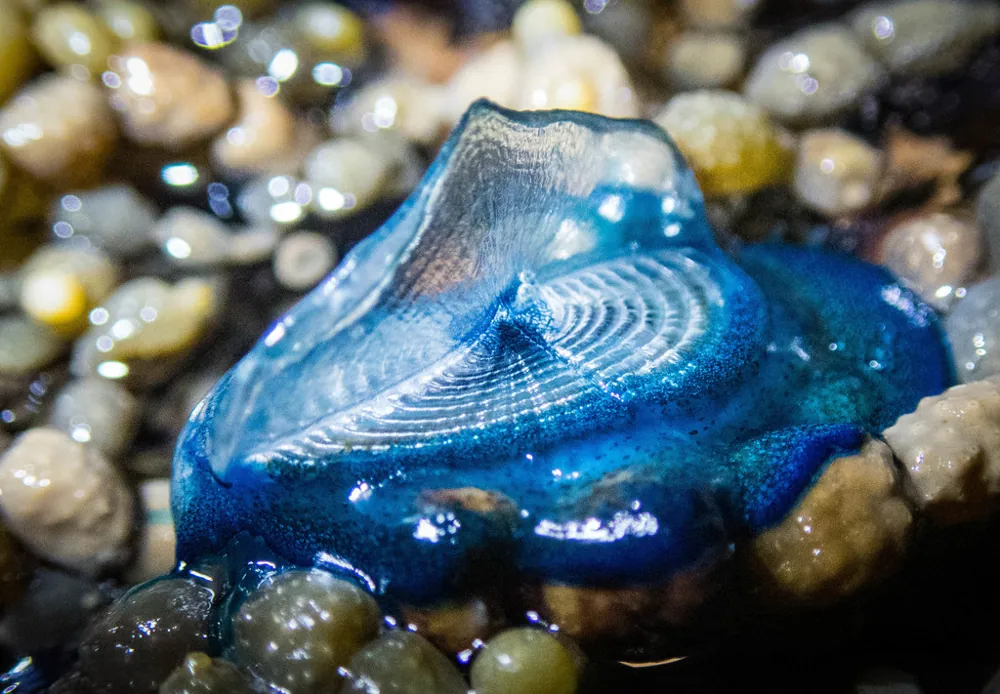
 So erkennst du es
Giftkraft
Tausende winzige Nesselzellen feuern, wenn etwas sie berührt.
Was macht sein Gift, wenn es beißt oder sticht?
Its nematocysts contain toxins that are effective against its prey, which are mostly plankton. The nematocysts are relatively benign to humans, but each person may respond differently to the toxin. Contact may cause irritation to exposed skin.1
Wie gefährlich ist es für Menschen?
Gefahr für Menschen: LeichtWie ein Bienenstich oder weniger. Für Menschen praktisch harmlos.It is relatively harmless to humans. Its main effect is possible skin irritation after contact. Mass strandings can leave large numbers of dying and rotting animals on beaches.1
 Wenn es sticht
- Raus aus dem Wasser und alle Tentakel abnehmen (mit Handschuhen oder einem Tuch).
- Bei tropischen Würfelquallen: Gieß mindestens 30 Sekunden lang Essig auf die Nesselstellen, ruf Hilfe und sei bereit für eine Herz-Lungen-Wiederbelebung. Bei Portugiesischen Galeeren und den meisten anderen: mit Meerwasser abspülen, dann heißes Wasser gegen die Schmerzen.
Ruf immer zuerst deine Notrufnummer an (112, 000, 911). Das sind allgemeine Erste-Hilfe-Hinweise, keine ärztliche Beratung. Erste-Hilfe-Grundlagen
 Bleib sicher
- Fass ein wildes Tier niemals an, fang es nicht und ärgere es nicht, auch kein kleines, und auch nicht, wenn es schlafend aussieht oder tot.
- Halte Abstand. Wenn du einem begegnest, bleib ruhig, geh langsam zurück und lass es seiner Wege gehen.
- Wenn dich eines sticht: Bleib ruhig, halt still, ruf deine Notrufnummer an (112, 000, 911) oder fahr schnell in ein Krankenhaus. Merk dir, wie es aussah, ein Foto hilft.
Es hat es nicht auf dich abgesehen. Es benutzt sein Gift, um Futter zu fangen oder sich zu schützen, und versteckt sich viel lieber. Mehr über Sicherheit
Wo auf der Welt?
Wie groß ist es?
Wie lang ist es?
 so lang wie 2 Bausteine in einer Reihe
 könnte die Länge eines großen Schwimmbeckens (50 m) in 180 Sekunden schwimmen
Wie groß ist By-the-wind sailor im Vergleich zu DIR?
Nur Rechnen in deinem Browser. Nichts wird gespeichert oder irgendwohin geschickt.
Wie schnell ist es?

Fakten
Its floating colonies are mirror images of each other, either 'left-handed' or 'right-handed', and this affects where they drift. In the northern Pacific, one form tends to drift to North America and the other to eastern Asia, such as Japan.1
Each blue 'animal' with a sail is really a colony of linked polyps that share food through a canal system.1
Each colony is either all male or all female.1
Its sail is not a fin. It works like a sail, so the animal tends to drift downwind at a small angle to the wind.1
Its tiny jellyfish carry zooxanthellae, single-celled organisms that use sunlight to provide energy, a feature also found in corals.1
It has no means of moving other than its sail, so it depends on prevailing winds, and mass strandings on beaches happen in many parts of the world.1
Mythen-Check
Mythos: Each blue sail is a single, simple animal.
Wahrheit: Each apparent individual is a colony of many connected polyps that share food and divide the work between feeding, reproductive and protective polyps.1
Für Giftexperten
- Wissenschaftlicher Name
- Velella velella
- Gruppe
- Quallen & Nesseltiere im Meer
- Familie
- Porpitidae2
- Ordnung
- Anthoathecata
- Kontinente
- Pazifischer Ozean, Atlantischer Ozean, Indischer Ozean, Mittelmeer, Südlicher Ozean, Antarktis, Die Ozeane
- Babys
- Each colony's feeding polyps (gonozooids) bud off thousands of tiny jellyfish, each about 1 mm wide, over several weeks. These develop into a free-swimming larva called a conaria, which grows into a new floating colony.1
- Gefahr für Menschen
- 1 / 5: Leicht3
Woher die Fakten kommen
- Velella (Wikipedia (CC BY-SA 4.0))
- Velella velella (iNaturalist): Namen und Klassifikation.
- Venom Wiki: die Gefahrenstufe, die typische Größe und die geschätzte Geschwindigkeit sind von uns. So berechnen wir sie: So bewerten wir die Gefahr.
Jeder Fakt auf dieser Seite hat eine Nummer, die auf seine Quelle zeigt. Wenn wir etwas falsch haben: Entschuldigung, wir sind Tierfans, keine Fachzeitschrift. Schreib uns an [email protected] und wir korrigieren es.
 Der Skorpion hat Hunger! Venom Wiki ist ein Ein-Mann-Projekt: kostenlos, ohne Werbung und ohne Tracker. Ein kleines Trinkgeld hilft, es online zu halten.Füttere den Skorpion
Mehr aus derselben Gruppe: Quallen & Nesseltiere im Meer
 Australische WürfelqualleQuallen & Nesseltiere im MeerTödlichNicht anfassen
 Irukandji jellyfishQuallen & Nesseltiere im MeerKann tötenNicht anfassen
 Portuguese man o' warQuallen & Nesseltiere im MeerBraucht einen ArztNicht anfassen
 Lion's mane jellyfishQuallen & Nesseltiere im MeerTut nur wehNicht anfassen
 Moon jellyfishQuallen & Nesseltiere im MeerHarmlos
 Common kingslayerQuallen & Nesseltiere im MeerKann tötenNicht anfassen
Lebt auch in: Pazifischer Ozean
 Landkarten-KegelschneckeKegelschnecken & KrakenTödlich
 Großer BlauringkrakeKegelschnecken & KrakenTödlich
 TigerkugelfischAndere passiv giftige TiereTödlich
 Südlicher BlauringkrakeKegelschnecken & KrakenTödlich
 Hawksbill sea turtleAndere passiv giftige TiereKann töten
 Reef stonefishGiftfischeKann tötenNicht anfassen