
 Afrika
 Asien
Asien Europa
 Südamerika
 Australien & Ozeanien
 Antarktis
 Pazifischer Ozean
 Atlantischer Ozean
 Indischer Ozean
 Nordpolarmeer
 Mittelmeer
 Rotes Meer
 Karibisches Meer
 Korallenmeer
 Südchinesisches Meer
 Philippinensee
 Andamanensee
 Nordsee
 Timorsee & Arafurasee
 Golf von Bengalen
 Golf von Kalifornien
Cinnabar moth
 Giftig beim Essen
The cinnabar moth is a brightly coloured day-flying moth with red and black wings. It is native to Europe and parts of Asia, and it has been introduced to New Zealand, Australia and North America. Its bright colours warn predators that it is poisonous.1


 So erkennst du es
- Predominantly black wings with red patches1
- Adults are about 2 cm long, with a wingspan of 3.4 to 4.6 cm1
- Often seen flying in daylight, though it is also active at night1
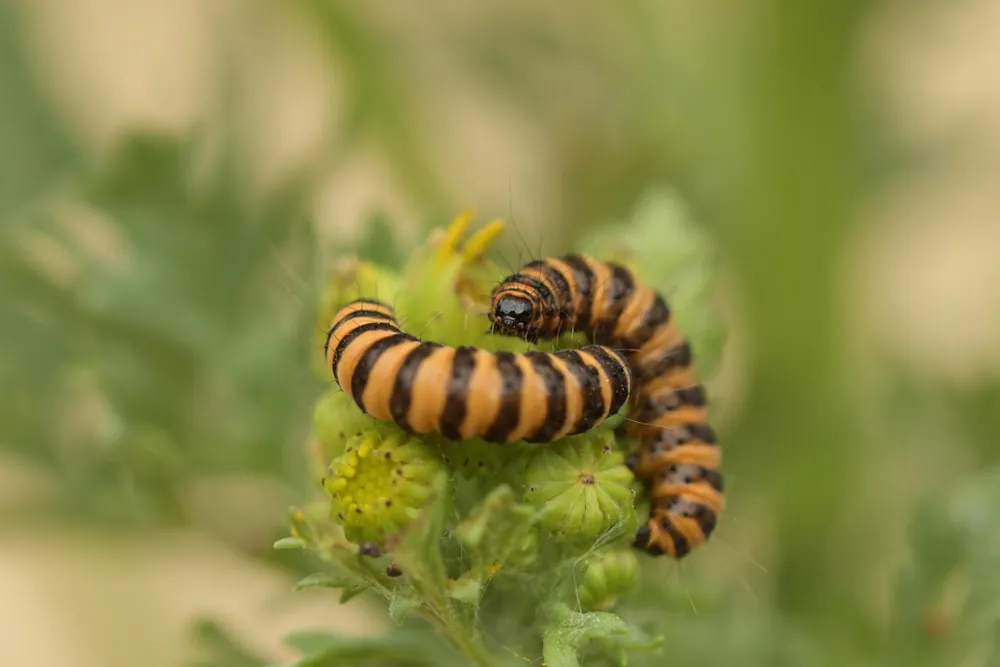
- Young caterpillars are pale yellow; later caterpillars are jet-black with orange or yellow stripes1
- Rarely, the red can be yellow, the forewing can be all red with a black border, or the wings can be completely black1
Giftkraft
Es ist nur schädlich, wenn etwas es frisst.
Wie gefährlich ist es für Menschen?
Gefahr für Menschen: LeichtWie ein Bienenstich oder weniger. Für Menschen praktisch harmlos.Was macht es, wenn es Angst hat?
Its bright red and black colours warn predators that it is unpalatable, and predators seldom eat it.1
 Wenn jemand es angefasst oder gegessen hat
- Wenn jemand es gegessen hat oder nach dem Essen Beschwerden hat: Ruf sofort deine Notrufnummer oder den Giftnotruf an.
Ruf immer zuerst deine Notrufnummer an (112, 000, 911). Das sind allgemeine Erste-Hilfe-Hinweise, keine ärztliche Beratung. Erste-Hilfe-Grundlagen
 Bleib sicher
- Fass ein wildes Tier niemals an, fang es nicht und ärgere es nicht, auch kein kleines, und auch nicht, wenn es schlafend aussieht oder tot.
- Halte Abstand. Wenn du einem begegnest, bleib ruhig, geh langsam zurück und lass es seiner Wege gehen.
- Wenn du es angefasst oder gegessen hast: Reib dir nicht die Augen oder den Mund, wasch dir die Hände und hol ärztliche Hilfe.
Es hat es nicht auf dich abgesehen. Sein Gift ist nur dazu da, dass es niemand frisst. Mehr über Sicherheit
Wo auf der Welt?
Wie groß ist es?
Wie lang ist es?
 etwa so lang wie eine Büroklammer
 könnte in 42 Sekunden über ein ganzes Fußballfeld fliegen
Wie groß ist Cinnabar moth im Vergleich zu DIR?
Nur Rechnen in deinem Browser. Nichts wird gespeichert oder irgendwohin geschickt.
Wie schnell ist es?


Fakten
The caterpillars can turn cannibalistic, mainly when food is short, and will eat other cinnabar caterpillars.1
Cuckoos are an exception to the moth's protection, as some species eat its hairy, poisonous caterpillars.1
The moth was used as a biocontrol agent against ragwort, working alongside the Tansy ragwort flea beetle in the western United States.1
Very few caterpillars usually survive to the pupal stage, because they can eat their food plant bare before they mature.1
Evidence suggests the Brown long-eared bat preys on this moth.1
The caterpillars overwinter as cocoons on the ground.1
Woher die Fakten kommen
- Cinnabar moth (Wikipedia (CC BY-SA 4.0))
- Tyria jacobaeae (iNaturalist): Namen und Klassifikation.
- Venom Wiki: die Gefahrenstufe, die typische Größe und die geschätzte Geschwindigkeit sind von uns. So berechnen wir sie: So bewerten wir die Gefahr.
Jeder Fakt auf dieser Seite hat eine Nummer, die auf seine Quelle zeigt. Wenn wir etwas falsch haben: Entschuldigung, wir sind Tierfans, keine Fachzeitschrift. Schreib uns an [email protected] und wir korrigieren es.
 Der Skorpion hat Hunger! Venom Wiki ist ein Ein-Mann-Projekt: kostenlos, ohne Werbung und ohne Tracker. Ein kleines Trinkgeld hilft, es online zu halten.Füttere den Skorpion
Mehr aus derselben Gruppe: Andere passiv giftige Tiere
 Spanish flyAndere passiv giftige TiereBraucht einen ArztNicht anfassen
 Green spotted pufferAndere passiv giftige TiereBraucht einen Arzt
 Common quailAndere passiv giftige TiereTut nur weh
 Black oil beetleAndere passiv giftige TiereTut nur wehNicht anfassen
 Red-striped oil beetleAndere passiv giftige TiereTut nur wehNicht anfassen
 Six-spot burnetAndere passiv giftige TiereHarmlos
Lebt auch in: Europa
 Common European adderVipern & OtternBraucht einen Arzt
 Common waspBienen, Wespen & HornissenTut nur weh
 European hornetBienen, Wespen & HornissenTut nur weh
 Fire salamanderPfeilgiftfrösche, Kröten & MolcheTut nur wehNicht anfassen
 Western honey beeBienen, Wespen & HornissenTut nur weh
 Blunt-nosed viperVipern & OtternKann töten