
 Afrika
 Asien
Asien Europa
 Südamerika
 Australien & Ozeanien
 Antarktis
 Pazifischer Ozean
 Atlantischer Ozean
 Indischer Ozean
 Nordpolarmeer
 Mittelmeer
 Rotes Meer
 Karibisches Meer
 Korallenmeer
 Südchinesisches Meer
 Philippinensee
 Andamanensee
 Nordsee
 Timorsee & Arafurasee
 Golf von Bengalen
 Golf von Kalifornien
Dinosaur ant of Brazil
 Stiche
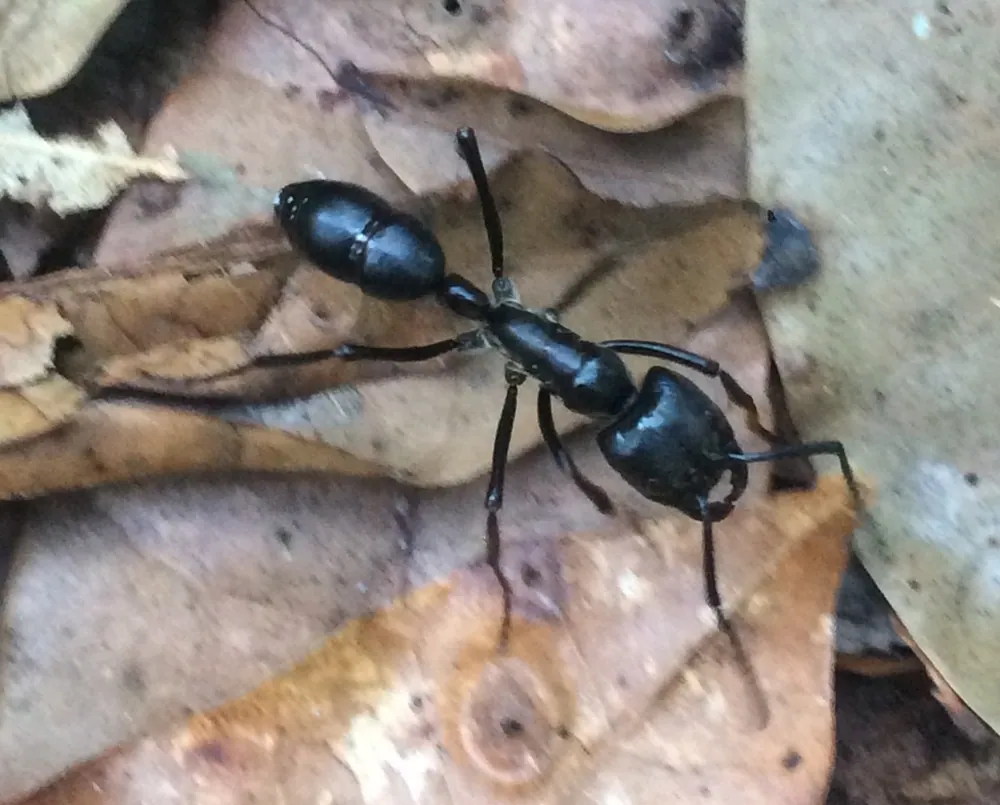
The Dinosaur ant is a large ant from northeastern Brazil. It has a venomous sting that it uses to subdue big live prey and to defend its nest. Scientists are studying its venom because it may be useful for medicines.1

 So erkennst du es
- Workers have a fine, textured surface that is dull rather than shiny.1
- Workers are covered in long, hair-like bristles.1
- Males are light brown and have long, fine hairs on the second segment of their antennae.1
- Colonies are large, with an average of 80 workers and a range of 26 to 238.1
Oft verwechselt mit: It is most often confused with Dinoponera mutica. Dinoponera quadriceps has a dull, finely textured surface, no striped throat and a petiole (the narrow waist segment) that bulges at its upper front edge. Dinoponera mutica has a rougher surface, a striped throat and a petiole with even, non-bulging corners.1
Giftkraft
Das Gift kommt durch einen Stachel heraus.
Was macht sein Gift, wenn es beißt oder sticht?
Its sting delivers venom that causes severe pain. The pain can last up to 48 hours. The venom contains many different compounds that can have wide effects on the body.1
Wie gefährlich ist es für Menschen?
Gefahr für Menschen: SchmerzhaftEs kann richtig wehtun, ist aber fast nie gefährlich.The sting causes severe pain lasting up to 48 hours.1
Was macht es, wenn es Angst hat?
Workers use their sting to defend the nest.1
 Wenn es sticht
- Wasch und kühl die Stiche.
- Wenn die Person Atemnot hat, Gesicht oder Hals anschwellen oder ihr schwindlig wird, ist das ein allergischer Notfall: Ruf deine Notrufnummer an.
Ruf immer zuerst deine Notrufnummer an (112, 000, 911). Das sind allgemeine Erste-Hilfe-Hinweise, keine ärztliche Beratung. Erste-Hilfe-Grundlagen
 Bleib sicher
- Fass ein wildes Tier niemals an, fang es nicht und ärgere es nicht, auch kein kleines, und auch nicht, wenn es schlafend aussieht oder tot.
- Halte Abstand. Wenn du einem begegnest, bleib ruhig, geh langsam zurück und lass es seiner Wege gehen.
- Wenn dich eines sticht: Bleib ruhig, halt still, ruf deine Notrufnummer an (112, 000, 911) oder fahr schnell in ein Krankenhaus. Merk dir, wie es aussah, ein Foto hilft.
Es hat es nicht auf dich abgesehen. Es benutzt sein Gift, um Futter zu fangen oder sich zu schützen, und versteckt sich viel lieber. Mehr über Sicherheit
Wo auf der Welt?
Wie groß ist es?
Wie lang ist es?
 etwa so lang wie eine Büroklammer
Wie groß ist Dinosaur ant of Brazil im Vergleich zu DIR?
Nur Rechnen in deinem Browser. Nichts wird gespeichert oder irgendwohin geschickt.
Wie schnell ist es?


Fakten
Woher die Fakten kommen
- Dinoponera quadriceps (Wikipedia (CC BY-SA 4.0))
- Dinoponera quadriceps (iNaturalist): Namen und Klassifikation.
- Venom Wiki: die Gefahrenstufe, die typische Größe und die geschätzte Geschwindigkeit sind von uns. So berechnen wir sie: So bewerten wir die Gefahr.
Jeder Fakt auf dieser Seite hat eine Nummer, die auf seine Quelle zeigt. Wenn wir etwas falsch haben: Entschuldigung, wir sind Tierfans, keine Fachzeitschrift. Schreib uns an [email protected] und wir korrigieren es.
 Der Skorpion hat Hunger! Venom Wiki ist ein Ein-Mann-Projekt: kostenlos, ohne Werbung und ohne Tracker. Ein kleines Trinkgeld hilft, es online zu halten.Füttere den Skorpion
 Bullet ant
 Red imported fire ant
 Army ant
 Giant Amazonian ant
 Trap-jaw ant
 Black imported fire ant
 Schrecklicher Pfeilgiftfrosch
 Terciopelo-Lanzenotter
 Brazilian wandering spider
 Eyelash viper
 Golden lancehead
 South American bushmaster