
 Afrika
 Asien
Asien Europa
 Südamerika
 Australien & Ozeanien
 Antarktis
 Pazifischer Ozean
 Atlantischer Ozean
 Indischer Ozean
 Nordpolarmeer
 Mittelmeer
 Rotes Meer
 Karibisches Meer
 Korallenmeer
 Südchinesisches Meer
 Philippinensee
 Andamanensee
 Nordsee
 Timorsee & Arafurasee
 Golf von Bengalen
 Golf von Kalifornien
Eastern brown snake
 Bisse
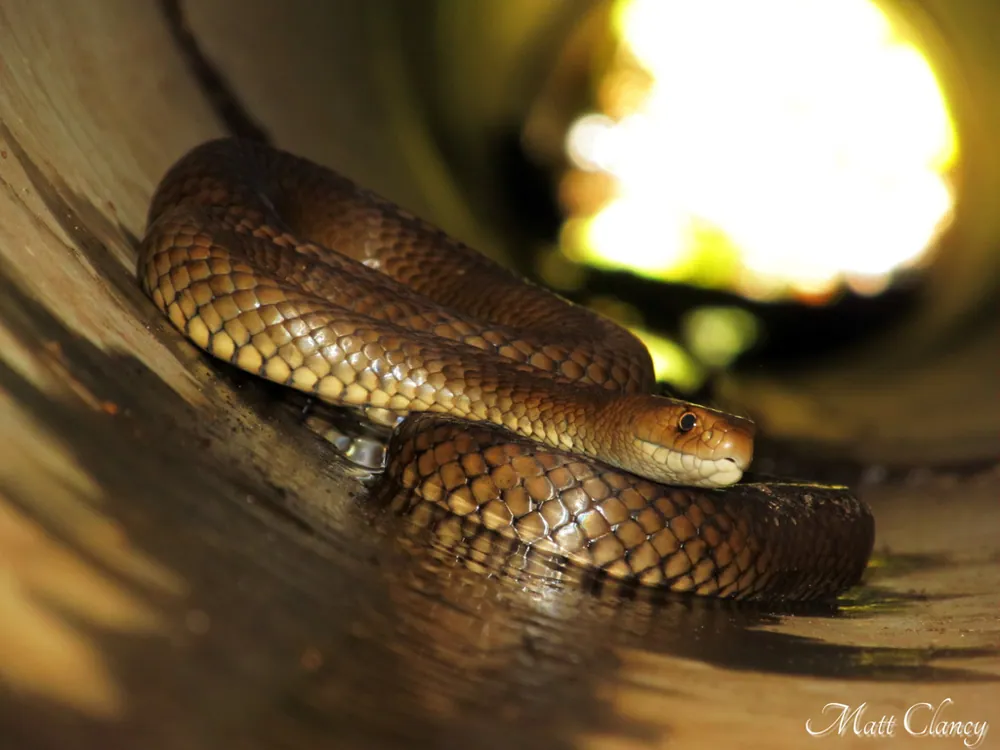
BisseThe eastern brown snake is a slender snake that lives across eastern and central Australia and in southern New Guinea. It is one of the most venomous land snakes in the world, so it is important to know what it looks like. It often lives near farms and the edges of towns, where it hunts house mice.1

 So erkennst du es
- Slender build, with no clear line between the head and neck.1
- Upper parts range from pale brown to black, and sometimes orange or russet.1
- Underside is pale cream or yellow, often with orange, brown or dark grey blotches.1
- Young snakes usually have a black head and may have dark bands or a pattern across the body. These markings fade as the snake grows.1
- Inside of the mouth is flesh-pink.1
Oft verwechselt mit: Large eastern brown snakes are often confused with mulga snakes, which share their habitat in many areas; they can be told apart by head size. Its yellowish underparts separate it from the dugite and peninsula brown snake, which are entirely brown or have grey underparts. Young eastern brown snakes have head markings similar to red-naped snakes, grey snakes, Dwyer's snakes and curl snakes.1
Giftkraft
Das Gift kommt beim Beißen durch die Giftzähne oder Zähne heraus.
Was macht sein Gift, wenn es beißt oder sticht?
Its venom mainly affects the circulatory system, which carries blood around the body. The main effects are coagulopathy (a problem with blood clotting), haemorrhage (bleeding), cardiovascular collapse (the heart and blood vessels failing) and cardiac arrest (the heart stopping). One of the main components is pseutarin-C, a prothrombinase complex that breaks down prothrombin, a substance needed for blood to clot.1
Wie gefährlich ist es für Menschen?
Gefahr für Menschen: TödlichEines der gefährlichsten Tiere der Welt.It is considered the world's second-most venomous land snake after the inland taipan, based on laboratory tests in mice.1
 Wenn es beißt
- Druck-Immobilisation: Wickle eine feste elastische Binde über den Biss und dann über den ganzen Arm oder das ganze Bein, leg eine Schiene an und halte die Person völlig still, bis Hilfe kommt.
- Wasch den Biss nicht ab: Im Krankenhaus kann man das Gift auf der Haut testen, um das richtige Gegengift (Antiserum) auszuwählen.
Ruf immer zuerst deine Notrufnummer an (112, 000, 911). Das sind allgemeine Erste-Hilfe-Hinweise, keine ärztliche Beratung. Erste-Hilfe-Grundlagen
 Bleib sicher
- Fass ein wildes Tier niemals an, fang es nicht und ärgere es nicht, auch kein kleines, und auch nicht, wenn es schlafend aussieht oder tot.
- Halte Abstand. Wenn du einem begegnest, bleib ruhig, geh langsam zurück und lass es seiner Wege gehen.
- Wenn dich eines beißt: Bleib ruhig, halt still, ruf deine Notrufnummer an (112, 000, 911) oder fahr schnell in ein Krankenhaus. Merk dir, wie es aussah, ein Foto hilft.
Es hat es nicht auf dich abgesehen. Es benutzt sein Gift, um Futter zu fangen oder sich zu schützen, und versteckt sich viel lieber. Mehr über Sicherheit
Wo auf der Welt?
Wie groß ist es?
Wie lang ist es?
 so lang wie 5 Hauskatzen von Nase bis Schwanz
 so lang wie 13 Bananen hintereinander
 könnte 100 Meter in 46 Sekunden schaffen (der schnellste Mensch braucht 9,6)
Wie groß ist Eastern brown snake im Vergleich zu DIR?
Nur Rechnen in deinem Browser. Nichts wird gespeichert oder irgendwohin geschickt.
Wie schnell ist es?


Fakten
In December 2023, an eastern brown snake paused a match at the Brisbane International tennis tournament for 40 minutes until a professional snake catcher removed it.1
In winter, it brumates (goes into a state of rest like hibernation). Groups have been found sheltering under concrete slabs of houses in Sydney.1
Its fangs are small compared with other Australian venomous snakes, averaging 2.8 mm and reaching up to 4 mm in larger specimens.1
Within its genus, it has the largest number of chromosomes, at 38 in its cells.1
Local Aboriginal peoples in Sydney, the Illawarra and the Wiradjuri region had their own names for it, and the Dharawal and Awabakal held ceremonies for it.1
Mythen-Check
Mythos: Young and adult brown snakes are different species.
Wahrheit: Early scientists thought they were different because their markings differ. Later research showed that the markings of young snakes fade as they grow, and all these forms are the same species.1
Woher die Fakten kommen
- Eastern brown snake (Wikipedia (CC BY-SA 4.0))
- Pseudonaja textilis (iNaturalist): Namen und Klassifikation.
- Venom Wiki: die Gefahrenstufe, die typische Größe und die geschätzte Geschwindigkeit sind von uns. So berechnen wir sie: So bewerten wir die Gefahr.
Jeder Fakt auf dieser Seite hat eine Nummer, die auf seine Quelle zeigt. Wenn wir etwas falsch haben: Entschuldigung, wir sind Tierfans, keine Fachzeitschrift. Schreib uns an [email protected] und wir korrigieren es.
 Der Skorpion hat Hunger! Venom Wiki ist ein Ein-Mann-Projekt: kostenlos, ohne Werbung und ohne Tracker. Ein kleines Trinkgeld hilft, es online zu halten.Füttere den Skorpion
Mehr aus derselben Gruppe: Australische Schlangen
 Coastal taipan
 Common death adder
 Inlandtaipan
 Tigerotter
 Collett's snake
 Desert death adder
Lebt auch in: Australien & Ozeanien
 Sydney funnel-web spiderVogelspinnen & TrichternetzspinnenTödlich
 Redback spiderSpinnenBraucht einen Arzt
 Brown tree snakeTrugnatternTut nur weh
 Hooded pitohuiAndere passiv giftige TiereTut nur wehNicht anfassen
 PlatypusGiftige SäugetiereTut nur weh
 Northern tree-dwelling funnel-web spiderVogelspinnen & TrichternetzspinnenTödlich