
 Afrika
 Asien
Asien Europa
 Südamerika
 Australien & Ozeanien
 Antarktis
 Pazifischer Ozean
 Atlantischer Ozean
 Indischer Ozean
 Nordpolarmeer
 Mittelmeer
 Rotes Meer
 Karibisches Meer
 Korallenmeer
 Südchinesisches Meer
 Philippinensee
 Andamanensee
 Nordsee
 Timorsee & Arafurasee
 Golf von Bengalen
 Golf von Kalifornien
Eastern copperhead
 Bisse
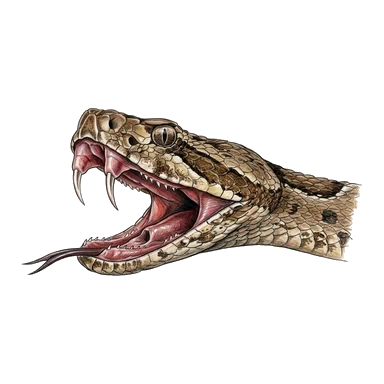
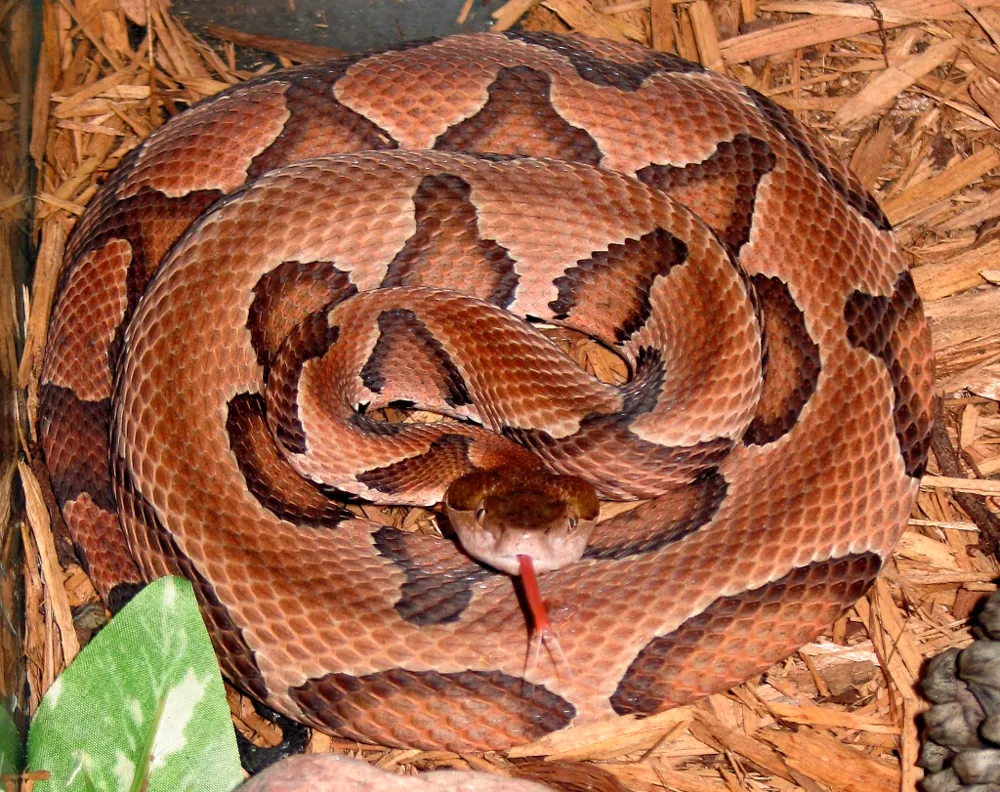
BisseThe eastern copperhead is a venomous pit viper that lives across much of the eastern United States. It has hourglass-shaped bands on a tan or reddish-brown body, which help it hide in leaves and clay. It is common, so people sometimes meet it without realising, and it makes up half of the treated snake bites in the United States.1
 So erkennst du es
- Dark brown, hourglass-shaped crossbands on a light reddish-brown or brown background1
- A heavy, stout body rather than a slender one1
- A broad head that is distinct from the neck1
- Young have green or yellow tail tips, which darken to brown or black within a year1
- Adults are typically 50 to 95 cm long, including the tail1
Oft verwechselt mit: The snout slopes down and back, so it looks less blunt than the snout of the cottonmouth. The head also extends further forward than the mouth.1
Giftkraft
Das Gift kommt beim Beißen durch die Giftzähne oder Zähne heraus.
Wie gefährlich ist es für Menschen?
Gefahr für Menschen: ErnstEin Biss gehört zum Arzt. Todesfälle sind sehr selten.Copperhead bites account for half of the treated snake bites in the United States. Bites usually happen when people unknowingly step on or near the snake. It is generally nonaggressive and will strike only if threatened as a last resort.1
Was macht es, wenn es Angst hat?
It often freezes instead of fleeing, relying on its camouflage, and may vibrate its tail when closely approached.1
 Wenn es beißt
- Halte die Person still und ruhig, halte den gebissenen Arm oder das Bein auf Herzhöhe, nimm Ringe und alles Enge ab und bring sie schnell in ein Krankenhaus.
Ruf immer zuerst deine Notrufnummer an (112, 000, 911). Das sind allgemeine Erste-Hilfe-Hinweise, keine ärztliche Beratung. Erste-Hilfe-Grundlagen
 Bleib sicher
- Fass ein wildes Tier niemals an, fang es nicht und ärgere es nicht, auch kein kleines, und auch nicht, wenn es schlafend aussieht oder tot.
- Halte Abstand. Wenn du einem begegnest, bleib ruhig, geh langsam zurück und lass es seiner Wege gehen.
- Wenn dich eines beißt: Bleib ruhig, halt still, ruf deine Notrufnummer an (112, 000, 911) oder fahr schnell in ein Krankenhaus. Merk dir, wie es aussah, ein Foto hilft.
Es hat es nicht auf dich abgesehen. Es benutzt sein Gift, um Futter zu fangen oder sich zu schützen, und versteckt sich viel lieber. Mehr über Sicherheit
Wo auf der Welt?
Wie groß ist es?
Wie lang ist es?
Wie schwer ist es?
 so lang wie 2 Hauskatzen von Nase bis Schwanz
 so lang wie 5 Bananen hintereinander
 könnte 100 Meter in 100 Sekunden schaffen (der schnellste Mensch braucht 9,6)
Wie groß ist Eastern copperhead im Vergleich zu DIR?
Nur Rechnen in deinem Browser. Nichts wird gespeichert oder irgendwohin geschickt.
Wie schnell ist es?


Fakten
Its tail can vibrate more than 40 times per second, faster than almost any non-rattlesnake snake.1
Juveniles wave a brightly coloured tail to attract frogs and perhaps lizards, a behaviour called caudal luring.1
Its camouflage is so good that it can be almost impossible to see on dead leaves or red clay.1
In Texas, copperheads have been found in bushes, vines and trees up to 12 metres above the ground, seeking newly emerged cicadas.1
Its venom has potential medicinal value to humans.1
Historically, kingsnakes were major predators of copperheads, and recent copperhead numbers have risen where kingsnake populations have declined.1
Mythen-Check
Mythos: Copperheads are aggressive snakes that chase people and go looking for trouble.
Wahrheit: They are generally nonaggressive. They usually freeze or flee, and they strike only if threatened as a last resort. Most bites happen when people step on or near them without noticing.1
Für Giftexperten
- Wissenschaftlicher Name
- Agkistrodon contortrix
- Gruppe
- Grubenottern
- Familie
- Viperidae2
- Ordnung
- Squamata
- Kontinente
- Nordamerika
- Babys
- Newborn copperheads are born with green or yellow tail tips, which darken to brown or black within one year.1
- Wie es ihm in der Natur geht
- Least Concern (IUCN Red List, v3.1, 2001); population trend stable when assessed in 20071
- Gefahr für Menschen
- 3 / 5: Ernst3
Woher die Fakten kommen
- Eastern copperhead (Wikipedia (CC BY-SA 4.0))
- Agkistrodon contortrix (iNaturalist): Namen und Klassifikation.
- Venom Wiki: die Gefahrenstufe, die typische Größe und die geschätzte Geschwindigkeit sind von uns. So berechnen wir sie: So bewerten wir die Gefahr.
Jeder Fakt auf dieser Seite hat eine Nummer, die auf seine Quelle zeigt. Wenn wir etwas falsch haben: Entschuldigung, wir sind Tierfans, keine Fachzeitschrift. Schreib uns an [email protected] und wir korrigieren es.
 Der Skorpion hat Hunger! Venom Wiki ist ein Ein-Mann-Projekt: kostenlos, ohne Werbung und ohne Tracker. Ein kleines Trinkgeld hilft, es online zu halten.Füttere den Skorpion
 Terciopelo
 Eyelash viper
 Cottonmouth
 Cantil
 Central American bushmaster
 Martinique lancehead
 Eastern coral snake
 Eastern diamondback rattlesnake
 Timber rattlesnake
 Western diamondback rattlesnake
 Arizona bark scorpion
 Brown recluse