
 Afrika
 Asien
Asien Europa
 Südamerika
 Australien & Ozeanien
 Antarktis
 Pazifischer Ozean
 Atlantischer Ozean
 Indischer Ozean
 Nordpolarmeer
 Mittelmeer
 Rotes Meer
 Karibisches Meer
 Korallenmeer
 Südchinesisches Meer
 Philippinensee
 Andamanensee
 Nordsee
 Timorsee & Arafurasee
 Golf von Bengalen
 Golf von Kalifornien
Gafftopsail catfish
 Giftstacheln
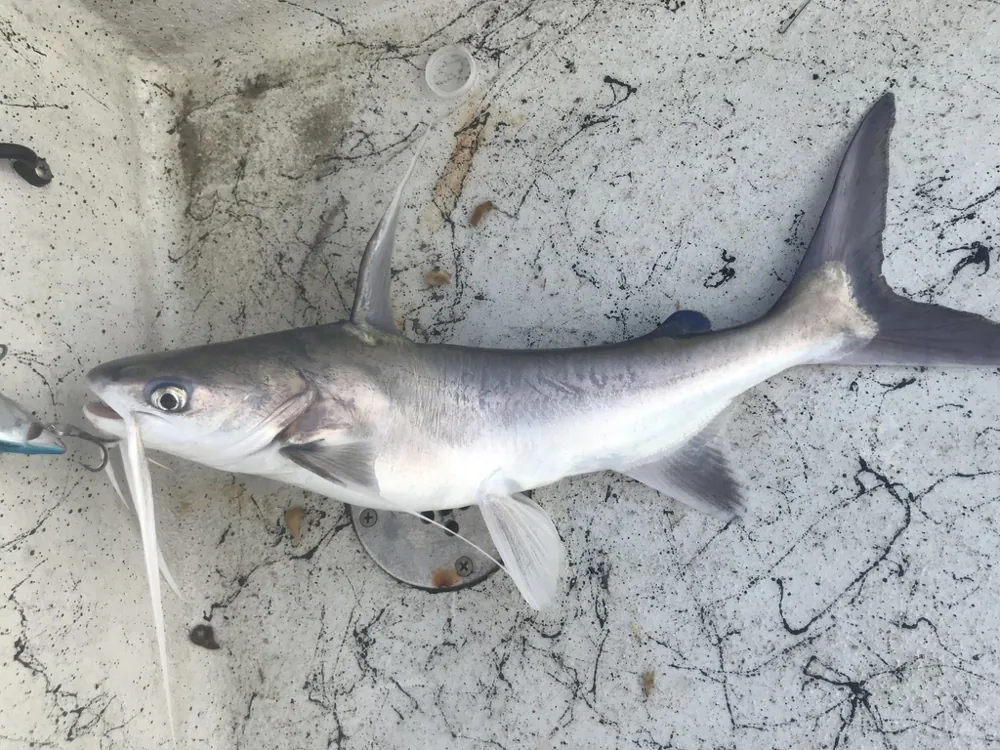
The gafftopsail catfish is a sea catfish with long, venomous spines that can cause painful wounds. It lives in warm coastal waters of the western Atlantic, the Gulf of Mexico and the Caribbean Sea. The male carries the eggs in his mouth until they hatch.1



 So erkennst du es
- Blue-grey to dark brown on the back, with a light grey belly.1
- Deeply forked tail.1
- Long, serrated venomous spines on the pectoral and dorsal fins.1
- A small hump on the back that looks somewhat like a wave.1
- A white or pale blue anal fin, and a fleshy extension on the dorsal spine.1
Oft verwechselt mit: It resembles the hardhead catfish. The gafftopsail can be told apart by the distinctive fleshy extension on its dorsal spine.1
Giftkraft
Spitze Stacheln tragen das Gift. Drauftreten oder Anfassen tut weh.
Was macht sein Gift, wenn es beißt oder sticht?
Its long, serrated spines are venomous and can cause painful wounds.1
Wie gefährlich ist es für Menschen?
Gefahr für Menschen: SchmerzhaftEs kann richtig wehtun, ist aber fast nie gefährlich.The spines can cause painful wounds, so care should be taken when handling this fish.1
 Wenn dich seine Stacheln stechen
- Leg die Wunde in heißes Wasser, so heiß, wie die Person es aushält, ohne sich zu verbrühen (prüf es mit deiner eigenen Hand), 30 bis 90 Minuten lang. Hol ärztliche Hilfe, besonders bei Steinfischen und Stachelrochen.
Ruf immer zuerst deine Notrufnummer an (112, 000, 911). Das sind allgemeine Erste-Hilfe-Hinweise, keine ärztliche Beratung. Erste-Hilfe-Grundlagen
 Bleib sicher
- Fass ein wildes Tier niemals an, fang es nicht und ärgere es nicht, auch kein kleines, und auch nicht, wenn es schlafend aussieht oder tot.
- Halte Abstand. Wenn du einem begegnest, bleib ruhig, geh langsam zurück und lass es seiner Wege gehen.
- Wenn dich seine Stacheln stechen: Bleib ruhig, halt still, ruf deine Notrufnummer an (112, 000, 911) oder fahr schnell in ein Krankenhaus. Merk dir, wie es aussah, ein Foto hilft.
Es hat es nicht auf dich abgesehen. Es benutzt sein Gift, um Futter zu fangen oder sich zu schützen, und versteckt sich viel lieber. Mehr über Sicherheit
Wo auf der Welt?
Wie groß ist es?
Wie lang ist es?
Wie schwer ist es?
 so lang wie 4 Bananen hintereinander
 etwa so schwer wie eine Hauskatze
 könnte die Länge eines großen Schwimmbeckens (50 m) in 24 Sekunden schwimmen
Wie groß ist Gafftopsail catfish im Vergleich zu DIR?
Nur Rechnen in deinem Browser. Nichts wird gespeichert oder irgendwohin geschickt.
Wie schnell ist es?
Fakten
Males carry the eggs in their mouths, and do not feed while they are brooding eggs or young.1
Anglers consider it a strong fighter, and it is attracted to the sound of struggling fish.1
Unlike most catfish, which mainly feed on the bottom, this fish feeds throughout the water column.1
Young fish are about 5 cm long when they hatch from the eggs.1
Für Giftexperten
- Wissenschaftlicher Name
- Bagre marinus
- Gruppe
- Giftfische
- Familie
- Ariidae2
- Ordnung
- Siluriformes
- Kontinente
- Atlantischer Ozean, Golf von Mexiko, Karibisches Meer, Die Ozeane
- Babys
- The male keeps up to 55 eggs in his mouth until they hatch, and may keep brooding the young until they are about 10 cm long. Spawning takes place over inshore mudflats from May to August.1
- Gefahr für Menschen
- 2 / 5: Schmerzhaft3
Woher die Fakten kommen
- Gafftopsail catfish (Wikipedia (CC BY-SA 4.0))
- Bagre marinus (iNaturalist): Namen und Klassifikation.
- Venom Wiki: die Gefahrenstufe, die typische Größe und die geschätzte Geschwindigkeit sind von uns. So berechnen wir sie: So bewerten wir die Gefahr.
Jeder Fakt auf dieser Seite hat eine Nummer, die auf seine Quelle zeigt. Wenn wir etwas falsch haben: Entschuldigung, wir sind Tierfans, keine Fachzeitschrift. Schreib uns an [email protected] und wir korrigieren es.
 Der Skorpion hat Hunger! Venom Wiki ist ein Ein-Mann-Projekt: kostenlos, ohne Werbung und ohne Tracker. Ein kleines Trinkgeld hilft, es online zu halten.Füttere den Skorpion
Mehr aus derselben Gruppe: Giftfische
 Reef stonefishGiftfischeKann tötenNicht anfassen
 Red lionfishGiftfischeBraucht einen ArztNicht anfassen
 Estuarine stonefishGiftfischeKann tötenNicht anfassen
 Short-tail stingrayGiftfischeKann töten
 Striped eel catfishGiftfischeKann tötenNicht anfassen
 Bluespotted ribbontail rayGiftfischeBraucht einen Arzt
Lebt auch in: Atlantischer Ozean
 Hawksbill sea turtleAndere passiv giftige TiereKann töten
 Portuguese man o' warQuallen & Nesseltiere im MeerBraucht einen ArztNicht anfassen
 Blue sea dragonKegelschnecken & KrakenTut nur weh
 Greenland sharkAndere passiv giftige TiereTut nur weh
 Lion's mane jellyfishQuallen & Nesseltiere im MeerTut nur wehNicht anfassen
 Common octopusKegelschnecken & KrakenHarmlos