
 Afrika
 Asien
Asien Europa
 Südamerika
 Australien & Ozeanien
 Antarktis
 Pazifischer Ozean
 Atlantischer Ozean
 Indischer Ozean
 Nordpolarmeer
 Mittelmeer
 Rotes Meer
 Karibisches Meer
 Korallenmeer
 Südchinesisches Meer
 Philippinensee
 Andamanensee
 Nordsee
 Timorsee & Arafurasee
 Golf von Bengalen
 Golf von Kalifornien
Glory of the sea cone
 Stiche
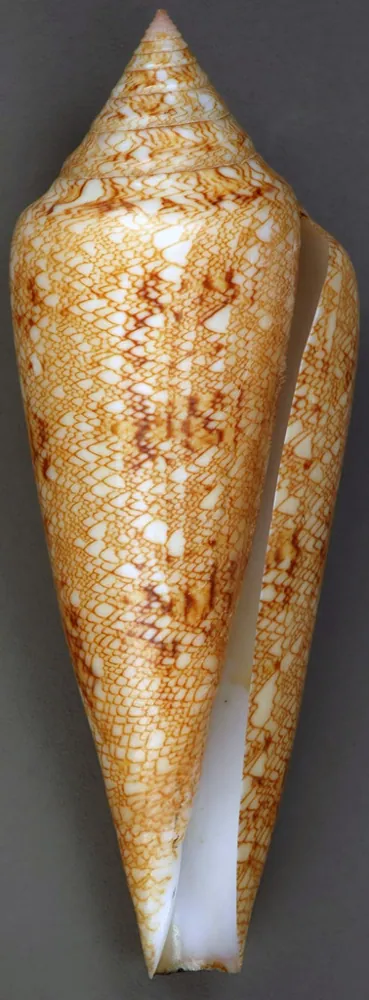
The Glory of the Sea Cone is a sea snail with a striking shell, part of the cone snail family. It lives in the warm waters of the Pacific and Indian Oceans. It is special because collectors once thought it was the rarest shell in the world.1
 So erkennst du es
- A relatively large, slender shell with a tall spire1
- Typical shell length is 8 to 12 cm, and it can reach 16 cm1
- A fine net-like pattern of orange-brown lines that enclose triangular spaces1
- Two or three bands of chestnut, hieroglyphic-like markings across the body1
- Tan colouring that can range from light golden to deep dark brown1
Oft verwechselt mit: It is sometimes confused with the common Textile cone, and it has a similarity to the Bengal cone.1
Giftkraft
Das Gift kommt durch einen Stachel heraus.
Wie gefährlich ist es für Menschen?
Gefahr für Menschen: ErnstEin Stich gehört zum Arzt. Todesfälle sind sehr selten. Wenn es sticht
- Druck-Immobilisation: Wickle eine feste elastische Binde über den Biss und dann über den ganzen Arm oder das ganze Bein, leg eine Schiene an und halte die Person völlig still, bis Hilfe kommt.
- Ein Blauring-Krake oder eine Kegelschnecke kann die Atmung eines Menschen stoppen, während er noch wach ist: Ruf Hilfe und sei bereit, Atemspende zu geben, bis der Rettungsdienst übernimmt.
Ruf immer zuerst deine Notrufnummer an (112, 000, 911). Das sind allgemeine Erste-Hilfe-Hinweise, keine ärztliche Beratung. Erste-Hilfe-Grundlagen
 Bleib sicher
- Fass ein wildes Tier niemals an, fang es nicht und ärgere es nicht, auch kein kleines, und auch nicht, wenn es schlafend aussieht oder tot.
- Halte Abstand. Wenn du einem begegnest, bleib ruhig, geh langsam zurück und lass es seiner Wege gehen.
- Wenn dich eines sticht: Bleib ruhig, halt still, ruf deine Notrufnummer an (112, 000, 911) oder fahr schnell in ein Krankenhaus. Merk dir, wie es aussah, ein Foto hilft.
Es hat es nicht auf dich abgesehen. Es benutzt sein Gift, um Futter zu fangen oder sich zu schützen, und versteckt sich viel lieber. Mehr über Sicherheit
Wo auf der Welt?
Wie groß ist es?
Wie lang ist es?
 so lang wie 5 Bausteine in einer Reihe
 langsamer als eine Weinbergschnecke
Wie groß ist Glory of the sea cone im Vergleich zu DIR?
Nur Rechnen in deinem Browser. Nichts wird gespeichert oder irgendwohin geschickt.
Wie schnell ist es?

Fakten
For about two centuries, this shell was regarded as the rarest shell in the world.1
Specimens were once valued in the thousands of U.S. dollars and were generally owned only by museums and wealthy private collectors.1
Today, shells can often be found from retailers or online auction sites for less than $100 U.S.1
Its habitat was not discovered until 1969.1
Improvements in diving technology, such as scuba, led to the discovery of far more shells.1
Mythen-Check
Mythos: A collector bought one at auction in 1792 and destroyed it to keep the value of another one he owned.
Wahrheit: This is an urban legend, a popular story that has spread among collectors. It is not an established fact.1
Woher die Fakten kommen
- Conus gloriamaris (Wikipedia (CC BY-SA 4.0))
- Conus gloriamaris (iNaturalist): Namen und Klassifikation.
- Venom Wiki: die Gefahrenstufe, die typische Größe und die geschätzte Geschwindigkeit sind von uns. So berechnen wir sie: So bewerten wir die Gefahr.
Jeder Fakt auf dieser Seite hat eine Nummer, die auf seine Quelle zeigt. Wenn wir etwas falsch haben: Entschuldigung, wir sind Tierfans, keine Fachzeitschrift. Schreib uns an [email protected] und wir korrigieren es.
 Der Skorpion hat Hunger! Venom Wiki ist ein Ein-Mann-Projekt: kostenlos, ohne Werbung und ohne Tracker. Ein kleines Trinkgeld hilft, es online zu halten.Füttere den Skorpion
Mehr aus derselben Gruppe: Kegelschnecken & Kraken
 Landkarten-KegelschneckeKegelschnecken & KrakenTödlich
 Großer BlauringkrakeKegelschnecken & KrakenTödlich
 Südlicher BlauringkrakeKegelschnecken & KrakenTödlich
 Blue sea dragonKegelschnecken & KrakenTut nur weh
 Common octopusKegelschnecken & KrakenHarmlos
 Giant Pacific octopusKegelschnecken & KrakenHarmlos
Lebt auch in: Pazifischer Ozean
 Australische WürfelqualleQuallen & Nesseltiere im MeerTödlichNicht anfassen
 TigerkugelfischAndere passiv giftige TiereTödlich
 Hawksbill sea turtleAndere passiv giftige TiereKann töten
 Irukandji jellyfishQuallen & Nesseltiere im MeerKann tötenNicht anfassen
 Reef stonefishGiftfischeKann tötenNicht anfassen
 Crown-of-thorns starfishSeeigel, Seesterne & WürmerBraucht einen ArztNicht anfassen