
 Afrika
 Asien
Asien Europa
 Südamerika
 Australien & Ozeanien
 Antarktis
 Pazifischer Ozean
 Atlantischer Ozean
 Indischer Ozean
 Nordpolarmeer
 Mittelmeer
 Rotes Meer
 Karibisches Meer
 Korallenmeer
 Südchinesisches Meer
 Philippinensee
 Andamanensee
 Nordsee
 Timorsee & Arafurasee
 Golf von Bengalen
 Golf von Kalifornien
Golfodulcean poison frog
 Gift in der Haut
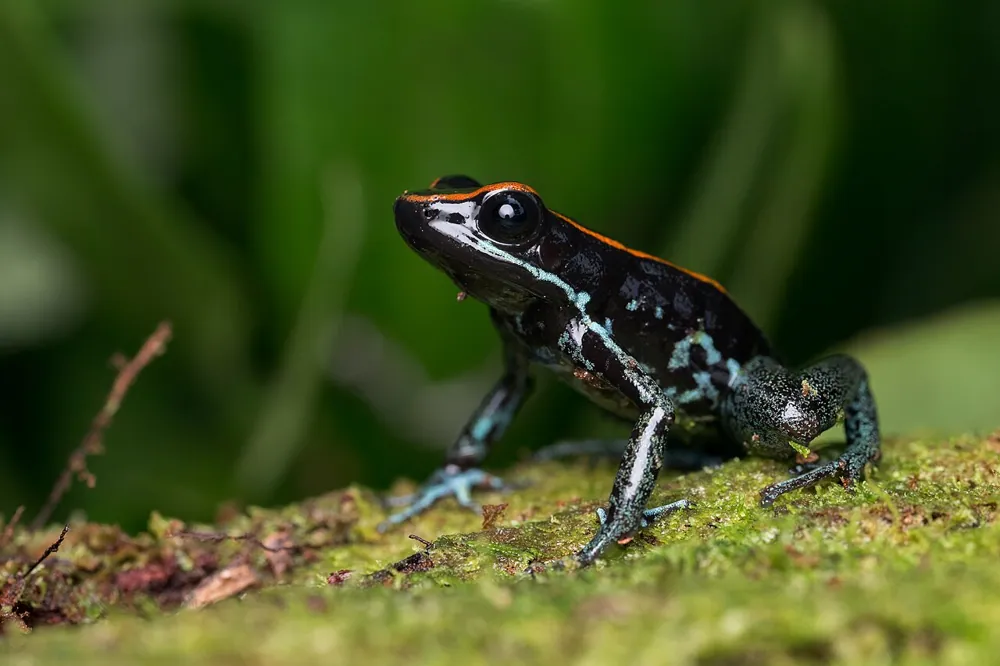
The Golfodulcean poison frog is a small, brightly marked frog that lives only in Costa Rica. Its skin contains a strong nerve poison, so it is one of the most toxic frogs in its genus, and it is a reminder that bright colours can be a warning. It lives in wet forests near streams.1

 So erkennst du es
- The body is black, but it can look glittery because of pigments in the skin.1
- Two stripes run down the back from just above the vent to the tip of the nose. They are usually fire orange, but can be golden, yellow or green.1
- The legs are mottled blue, and the sides often have a blue or green marble pattern.1
- It is a fairly large poison frog for its genus, with a smooth, sloping back. Its shoulder blades are usually hidden under the skin, so it can look a little plump.1
- Females are typically larger than males. Adults reach about 3.5 cm long.1
Oft verwechselt mit: The related P. bicolor and P. terribilis have visible shoulder blades under the skin, which the Golfodulcean poison frog usually lacks, so it looks smoother and rounder.1
Giftkraft
Seine Haut ist giftig. Es ist gefährlich, es anzufassen, abzulecken oder zu essen.
Was macht sein Gift, wenn man es anfasst oder isst?
Its skin contains batrachotoxin, a neurotoxic alkaloid poison, which attacks the nerves. A large enough dose causes severe pain, then tonic-clonic seizures (violent convulsions) and paralysis.1
Wie gefährlich ist es für Menschen?
Gefahr für Menschen: SchmerzhaftEs kann richtig wehtun, ist aber fast nie gefährlich.It is highly toxic, though it is only the fourth most toxic species in the genus Phyllobates. The poison is in the skin, so the risk comes from handling the frog or getting the poison from its skin into the body.1
Was macht es, wenn es Angst hat?
Its bright, multi-coloured body advertises its toxin as a warning to predators.1
 Wenn jemand es angefasst oder gegessen hat
- Wenn jemand eines angefasst hat: Hände gründlich waschen und nicht an Augen oder Mund fassen. Wenn ein Kind oder Haustier eines abgeleckt oder gegessen hat: Ruf den Giftnotruf oder deine Notrufnummer an.
Ruf immer zuerst deine Notrufnummer an (112, 000, 911). Das sind allgemeine Erste-Hilfe-Hinweise, keine ärztliche Beratung. Erste-Hilfe-Grundlagen
 Bleib sicher
- Fass ein wildes Tier niemals an, fang es nicht und ärgere es nicht, auch kein kleines, und auch nicht, wenn es schlafend aussieht oder tot.
- Halte Abstand. Wenn du einem begegnest, bleib ruhig, geh langsam zurück und lass es seiner Wege gehen.
- Wenn du es angefasst oder gegessen hast: Reib dir nicht die Augen oder den Mund, wasch dir die Hände und hol ärztliche Hilfe.
Es hat es nicht auf dich abgesehen. Sein Gift ist nur dazu da, dass es niemand frisst. Mehr über Sicherheit
Wo auf der Welt?
Wie groß ist es?
Wie lang ist es?
 etwa so lang wie eine Büroklammer
 könnte 100 Meter in 100 Sekunden schaffen (der schnellste Mensch braucht 9,6)
Wie groß ist Golfodulcean poison frog im Vergleich zu DIR?
Nur Rechnen in deinem Browser. Nichts wird gespeichert oder irgendwohin geschickt.
Wie schnell ist es?


Fakten
It is one of the few frogs whose poison is named batrachotoxin, a potent nerve toxin.1
Its climbing toe pads stick to leaves in a similar way to geckos, and it can climb out of an unsealed container.1
Male frogs carry their tadpoles on their backs, often for 1 to 2 days, to puddles, pools in palm leaves, or water-filled tree holes.1
Frogs in captivity have no toxin, which shows that their poison comes from what they eat.1
Its skin holds a large amount of poison, because it is comparatively large for a poison dart frog.1
The tadpoles become frogs after about 45 days, and the young frogs become sexually mature after ten months.1
Für Giftexperten
- Wissenschaftlicher Name
- Phyllobates vittatus
- Gruppe
- Pfeilgiftfrösche, Kröten & Molche
- Familie
- Dendrobatidae2
- Ordnung
- Anura
- Kontinente
- Nordamerika
- Babys
- During the breeding season, the female lays 7 to 21 eggs per clutch on leaves, about every one or two weeks, and the male guards the eggs and carries the hatched tadpoles on his back to water.1
- Gefahr für Menschen
- 2 / 5: Schmerzhaft3
Woher die Fakten kommen
- Golfodulcean poison frog (Wikipedia (CC BY-SA 4.0))
- Phyllobates vittatus (iNaturalist): Namen und Klassifikation.
- Venom Wiki: die Gefahrenstufe, die typische Größe und die geschätzte Geschwindigkeit sind von uns. So berechnen wir sie: So bewerten wir die Gefahr.
Jeder Fakt auf dieser Seite hat eine Nummer, die auf seine Quelle zeigt. Wenn wir etwas falsch haben: Entschuldigung, wir sind Tierfans, keine Fachzeitschrift. Schreib uns an [email protected] und wir korrigieren es.
 Der Skorpion hat Hunger! Venom Wiki ist ein Ein-Mann-Projekt: kostenlos, ohne Werbung und ohne Tracker. Ein kleines Trinkgeld hilft, es online zu halten.Füttere den Skorpion
Mehr aus derselben Gruppe: Pfeilgiftfrösche, Kröten & Molche
 Cane toadPfeilgiftfrösche, Kröten & MolcheBraucht einen ArztNicht anfassen
 Strawberry poison-dart frogPfeilgiftfrösche, Kröten & MolcheTut nur wehNicht anfassen
 California newtPfeilgiftfrösche, Kröten & MolcheKann tötenNicht anfassen
 Rough-skinned newtPfeilgiftfrösche, Kröten & MolcheKann tötenNicht anfassen
 Colorado River toadPfeilgiftfrösche, Kröten & MolcheBraucht einen ArztNicht anfassen
 Panamanian golden frogPfeilgiftfrösche, Kröten & MolcheBraucht einen ArztNicht anfassen
 Terciopelo-Lanzenotter
 Eastern coral snake
 Eastern diamondback rattlesnake
 Eyelash viper
 Timber rattlesnake
 Western diamondback rattlesnake