
 Afrika
 Asien
Asien Europa
 Südamerika
 Australien & Ozeanien
 Antarktis
 Pazifischer Ozean
 Atlantischer Ozean
 Indischer Ozean
 Nordpolarmeer
 Mittelmeer
 Rotes Meer
 Karibisches Meer
 Korallenmeer
 Südchinesisches Meer
 Philippinensee
 Andamanensee
 Nordsee
 Timorsee & Arafurasee
 Golf von Bengalen
 Golf von Kalifornien
Greening's frog
 Giftstacheln
Greening's frog is a small tree frog that lives in the dry thorn scrub of eastern Brazil. It is venomous: it has spines on its skull that can inject venom when it headbutts. It is special because it survives a semi-desert climate by hiding in tree hollows, rock cracks and bromeliads.1
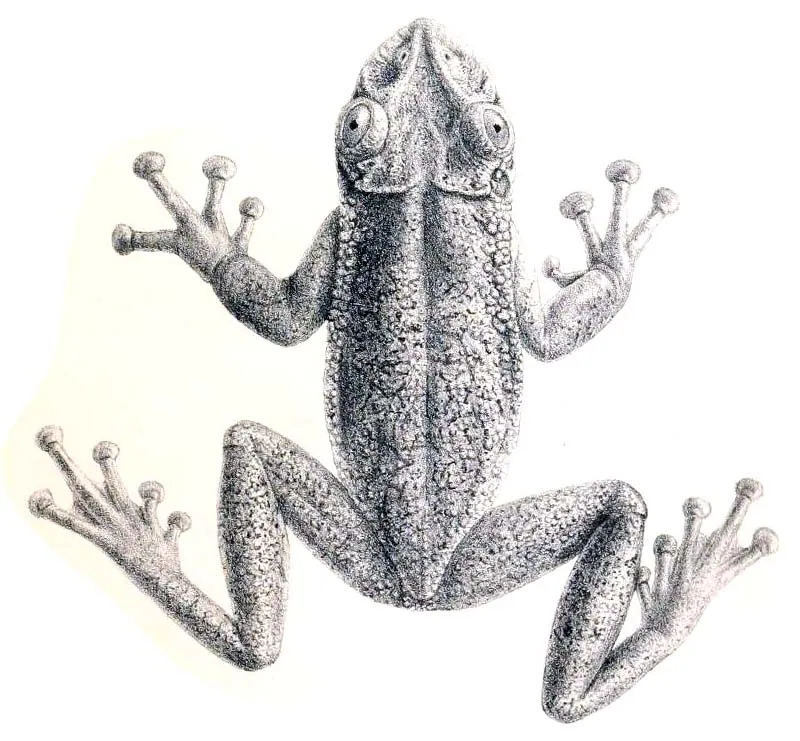
 So erkennst du es
Giftkraft
Spitze Stacheln tragen das Gift. Drauftreten oder Anfassen tut weh.
Was macht sein Gift, wenn es beißt oder sticht?
Its skull spines inject venom into other animals, or into a human hand, when it headbutts. Its skin secretions contain steroids and alkaloids, which in laboratory tests caused a powerful painful effect and swelling in mouse cells. In the wild these secretions act as a chemical defence against predators.1
Wie gefährlich ist es für Menschen?
Gefahr für Menschen: SchmerzhaftEs kann richtig wehtun, ist aber fast nie gefährlich.Was macht es, wenn es Angst hat?
It hides in a tree hollow, rock crevice or bromeliad, sealing the entrance with its head, and it defends itself by headbutting with its skull spines.1
 Wenn dich seine Stacheln stechen
- Wenn jemand eines angefasst hat: Hände gründlich waschen und nicht an Augen oder Mund fassen. Wenn ein Kind oder Haustier eines abgeleckt oder gegessen hat: Ruf den Giftnotruf oder deine Notrufnummer an.
Ruf immer zuerst deine Notrufnummer an (112, 000, 911). Das sind allgemeine Erste-Hilfe-Hinweise, keine ärztliche Beratung. Erste-Hilfe-Grundlagen
 Bleib sicher
- Fass ein wildes Tier niemals an, fang es nicht und ärgere es nicht, auch kein kleines, und auch nicht, wenn es schlafend aussieht oder tot.
- Halte Abstand. Wenn du einem begegnest, bleib ruhig, geh langsam zurück und lass es seiner Wege gehen.
- Wenn dich seine Stacheln stechen: Bleib ruhig, halt still, ruf deine Notrufnummer an (112, 000, 911) oder fahr schnell in ein Krankenhaus. Merk dir, wie es aussah, ein Foto hilft.
Es hat es nicht auf dich abgesehen. Es benutzt sein Gift, um Futter zu fangen oder sich zu schützen, und versteckt sich viel lieber. Mehr über Sicherheit
Wo auf der Welt?
Wie groß ist es?
Wie lang ist es?
 so lang wie 2,5 Bausteine in einer Reihe
 könnte 100 Meter in 82 Sekunden schaffen (der schnellste Mensch braucht 9,6)
Wie groß ist Greening's frog im Vergleich zu DIR?
Nur Rechnen in deinem Browser. Nichts wird gespeichert oder irgendwohin geschickt.
Wie schnell ist es?


Fakten
Unlike poison dart frogs, which only secrete poison from their skin, this frog can inject venom through spines on its skull.1
The skin of its head is fused to the skull to form a casque, a hard helmet-like structure.1
In laboratory tests, its skin secretions also slowed the growth of mouse fibroblast and melanoma cells.1
It has a tough, water-resistant skin and a low metabolic rate, which help it survive the dry semi-desert climate.1
When the rains start and the streams run with water, males set up territories near the water and call to attract females.1
It shares its headbutting, spine-injecting defence with another frog, Nyctimantis brunoi.1
Für Giftexperten
Woher die Fakten kommen
- Corythomantis greeningi (Wikipedia (CC BY-SA 4.0))
- Corythomantis greeningi (iNaturalist): Namen und Klassifikation.
- Venom Wiki: die Gefahrenstufe, die typische Größe und die geschätzte Geschwindigkeit sind von uns. So berechnen wir sie: So bewerten wir die Gefahr.
Jeder Fakt auf dieser Seite hat eine Nummer, die auf seine Quelle zeigt. Wenn wir etwas falsch haben: Entschuldigung, wir sind Tierfans, keine Fachzeitschrift. Schreib uns an [email protected] und wir korrigieren es.
 Der Skorpion hat Hunger! Venom Wiki ist ein Ein-Mann-Projekt: kostenlos, ohne Werbung und ohne Tracker. Ein kleines Trinkgeld hilft, es online zu halten.Füttere den Skorpion
Mehr aus derselben Gruppe: Pfeilgiftfrösche, Kröten & Molche
 Golden poison frogPfeilgiftfrösche, Kröten & MolcheTödlichNicht anfassen
 Cane toadPfeilgiftfrösche, Kröten & MolcheBraucht einen ArztNicht anfassen
 Dyeing poison dart frogPfeilgiftfrösche, Kröten & MolcheTut nur wehNicht anfassen
 Black-legged poison frogPfeilgiftfrösche, Kröten & MolcheKann tötenNicht anfassen
 Bruno's casque-headed frogPfeilgiftfrösche, Kröten & MolcheBraucht einen ArztNicht anfassen
 Harlequin poison frogPfeilgiftfrösche, Kröten & MolcheBraucht einen ArztNicht anfassen
 Terciopelo
 Brazilian wandering spider
 Eyelash viper
 Golden lancehead
 South American bushmaster
 Peruvian giant centipede