
 Afrika
 Asien
Asien Europa
 Südamerika
 Australien & Ozeanien
 Antarktis
 Pazifischer Ozean
 Atlantischer Ozean
 Indischer Ozean
 Nordpolarmeer
 Mittelmeer
 Rotes Meer
 Karibisches Meer
 Korallenmeer
 Südchinesisches Meer
 Philippinensee
 Andamanensee
 Nordsee
 Timorsee & Arafurasee
 Golf von Bengalen
 Golf von Kalifornien
House centipede
 Bisse
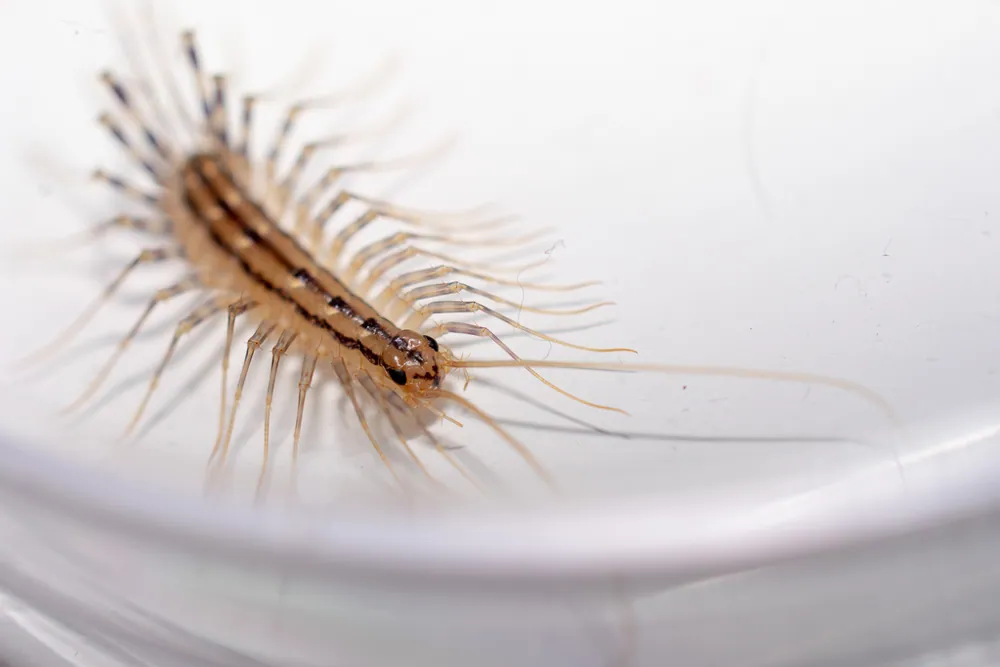
BisseThe house centipede is a long-legged, yellowish-grey centipede that often shares homes with people. It comes from the Mediterranean region and has spread across much of the world. It is fast, has very long legs, and eats household pests, so it is useful to have around.1
 So erkennst du es
- Typically yellowish-grey, with three dark stripes running down the length of its body.1
- Up to 15 pairs of long legs, which also have dark stripes.1
- Body is typically 25 to 35 mm long. With its legs and antennae, it looks about 75 to 100 mm long.1
- Runs very quickly across floors, up walls and along ceilings, and can stop suddenly and stay still.1
- Has well-developed eyes, unlike most other centipedes.1
Giftkraft
Das Gift kommt beim Beißen durch die Giftzähne oder Zähne heraus.
Was macht sein Gift, wenn es beißt oder sticht?
It has a mild venom, which it injects through small claw-like structures called forcipules. Its venom is used mainly to subdue prey. In a bite on a person, the effect is limited to mild pain and swelling in the local area, similar to a bee sting.1
Wie gefährlich ist es für Menschen?
Gefahr für Menschen: LeichtWie ein Bienenstich oder weniger. Für Menschen praktisch harmlos.House centipedes pose essentially no threat to people. They are not aggressive and usually flee when disturbed. Stings are rare and usually happen only when the centipede is cornered or handled roughly. Their forcipules have difficulty penetrating human skin. Allergic reactions have been reported but are rare, and nearly all successful bites heal quickly without complications.1
Was macht es, wenn es Angst hat?
When disturbed, it usually runs away quickly, and it can detach any legs that have become trapped.1
 Wenn es beißt
- Wasch den Biss, kühl ihn oder bade ihn gegen die Schmerzen in warmem Wasser, und hol ärztliche Hilfe, wenn es schlimmer wird.
Ruf immer zuerst deine Notrufnummer an (112, 000, 911). Das sind allgemeine Erste-Hilfe-Hinweise, keine ärztliche Beratung. Erste-Hilfe-Grundlagen
 Bleib sicher
- Fass ein wildes Tier niemals an, fang es nicht und ärgere es nicht, auch kein kleines, und auch nicht, wenn es schlafend aussieht oder tot.
- Halte Abstand. Wenn du einem begegnest, bleib ruhig, geh langsam zurück und lass es seiner Wege gehen.
- Wenn dich eines beißt: Bleib ruhig, halt still, ruf deine Notrufnummer an (112, 000, 911) oder fahr schnell in ein Krankenhaus. Merk dir, wie es aussah, ein Foto hilft.
Es hat es nicht auf dich abgesehen. Es benutzt sein Gift, um Futter zu fangen oder sich zu schützen, und versteckt sich viel lieber. Mehr über Sicherheit
Wo auf der Welt?
Wie groß ist es?
Wie lang ist es?
 etwa so lang wie eine Büroklammer
 könnte 100 Meter in 260 Sekunden schaffen (der schnellste Mensch braucht 9,6)
Wie groß ist House centipede im Vergleich zu DIR?
Nur Rechnen in deinem Browser. Nichts wird gespeichert oder irgendwohin geschickt.
Wie schnell ist es?


Fakten
It can detach its own legs if they become trapped, which helps it escape danger.1
It can tell harmful prey from safe prey, and it changes how it feeds depending on the danger. With wasps, it retreats after stinging to let the venom take effect.1
Its tail-like hind legs look like antennae, so when it is at rest it is hard to tell its head end from its tail end.1
Unlike most centipedes, it has well-developed faceted eyes, although it hunts mostly by smell and touch through its antennae.1
Its blood contains proteins that carry oxygen, which is unusual among centipedes.1
It can live its whole life inside a building, usually on the ground floor of homes.1
Mythen-Check
Mythos: House centipedes are dangerous and likely to attack people.
Wahrheit: They are not aggressive and usually run away. Their stings are rare and cause only mild, local pain and swelling.1
Für Giftexperten
- Wissenschaftlicher Name
- Scutigera coleoptrata
- Gruppe
- Hundertfüßer
- Familie
- Scutigeridae2
- Ordnung
- Scutigeromorpha
- Kontinente
- Europa, Asien, Afrika
- Babys
- They lay eggs in spring. In a laboratory study of 24 females, the average was 63 eggs and the maximum was 151. The young hatch with four pairs of legs and gain more with each moult until they reach 15 pairs.1
- Lebensdauer
- etwa 7 Jahre1
- Gefahr für Menschen
- 1 / 5: Leicht3
Woher die Fakten kommen
- Scutigera coleoptrata (Wikipedia (CC BY-SA 4.0))
- Scutigera coleoptrata (iNaturalist): Namen und Klassifikation.
- Venom Wiki: die Gefahrenstufe, die typische Größe und die geschätzte Geschwindigkeit sind von uns. So berechnen wir sie: So bewerten wir die Gefahr.
Jeder Fakt auf dieser Seite hat eine Nummer, die auf seine Quelle zeigt. Wenn wir etwas falsch haben: Entschuldigung, wir sind Tierfans, keine Fachzeitschrift. Schreib uns an [email protected] und wir korrigieren es.
 Der Skorpion hat Hunger! Venom Wiki ist ein Ein-Mann-Projekt: kostenlos, ohne Werbung und ohne Tracker. Ein kleines Trinkgeld hilft, es online zu halten.Füttere den Skorpion
Mehr aus derselben Gruppe: Hundertfüßer
 Chinese red-headed centipedeHundertfüßerBraucht einen Arzt
 Giant Australian centipedeHundertfüßerTut nur weh
 Mediterranean banded centipedeHundertfüßerTut nur weh
 Vietnamese giant centipedeHundertfüßerBraucht einen Arzt
 African blue-ring centipedeHundertfüßerTut nur weh
 Indian tiger centipedeHundertfüßerTut nur weh
Lebt auch in: Europa
 Common European adderVipern & OtternBraucht einen Arzt
 Spanish flyAndere passiv giftige TiereBraucht einen ArztNicht anfassen
 Common waspBienen, Wespen & HornissenTut nur weh
 European hornetBienen, Wespen & HornissenTut nur weh
 Fire salamanderPfeilgiftfrösche, Kröten & MolcheTut nur wehNicht anfassen
 Western honey beeBienen, Wespen & HornissenTut nur weh