
 Afrika
 Asien
Asien Europa
 Südamerika
 Australien & Ozeanien
 Antarktis
 Pazifischer Ozean
 Atlantischer Ozean
 Indischer Ozean
 Nordpolarmeer
 Mittelmeer
 Rotes Meer
 Karibisches Meer
 Korallenmeer
 Südchinesisches Meer
 Philippinensee
 Andamanensee
 Nordsee
 Timorsee & Arafurasee
 Golf von Bengalen
 Golf von Kalifornien
Longhorn cowfish
 Gift in der HautFrisst: Von allem etwasPassiv giftig, nicht aktiv giftig
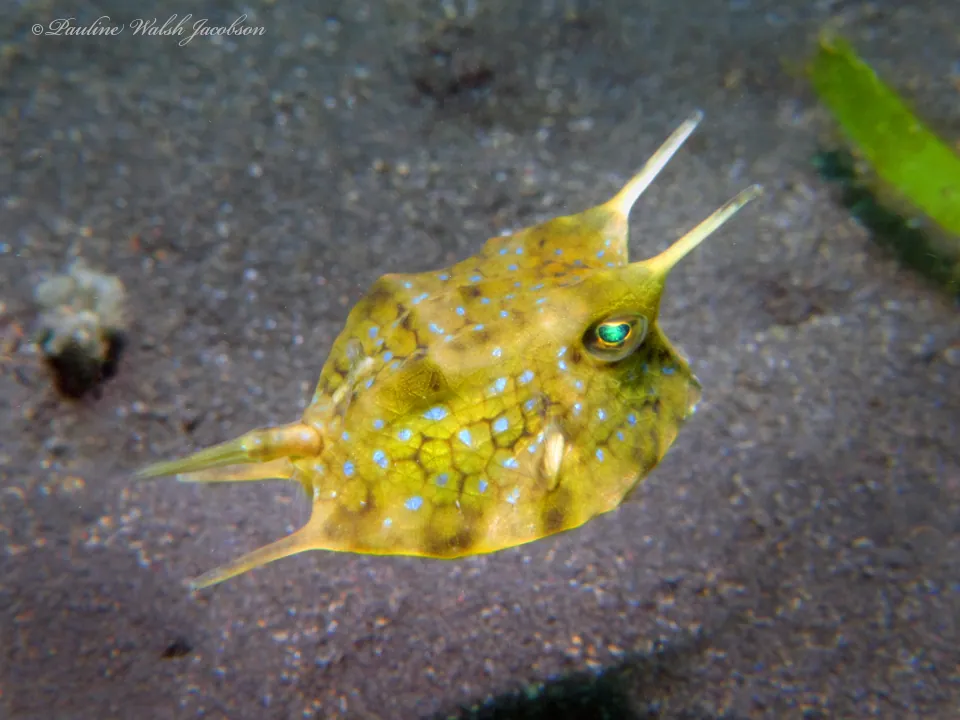
The longhorn cowfish is a small, boxy reef fish with two long horns above its eyes, like a cow's. It lives in warm waters across the Indo-Pacific, from the Red Sea to Japan and Australia. It is a slow swimmer that protects itself with a hard box-like body and a skin poison.1


 So erkennst du es
- Two long horns stick out from the front of the head, above the large eyes1
- Its body is a solid, triangular, box-like shell made of fused plate-like scales, with the fins and tail sticking out1
- The base colour is yellow to olive, decorated with white or bluish spots1
- It has no gill cover, only a small slit or hole behind the head1
- It swims slowly with its fins, so it looks as if it is hovering1
Giftkraft
Seine Haut ist giftig. Es ist gefährlich, es anzufassen, abzulecken oder zu essen.
Was macht sein Gift, wenn man es anfasst oder isst?
When it is severely stressed, it can release a toxin called pahutoxin from the mucus on its skin. This poison is toxic to other boxfish and has properties similar to sea cucumber toxins.1
Wie gefährlich ist es für Menschen?
Gefahr für Menschen: LeichtWie ein Bienenstich oder weniger. Für Menschen praktisch harmlos.Was macht es, wenn es Angst hat?
Its hard box-like shell, its horns, which can be used to charge at predators, and its skin poison all protect it. If severely stressed, it may release its toxin.1
 Wenn jemand es angefasst oder gegessen hat
- Wenn jemand es gegessen hat oder nach dem Essen Beschwerden hat: Ruf sofort deine Notrufnummer oder den Giftnotruf an.
Ruf immer zuerst deine Notrufnummer an (112, 000, 911). Das sind allgemeine Erste-Hilfe-Hinweise, keine ärztliche Beratung. Erste-Hilfe-Grundlagen
 Bleib sicher
- Fass ein wildes Tier niemals an, fang es nicht und ärgere es nicht, auch kein kleines, und auch nicht, wenn es schlafend aussieht oder tot.
- Halte Abstand. Wenn du einem begegnest, bleib ruhig, geh langsam zurück und lass es seiner Wege gehen.
- Wenn du es angefasst oder gegessen hast: Reib dir nicht die Augen oder den Mund, wasch dir die Hände und hol ärztliche Hilfe.
Es hat es nicht auf dich abgesehen. Sein Gift ist nur dazu da, dass es niemand frisst. Mehr über Sicherheit
Wo auf der Welt?
Wie groß ist es?
Wie lang ist es?
Wie schwer ist es?
 so lang wie 3 Bananen hintereinander
 so lang wie 16 Bausteine in einer Reihe
 könnte die Länge eines großen Schwimmbeckens (50 m) in 45 Sekunden schwimmen
Wie groß ist Longhorn cowfish im Vergleich zu DIR?
Nur Rechnen in deinem Browser. Nichts wird gespeichert oder irgendwohin geschickt.
Wie schnell ist es?
Fakten
Its horns may have evolved to make it harder for predators to swallow it, and if damaged, they can grow back within a few months.1
It can make humming and clicking sounds using muscles connected to its swim bladder.1
It is slow and easy to catch by hand, and it makes a grunting noise when caught.1
On Pamban Island in India, a local belief says cows on the island turned into these fish when the land separated.1
It helps protect coral reefs by eating invertebrates that damage them, and it is also important to reef growth.1
Für Giftexperten
- Wissenschaftlicher Name
- Lactoria cornuta
- Gruppe
- Andere passiv giftige Tiere
- Familie
- Ostraciidae2
- Ordnung
- Tetraodontiformes
- Kontinente
- Pazifischer Ozean, Indischer Ozean, Rotes Meer, Korallenmeer, Philippinensee, Südchinesisches Meer, Timorsee & Arafurasee, Golf von Bengalen, Die Ozeane
- Babys
- Females spawn in small groups, with one male and 3 to 4 females in each harem. The oval eggs hatch into larvae that quickly form the box-like armour.1
- Gefahr für Menschen
- 1 / 5: Leicht3
Woher die Fakten kommen
- Longhorn cowfish (Wikipedia (CC BY-SA 4.0))
- Lactoria cornuta (iNaturalist): Namen und Klassifikation.
- Venom Wiki: die Gefahrenstufe, die typische Größe und die geschätzte Geschwindigkeit sind von uns. So berechnen wir sie: So bewerten wir die Gefahr.
Jeder Fakt auf dieser Seite hat eine Nummer, die auf seine Quelle zeigt. Wenn wir etwas falsch haben: Entschuldigung, wir sind Tierfans, keine Fachzeitschrift. Schreib uns an [email protected] und wir korrigieren es.
 Der Skorpion hat Hunger! Venom Wiki ist ein Ein-Mann-Projekt: kostenlos, ohne Werbung und ohne Tracker. Ein kleines Trinkgeld hilft, es online zu halten.Füttere den Skorpion
Mehr aus derselben Gruppe: Andere passiv giftige Tiere
 TigerkugelfischAndere passiv giftige TiereTödlich
 Hawksbill sea turtleAndere passiv giftige TiereKann töten
 Greenland sharkAndere passiv giftige TiereTut nur weh
 Silver-cheeked toadfishAndere passiv giftige TiereTödlich
 Blackspotted pufferAndere passiv giftige TiereKann töten
 White-spotted pufferAndere passiv giftige TiereKann töten
Lebt auch in: Pazifischer Ozean
 Australische WürfelqualleQuallen & Nesseltiere im MeerTödlichNicht anfassen
 Landkarten-KegelschneckeKegelschnecken & KrakenTödlich
 Großer BlauringkrakeKegelschnecken & KrakenTödlich
 Südlicher BlauringkrakeKegelschnecken & KrakenTödlich
 Irukandji jellyfishQuallen & Nesseltiere im MeerKann tötenNicht anfassen
 Reef stonefishGiftfischeKann tötenNicht anfassen