
 Afrika
 Asien
Asien Europa
 Südamerika
 Australien & Ozeanien
 Antarktis
 Pazifischer Ozean
 Atlantischer Ozean
 Indischer Ozean
 Nordpolarmeer
 Mittelmeer
 Rotes Meer
 Karibisches Meer
 Korallenmeer
 Südchinesisches Meer
 Philippinensee
 Andamanensee
 Nordsee
 Timorsee & Arafurasee
 Golf von Bengalen
 Golf von Kalifornien
Oriental hornet
 Stiche
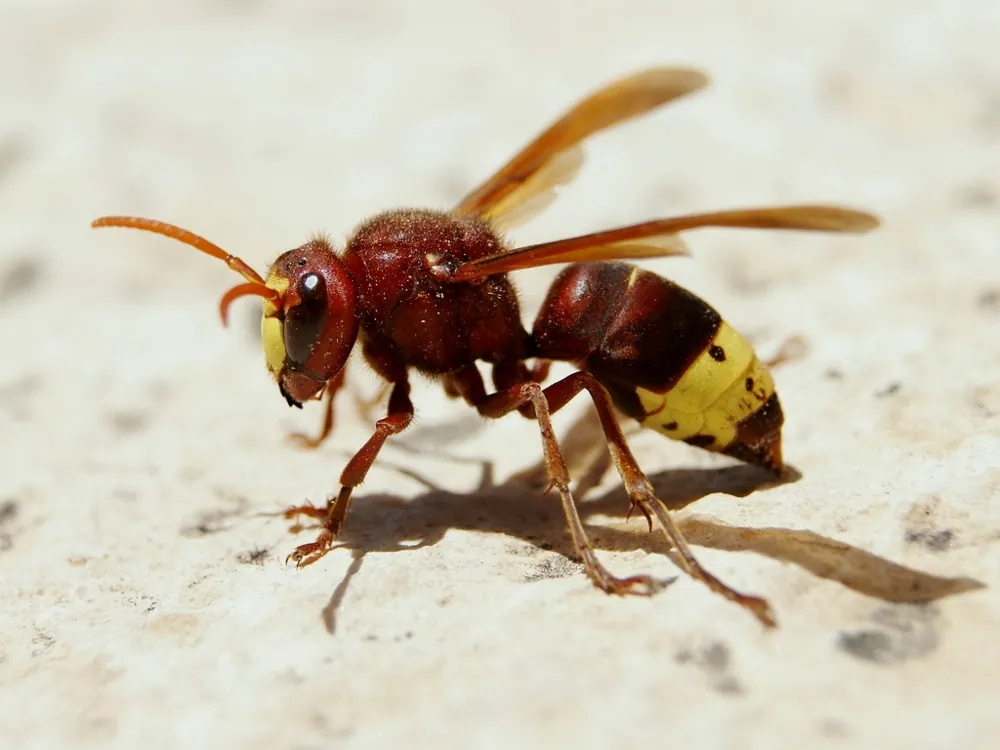
The Oriental hornet is a large social wasp that lives in colonies of thousands of insects, led by a single queen. It lives in parts of Southwest Asia, Northeast Africa, the Middle East and Southern Europe, and it is one of the main pests of honey bees. Its sting can be very painful.1



 So erkennst du es
- Reddish-brown body1
- Thick yellow bands across the abdomen1
- Yellow patches on the head between the eyes1
- Body 25 to 35 mm long; the queen and drones are larger than workers1
- Very strong jaws, and will bite if provoked1
Oft verwechselt mit: It looks similar to the European hornet (Vespa crabro). The Asian giant hornet of East Asia should not be confused with it. Males (drones) have 13 antenna segments, while workers and the queen have 12.1
Giftkraft
Das Gift kommt durch einen Stachel heraus.
Was macht sein Gift, wenn es beißt oder sticht?
The sting is quite painful to people. Some people are allergic to these stings. Tests on the venom showed that it slowed the growth of some Gram-positive bacteria, a group of bacteria, so it may be useful as a medicine.1
Wie gefährlich ist es für Menschen?
Gefahr für Menschen: SchmerzhaftEs kann richtig wehtun, ist aber fast nie gefährlich.The sting can be quite painful, and some people are allergic to it.1
Was macht es, wenn es Angst hat?
Workers defend the colony, and will bite if provoked.1
 Wenn es sticht
- Kratz den Bienenstachel heraus und kühl die Stelle.
- Wenn die Person Atemnot hat, Gesicht oder Hals anschwellen oder ihr schwindlig wird, ist das ein allergischer Notfall: Ruf deine Notrufnummer an und benutze ihren Adrenalin-Autoinjektor, wenn sie einen hat.
Ruf immer zuerst deine Notrufnummer an (112, 000, 911). Das sind allgemeine Erste-Hilfe-Hinweise, keine ärztliche Beratung. Erste-Hilfe-Grundlagen
 Bleib sicher
- Fass ein wildes Tier niemals an, fang es nicht und ärgere es nicht, auch kein kleines, und auch nicht, wenn es schlafend aussieht oder tot.
- Halte Abstand. Wenn du einem begegnest, bleib ruhig, geh langsam zurück und lass es seiner Wege gehen.
- Wenn dich eines sticht: Bleib ruhig, halt still, ruf deine Notrufnummer an (112, 000, 911) oder fahr schnell in ein Krankenhaus. Merk dir, wie es aussah, ein Foto hilft.
Es hat es nicht auf dich abgesehen. Es benutzt sein Gift, um Futter zu fangen oder sich zu schützen, und versteckt sich viel lieber. Mehr über Sicherheit
Wo auf der Welt?
Wie groß ist es?
Wie lang ist es?
 etwa so lang wie eine Büroklammer
 könnte in 12 Sekunden über ein ganzes Fußballfeld fliegen
Wie groß ist Oriental hornet im Vergleich zu DIR?
Nur Rechnen in deinem Browser. Nichts wird gespeichert oder irgendwohin geschickt.
Wie schnell ist es?


Fakten
The yellow stripe on its exoskeleton can absorb sunlight and generate a small electrical potential, which may help supply energy for digging.1
A 2024 study found that hornets fed sugary solutions containing up to 80% ethanol for a week showed no harmful effects on behaviour or lifespan. Most animals tolerate only up to 4%.1
It is the primary pest that attacks honey bee colonies in many countries.1
It is the only member of the genus Vespa that lives in desert climates, such as those in North Africa and the Middle East.1
Unlike most wasps, which are most active early in the morning, it is most active in the middle of the day.1
Its sisters are closely related, with each worker on average 75% related to her sisters, so workers help raise the colony's young.1
Für Giftexperten
- Wissenschaftlicher Name
- Vespa orientalis
- Gruppe
- Bienen, Wespen & Hornissen
- Familie
- Vespidae2
- Ordnung
- Hymenoptera
- Kontinente
- Europa, Asien, Afrika
- Babys
- The queen lays eggs in the comb cells. Some eggs become new queens and drones, and workers raise the young, called brood.1
- Gefahr für Menschen
- 2 / 5: Schmerzhaft3
Woher die Fakten kommen
- Oriental hornet (Wikipedia (CC BY-SA 4.0))
- Vespa orientalis (iNaturalist): Namen und Klassifikation.
- Venom Wiki: die Gefahrenstufe, die typische Größe und die geschätzte Geschwindigkeit sind von uns. So berechnen wir sie: So bewerten wir die Gefahr.
Jeder Fakt auf dieser Seite hat eine Nummer, die auf seine Quelle zeigt. Wenn wir etwas falsch haben: Entschuldigung, wir sind Tierfans, keine Fachzeitschrift. Schreib uns an [email protected] und wir korrigieren es.
 Der Skorpion hat Hunger! Venom Wiki ist ein Ein-Mann-Projekt: kostenlos, ohne Werbung und ohne Tracker. Ein kleines Trinkgeld hilft, es online zu halten.Füttere den Skorpion
Mehr aus derselben Gruppe: Bienen, Wespen & Hornissen
 Asian giant hornetBienen, Wespen & HornissenKann töten
 Common waspBienen, Wespen & HornissenTut nur weh
 European hornetBienen, Wespen & HornissenTut nur weh
 Western honey beeBienen, Wespen & HornissenTut nur weh
 Giant honey beeBienen, Wespen & HornissenBraucht einen Arzt
 Asian hornetBienen, Wespen & HornissenTut nur weh
Lebt auch in: Europa
 Common European adderVipern & OtternBraucht einen Arzt
 Spanish flyAndere passiv giftige TiereBraucht einen ArztNicht anfassen
 Fire salamanderPfeilgiftfrösche, Kröten & MolcheTut nur wehNicht anfassen
 Blunt-nosed viperVipern & OtternKann töten
 Nose-horned viperVipern & OtternKann töten
 Ottoman viperVipern & OtternKann töten