
 Afrika
 Asien
Asien Europa
 Südamerika
 Australien & Ozeanien
 Antarktis
 Pazifischer Ozean
 Atlantischer Ozean
 Indischer Ozean
 Nordpolarmeer
 Mittelmeer
 Rotes Meer
 Karibisches Meer
 Korallenmeer
 Südchinesisches Meer
 Philippinensee
 Andamanensee
 Nordsee
 Timorsee & Arafurasee
 Golf von Bengalen
 Golf von Kalifornien
Red-backed poison frog
 Gift in der Haut
The red-backed poison frog is a tiny frog that lives high in the Amazon rainforest of Peru and Ecuador. It is moderately poisonous, and its skin poison can cause serious injury to people. Its bright red back warns predators to stay away.1



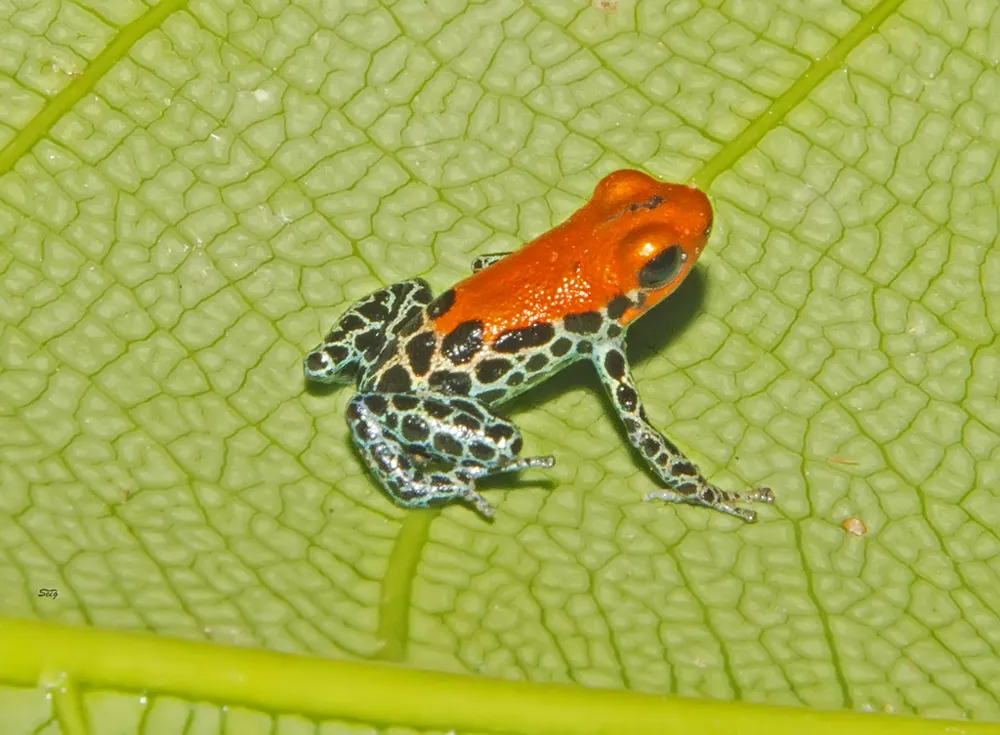
 So erkennst du es
Giftkraft
Seine Haut ist giftig. Es ist gefährlich, es anzufassen, abzulecken oder zu essen.
Was macht sein Gift, wenn man es anfasst oder isst?
This frog is poisonous, not venomous, so it does not bite or sting. Its poison is stored in skin glands just beneath the outer layer of skin. It seeps through open wounds, body openings and pores. The poison can cause serious injury to humans and death in animals such as chickens.1
Wie gefährlich ist es für Menschen?
Gefahr für Menschen: SchmerzhaftEs kann richtig wehtun, ist aber fast nie gefährlich.The poison is moderately toxic and can cause serious injury to humans.1
Was macht es, wenn es Angst hat?
When it is threatened, it shows its bright warning colours, climbs trees to escape, or uses its poison if it cannot get away.1
 Wenn jemand es angefasst oder gegessen hat
- Wenn jemand eines angefasst hat: Hände gründlich waschen und nicht an Augen oder Mund fassen. Wenn ein Kind oder Haustier eines abgeleckt oder gegessen hat: Ruf den Giftnotruf oder deine Notrufnummer an.
Ruf immer zuerst deine Notrufnummer an (112, 000, 911). Das sind allgemeine Erste-Hilfe-Hinweise, keine ärztliche Beratung. Erste-Hilfe-Grundlagen
 Bleib sicher
- Fass ein wildes Tier niemals an, fang es nicht und ärgere es nicht, auch kein kleines, und auch nicht, wenn es schlafend aussieht oder tot.
- Halte Abstand. Wenn du einem begegnest, bleib ruhig, geh langsam zurück und lass es seiner Wege gehen.
- Wenn du es angefasst oder gegessen hast: Reib dir nicht die Augen oder den Mund, wasch dir die Hände und hol ärztliche Hilfe.
Es hat es nicht auf dich abgesehen. Sein Gift ist nur dazu da, dass es niemand frisst. Mehr über Sicherheit
Wo auf der Welt?
Wie groß ist es?
Wie lang ist es?
 kürzer als dein kleiner Finger
 könnte 100 Meter in 110 Sekunden schaffen (der schnellste Mensch braucht 9,6)
Wie groß ist Red-backed poison frog im Vergleich zu DIR?
Nur Rechnen in deinem Browser. Nichts wird gespeichert oder irgendwohin geschickt.
Wie schnell ist es?


Fakten
Males stick the tadpoles to their backs using a water-soluble mucus, then carry them into the canopy.1
Males place the tadpoles in tiny pools that collect in the centre of bromeliad plants. The mother then feeds them infertile eggs laid in the water.1
Once they become froglets, the young are led to an existing group, where all members accept them, though only their parents care for them.1
It is the second most poisonous frog in its genus Ranitomeya, after R. variabilis.1
Breeding gatherings take place at the end of the wet season, so the eggs are laid at the start of the next wet season, when the young have a steady supply of water.1
Deforestation for charcoal and the capture of frogs for the international pet trade are the main threats to it.1
Für Giftexperten
- Wissenschaftlicher Name
- Ranitomeya reticulata
- Gruppe
- Pfeilgiftfrösche, Kröten & Molche
- Familie
- Dendrobatidae2
- Ordnung
- Anura
- Kontinente
- Südamerika
- Babys
- Females lay eggs on the ground, and after the eggs hatch, males carry the tadpoles up into the canopy.1
- Wie es ihm in der Natur geht
- Least Concern1
- Gefahr für Menschen
- 2 / 5: Schmerzhaft3
Woher die Fakten kommen
- Red-backed poison frog (Wikipedia (CC BY-SA 4.0))
- Ranitomeya reticulata (iNaturalist): Namen und Klassifikation.
- Venom Wiki: die Gefahrenstufe, die typische Größe und die geschätzte Geschwindigkeit sind von uns. So berechnen wir sie: So bewerten wir die Gefahr.
Jeder Fakt auf dieser Seite hat eine Nummer, die auf seine Quelle zeigt. Wenn wir etwas falsch haben: Entschuldigung, wir sind Tierfans, keine Fachzeitschrift. Schreib uns an [email protected] und wir korrigieren es.
 Der Skorpion hat Hunger! Venom Wiki ist ein Ein-Mann-Projekt: kostenlos, ohne Werbung und ohne Tracker. Ein kleines Trinkgeld hilft, es online zu halten.Füttere den Skorpion
Mehr aus derselben Gruppe: Pfeilgiftfrösche, Kröten & Molche
 Schrecklicher PfeilgiftfroschPfeilgiftfrösche, Kröten & MolcheTödlichNicht anfassen
 Cane toadPfeilgiftfrösche, Kröten & MolcheBraucht einen ArztNicht anfassen
 Dyeing poison dart frogPfeilgiftfrösche, Kröten & MolcheTut nur wehNicht anfassen
 Black-legged poison frogPfeilgiftfrösche, Kröten & MolcheKann tötenNicht anfassen
 Bruno's casque-headed frogPfeilgiftfrösche, Kröten & MolcheBraucht einen ArztNicht anfassen
 Harlequin poison frogPfeilgiftfrösche, Kröten & MolcheBraucht einen ArztNicht anfassen
 Terciopelo-Lanzenotter
 Brazilian wandering spider
 Eyelash viper
 Golden lancehead
 South American bushmaster
 Peruvian giant centipede