
 Afrika
 Asien
Asien Europa
 Südamerika
 Australien & Ozeanien
 Antarktis
 Pazifischer Ozean
 Atlantischer Ozean
 Indischer Ozean
 Nordpolarmeer
 Mittelmeer
 Rotes Meer
 Karibisches Meer
 Korallenmeer
 Südchinesisches Meer
 Philippinensee
 Andamanensee
 Nordsee
 Timorsee & Arafurasee
 Golf von Bengalen
 Golf von Kalifornien
South American rattlesnake
 Bisse
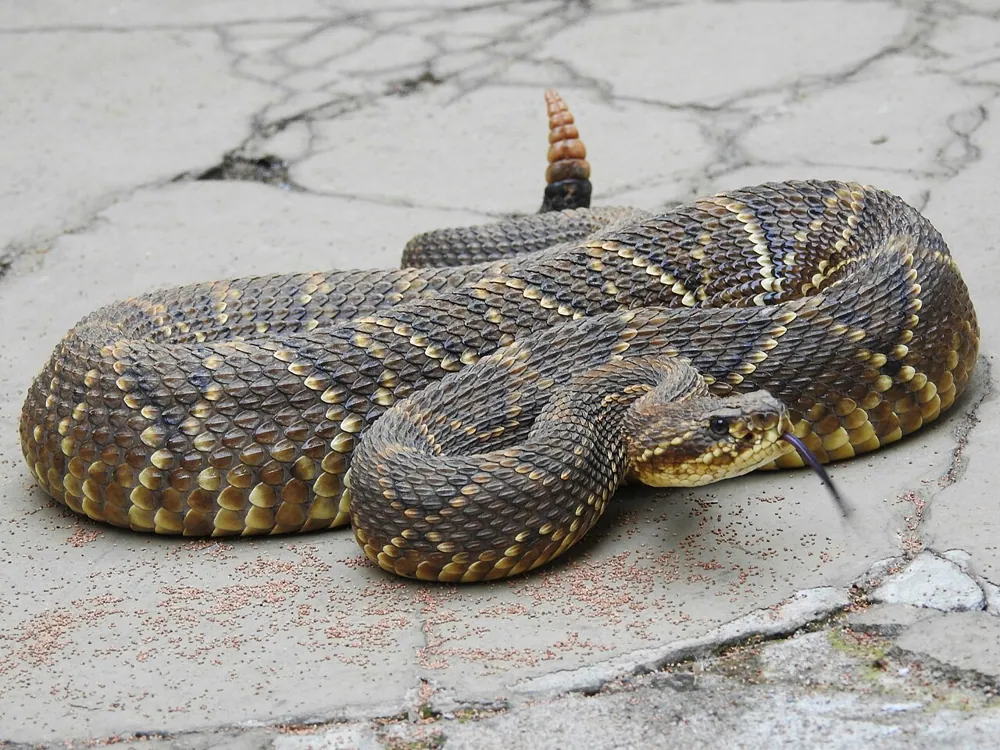
BisseThe South American rattlesnake is a large, highly venomous pit viper. It lives across much of South America, except the Andes Mountains, and also on some Caribbean islands. It is the most widely spread member of its genus, which is why it matters to people in so many places.1


 So erkennst du es
- Two distinct stripes start at the base of the head, and the colour between the lines is lighter than the stripes.1
- Body colour and pattern vary, but most have 18 to 32 dark diamond or rhombic spots along the back.1
- The head has a dark brown bar at the top and a dark band behind the eye.1
- The tail is usually grey, with dark, faint crossed bands.1
- The belly is white or yellowish with light grey spots, getting darker towards the tail.1
Giftkraft
Das Gift kommt beim Beißen durch die Giftzähne oder Zähne heraus.
Was macht sein Gift, wenn es beißt oder sticht?
Its venom contains neurotoxins, which attack the nerves, and myotoxins, which damage muscle. These cause progressive paralysis, including impaired or lost vision, hearing problems, drooping eyelids and weakness in the neck muscles, which can become so limp that the head appears broken. Breathing can eventually be stopped by paralysis, and the muscle damage can cause dark urine.1
Wie gefährlich ist es für Menschen?
Gefahr für Menschen: Sehr gefährlichEs kann einen Menschen töten, der keine Behandlung bekommt.It is a highly venomous snake. The mortality rate is 72% for bite cases without specific serum treatment, and 11% for cases with it. Acute kidney failure is considered the main cause of death.1
 Gute Nachricht: Ärzte haben dafür ein Medikament (Gegengift) oder eine Behandlung.1
Was macht es, wenn es Angst hat?
It is highly alert and gives little warning before it strikes, but it is seldom aggressive towards people.1
 Wenn es beißt
- Specific serum treatment (antivenom) greatly lowers the death rate, so a bite needs urgent hospital care to give it.1
- Halte die Person still und ruhig, halte den gebissenen Arm oder das Bein auf Herzhöhe, nimm Ringe und alles Enge ab und bring sie schnell in ein Krankenhaus.
Ruf immer zuerst deine Notrufnummer an (112, 000, 911). Das sind allgemeine Erste-Hilfe-Hinweise, keine ärztliche Beratung. Erste-Hilfe-Grundlagen
 Bleib sicher
- Fass ein wildes Tier niemals an, fang es nicht und ärgere es nicht, auch kein kleines, und auch nicht, wenn es schlafend aussieht oder tot.
- Halte Abstand. Wenn du einem begegnest, bleib ruhig, geh langsam zurück und lass es seiner Wege gehen.
- Wenn dich eines beißt: Bleib ruhig, halt still, ruf deine Notrufnummer an (112, 000, 911) oder fahr schnell in ein Krankenhaus. Merk dir, wie es aussah, ein Foto hilft.
Es hat es nicht auf dich abgesehen. Es benutzt sein Gift, um Futter zu fangen oder sich zu schützen, und versteckt sich viel lieber. Mehr über Sicherheit
Wo auf der Welt?
Wie groß ist es?
Wie lang ist es?
 so lang wie 4 Hauskatzen von Nase bis Schwanz
 so lang wie 11 Bananen hintereinander
 könnte 100 Meter in 90 Sekunden schaffen (der schnellste Mensch braucht 9,6)
Wie groß ist South American rattlesnake im Vergleich zu DIR?
Nur Rechnen in deinem Browser. Nichts wird gespeichert oder irgendwohin geschickt.
Wie schnell ist es?


Fakten
The lethal dose for a 60 kg human is possibly 18 mg, while a snake's venom yield is 20 to 100 mg.1
Crotoxin, a neurotoxin, makes up about 48.5% to 89.4% of the venom proteins in one subspecies, though it is typically 60% to 70%.1
It is the most widely distributed member of its genus, and seven subspecies are currently recognised.1
It is more active at dusk and in the early hours of the morning.1
Males compete for access to females from the end of summer, with mating in autumn and the young born the following spring or summer.1
Mythen-Check
Mythos: Yellow venom means the bite damages blood and tissue, and white venom means it attacks the nerves.
Wahrheit: Venom colour does not determine the type. Colour depends on pigments in the venom, not on whether it is haemorrhagic or neurotoxic.1
Für Giftexperten
- Wissenschaftlicher Name
- Crotalus durissus
- Gruppe
- Klapperschlangen
- Familie
- Viperidae2
- Ordnung
- Squamata
- Kontinente
- Südamerika
- Babys
- It gives birth to live young (ovoviviparous), usually four to eight at a time. In Roraima, Brazil, gestation has been reported to last five months, with up to 14 young.1
- Gefahr für Menschen
- 4 / 5: Sehr gefährlich3
Woher die Fakten kommen
- Crotalus durissus (Wikipedia (CC BY-SA 4.0))
- Crotalus durissus (iNaturalist): Namen und Klassifikation.
- Venom Wiki: die Gefahrenstufe, die typische Größe und die geschätzte Geschwindigkeit sind von uns. So berechnen wir sie: So bewerten wir die Gefahr.
Jeder Fakt auf dieser Seite hat eine Nummer, die auf seine Quelle zeigt. Wenn wir etwas falsch haben: Entschuldigung, wir sind Tierfans, keine Fachzeitschrift. Schreib uns an [email protected] und wir korrigieren es.
 Der Skorpion hat Hunger! Venom Wiki ist ein Ein-Mann-Projekt: kostenlos, ohne Werbung und ohne Tracker. Ein kleines Trinkgeld hilft, es online zu halten.Füttere den Skorpion
 Uracoan rattlesnake
 Eastern diamondback rattlesnake
 Timber rattlesnake
 Western diamondback rattlesnake
 Sidewinder
 Mojave rattlesnake
 Schrecklicher Pfeilgiftfrosch
 Terciopelo-Lanzenotter
 Brazilian wandering spider
 Eyelash viper
 Golden lancehead
 South American bushmaster