
 Afrika
 Asien
Asien Europa
 Südamerika
 Australien & Ozeanien
 Antarktis
 Pazifischer Ozean
 Atlantischer Ozean
 Indischer Ozean
 Nordpolarmeer
 Mittelmeer
 Rotes Meer
 Karibisches Meer
 Korallenmeer
 Südchinesisches Meer
 Philippinensee
 Andamanensee
 Nordsee
 Timorsee & Arafurasee
 Golf von Bengalen
 Golf von Kalifornien
Splash-backed poison frog
 Gift in der Haut
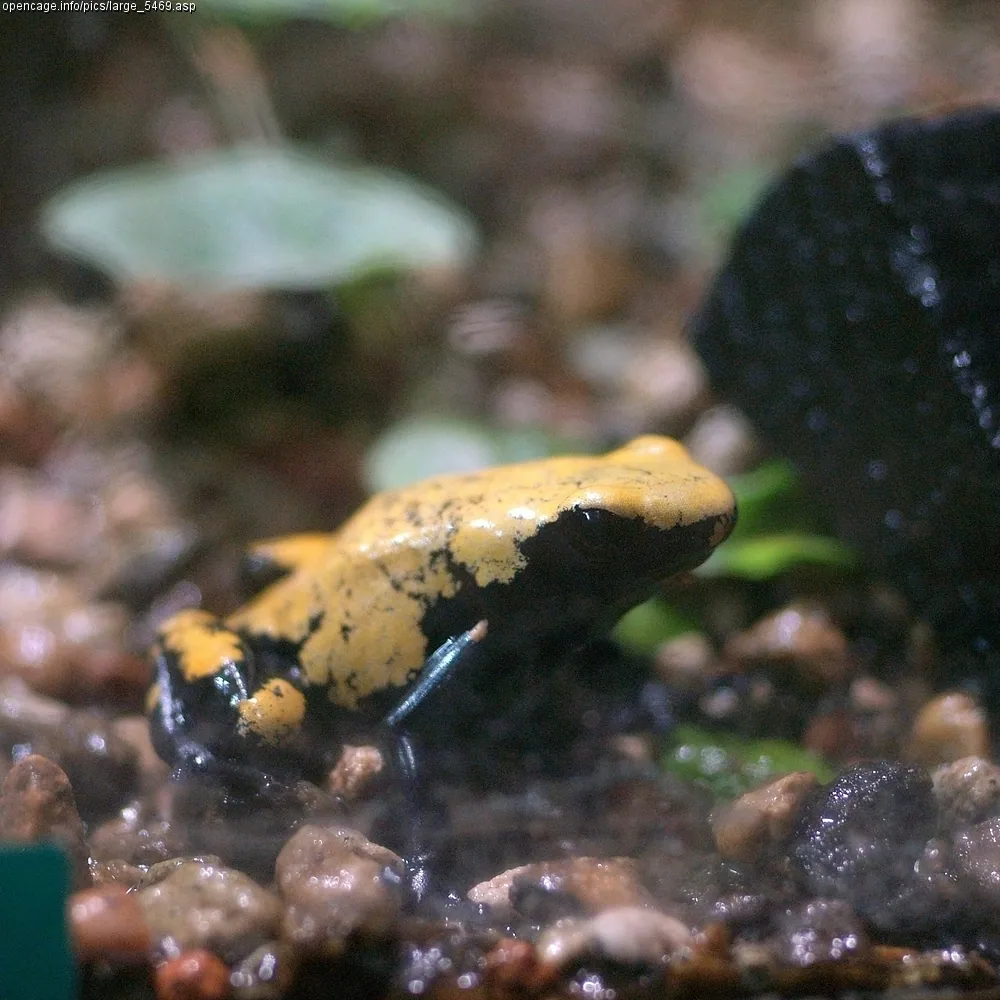
The splash-backed poison frog is a fairly large, brightly coloured frog from the rainforests of the southern Amazon Basin in Brazil. It is poisonous, not venomous, which means its skin is harmful to touch or eat rather than injecting venom with a bite. Its colours vary a great deal, which has made it an interesting case for scientists studying bright colours in poisonous frogs.1
 So erkennst du es
- The best-known form is black below and yellow, orange or red above.1
- Its colour is very variable. Some have whitish-mint or light blue upperparts, and some have a mottled or spotted pattern on top.1
- Some individuals are almost all whitish, yellow-orange or black. Captive keepers call the whitish ones 'moonshine'.1
- A relatively large poison dart frog, with a snout-vent length of up to 42 mm.1
Giftkraft
Seine Haut ist giftig. Es ist gefährlich, es anzufassen, abzulecken oder zu essen.
Wie gefährlich ist es für Menschen?
Gefahr für Menschen: SchmerzhaftEs kann richtig wehtun, ist aber fast nie gefährlich. Wenn jemand es angefasst oder gegessen hat
- Wenn jemand eines angefasst hat: Hände gründlich waschen und nicht an Augen oder Mund fassen. Wenn ein Kind oder Haustier eines abgeleckt oder gegessen hat: Ruf den Giftnotruf oder deine Notrufnummer an.
Ruf immer zuerst deine Notrufnummer an (112, 000, 911). Das sind allgemeine Erste-Hilfe-Hinweise, keine ärztliche Beratung. Erste-Hilfe-Grundlagen
 Bleib sicher
- Fass ein wildes Tier niemals an, fang es nicht und ärgere es nicht, auch kein kleines, und auch nicht, wenn es schlafend aussieht oder tot.
- Halte Abstand. Wenn du einem begegnest, bleib ruhig, geh langsam zurück und lass es seiner Wege gehen.
- Wenn du es angefasst oder gegessen hast: Reib dir nicht die Augen oder den Mund, wasch dir die Hände und hol ärztliche Hilfe.
Es hat es nicht auf dich abgesehen. Sein Gift ist nur dazu da, dass es niemand frisst. Mehr über Sicherheit
Wo auf der Welt?
Wie groß ist es?
Wie lang ist es?
 kürzer als dein kleiner Finger
 könnte 100 Meter in 97 Sekunden schaffen (der schnellste Mensch braucht 9,6)
Wie groß ist Splash-backed poison frog im Vergleich zu DIR?
Nur Rechnen in deinem Browser. Nichts wird gespeichert oder irgendwohin geschickt.
Wie schnell ist es?


Fakten
Bright colour in poisonous frogs is often thought to warn predators away, but studies of this frog suggest the colour may matter more for recognising each other and for choosing mates.1
Adults carry their tadpoles to water, and scientists believe Brazil nut husks may be among the places they use.1
Its colours vary so much that some forms were once thought to be separate species, but genetic tests found almost no difference between them.1
The two most different-looking colour forms have largely the same poison profile.1
It is relatively common and regularly bred in captivity, but wild populations are still at risk from illegal collection.1
Mythen-Check
Mythos: Bright colours on a poisonous frog always warn predators that it will poison them if they try to eat it.
Wahrheit: That is a longstanding interpretation, but studies of this frog suggest its colour may have more to do with recognising others of its kind and sexual selection than with deterring predators.1
Für Giftexperten
- Wissenschaftlicher Name
- Adelphobates galactonotus
- Gruppe
- Pfeilgiftfrösche, Kröten & Molche
- Familie
- Dendrobatidae2
- Ordnung
- Anura
- Kontinente
- Südamerika
- Babys
- Eggs are laid on the ground. After they hatch, the adults carry the tadpoles to water, possibly including water collected in Brazil nut husks.1
- Wie es ihm in der Natur geht
- Least Concern1
- Gefahr für Menschen
- 2 / 5: Schmerzhaft3
Woher die Fakten kommen
- Adelphobates galactonotus (Wikipedia (CC BY-SA 4.0))
- Adelphobates galactonotus (iNaturalist): Namen und Klassifikation.
- Venom Wiki: die Gefahrenstufe, die typische Größe und die geschätzte Geschwindigkeit sind von uns. So berechnen wir sie: So bewerten wir die Gefahr.
Jeder Fakt auf dieser Seite hat eine Nummer, die auf seine Quelle zeigt. Wenn wir etwas falsch haben: Entschuldigung, wir sind Tierfans, keine Fachzeitschrift. Schreib uns an [email protected] und wir korrigieren es.
 Der Skorpion hat Hunger! Venom Wiki ist ein Ein-Mann-Projekt: kostenlos, ohne Werbung und ohne Tracker. Ein kleines Trinkgeld hilft, es online zu halten.Füttere den Skorpion
Mehr aus derselben Gruppe: Pfeilgiftfrösche, Kröten & Molche
 Schrecklicher PfeilgiftfroschPfeilgiftfrösche, Kröten & MolcheTödlichNicht anfassen
 Cane toadPfeilgiftfrösche, Kröten & MolcheBraucht einen ArztNicht anfassen
 Dyeing poison dart frogPfeilgiftfrösche, Kröten & MolcheTut nur wehNicht anfassen
 Black-legged poison frogPfeilgiftfrösche, Kröten & MolcheKann tötenNicht anfassen
 Bruno's casque-headed frogPfeilgiftfrösche, Kröten & MolcheBraucht einen ArztNicht anfassen
 Harlequin poison frogPfeilgiftfrösche, Kröten & MolcheBraucht einen ArztNicht anfassen
 Terciopelo-Lanzenotter
 Brazilian wandering spider
 Eyelash viper
 Golden lancehead
 South American bushmaster
 Peruvian giant centipede