
 Afrika
 Asien
Asien Europa
 Südamerika
 Australien & Ozeanien
 Antarktis
 Pazifischer Ozean
 Atlantischer Ozean
 Indischer Ozean
 Nordpolarmeer
 Mittelmeer
 Rotes Meer
 Karibisches Meer
 Korallenmeer
 Südchinesisches Meer
 Philippinensee
 Andamanensee
 Nordsee
 Timorsee & Arafurasee
 Golf von Bengalen
 Golf von Kalifornien
Spotted jelly
 Nesselnde Tentakel
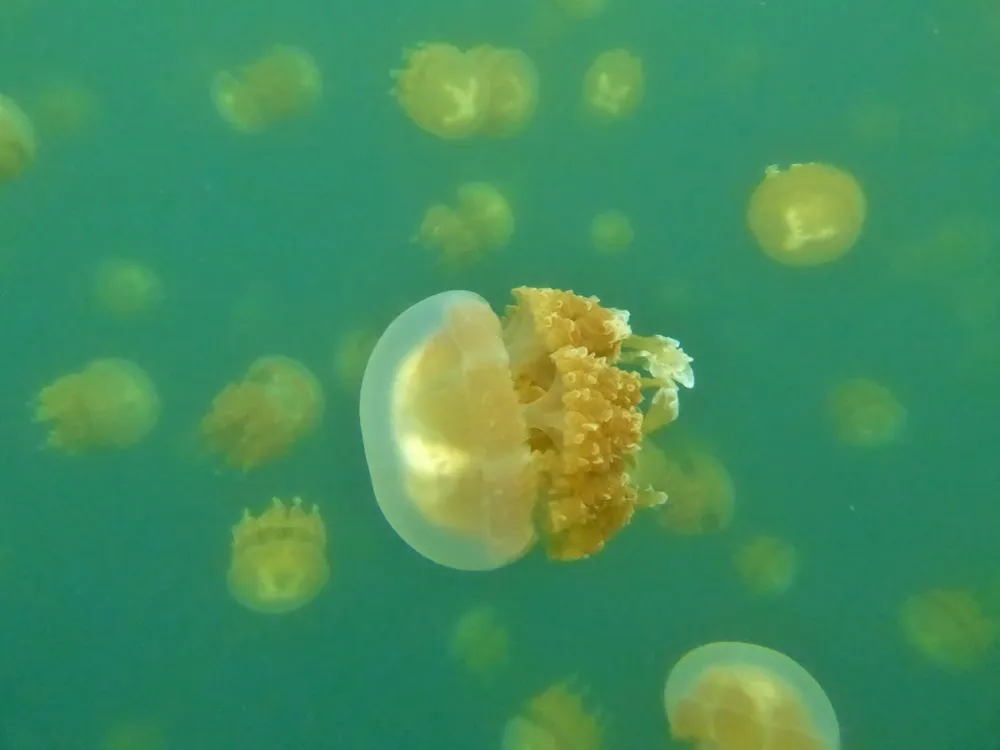
The spotted jelly is a jellyfish with spots on the top of its bell, the rounded body. It lives in the warm Indo-Pacific oceans, and in some saltwater lakes in Palau and Indonesia. Its lake populations are famous because they have lost most of their sting.1


 So erkennst du es
- Distinctive spots on the top of the bell1
- Colour ranges from greenish blue to olive green, from the algae living in its tissues1
- Eight rhopalia (sensory organs) along the edge of the bell1
- Eight frilled oral arms, each ending in a club-like appendage1
- Numerous small mouths along the bottom of the oral arms, unlike many other jellies1
Giftkraft
Tausende winzige Nesselzellen feuern, wenn etwas sie berührt.
Was macht sein Gift, wenn es beißt oder sticht?
The venom is protein-based and is delivered by stinging cells called nematocytes (cnidocytes) on the upper surfaces of the oral arms. In jellyfish living in marine lakes, conditions in the lake are thought to break down this venom, so those populations do not sting humans.1
Wie gefährlich ist es für Menschen?
Gefahr für Menschen: LeichtWie ein Bienenstich oder weniger. Für Menschen praktisch harmlos.Jellyfish in the open ocean have stinging cells on their oral arms. Populations in marine lakes, such as Jellyfish Lake in Palau, do not sting humans.1
 Wenn es sticht
- Raus aus dem Wasser und alle Tentakel abnehmen (mit Handschuhen oder einem Tuch).
- Bei tropischen Würfelquallen: Gieß mindestens 30 Sekunden lang Essig auf die Nesselstellen, ruf Hilfe und sei bereit für eine Herz-Lungen-Wiederbelebung. Bei Portugiesischen Galeeren und den meisten anderen: mit Meerwasser abspülen, dann heißes Wasser gegen die Schmerzen.
Ruf immer zuerst deine Notrufnummer an (112, 000, 911). Das sind allgemeine Erste-Hilfe-Hinweise, keine ärztliche Beratung. Erste-Hilfe-Grundlagen
 Bleib sicher
- Fass ein wildes Tier niemals an, fang es nicht und ärgere es nicht, auch kein kleines, und auch nicht, wenn es schlafend aussieht oder tot.
- Halte Abstand. Wenn du einem begegnest, bleib ruhig, geh langsam zurück und lass es seiner Wege gehen.
- Wenn dich eines sticht: Bleib ruhig, halt still, ruf deine Notrufnummer an (112, 000, 911) oder fahr schnell in ein Krankenhaus. Merk dir, wie es aussah, ein Foto hilft.
Es hat es nicht auf dich abgesehen. Es benutzt sein Gift, um Futter zu fangen oder sich zu schützen, und versteckt sich viel lieber. Mehr über Sicherheit
Wo auf der Welt?
Wie groß ist es?
Wie lang ist es?
 so lang wie 9 Bausteine in einer Reihe
Wie groß ist Spotted jelly im Vergleich zu DIR?
Nur Rechnen in deinem Browser. Nichts wird gespeichert oder irgendwohin geschickt.
Wie schnell ist es?


Fakten
Lake populations of spotted jellies have lost most of their ability to sting, probably after being cut off in marine lakes long ago.1
Each day, spotted jellies rise to the surface and follow the sun from east to west, so their algae can photosynthesise.1
Lake jellyfish are over three times wider than ocean ones, yet their tentacles are about the same length.1
Unlike many jellies, spotted jellies have several small mouths along their oral arms.1
A sea anemone called Entacmaea medusivora preys on spotted jellies, catching them in its tentacles.1
At night they stay lower in the water column.1
Mythen-Check
Mythos: All spotted jellies sting people.
Wahrheit: Ocean populations have stinging cells, but the jellyfish in marine lakes such as Jellyfish Lake in Palau do not sting humans.1
Woher die Fakten kommen
- Spotted jelly (Wikipedia (CC BY-SA 4.0))
- Mastigias papua (iNaturalist): Namen und Klassifikation.
- Venom Wiki: die Gefahrenstufe, die typische Größe und die geschätzte Geschwindigkeit sind von uns. So berechnen wir sie: So bewerten wir die Gefahr.
Jeder Fakt auf dieser Seite hat eine Nummer, die auf seine Quelle zeigt. Wenn wir etwas falsch haben: Entschuldigung, wir sind Tierfans, keine Fachzeitschrift. Schreib uns an [email protected] und wir korrigieren es.
 Der Skorpion hat Hunger! Venom Wiki ist ein Ein-Mann-Projekt: kostenlos, ohne Werbung und ohne Tracker. Ein kleines Trinkgeld hilft, es online zu halten.Füttere den Skorpion
Mehr aus derselben Gruppe: Quallen & Nesseltiere im Meer
 Australian box jellyfishQuallen & Nesseltiere im MeerTödlichNicht anfassen
 Irukandji jellyfishQuallen & Nesseltiere im MeerKann tötenNicht anfassen
 Portuguese man o' warQuallen & Nesseltiere im MeerBraucht einen ArztNicht anfassen
 Lion's mane jellyfishQuallen & Nesseltiere im MeerTut nur wehNicht anfassen
 Moon jellyfishQuallen & Nesseltiere im MeerHarmlos
 Common kingslayerQuallen & Nesseltiere im MeerKann tötenNicht anfassen
Lebt auch in: Pazifischer Ozean
 Geography coneKegelschnecken & KrakenTödlich
 Greater blue-ringed octopusKegelschnecken & KrakenTödlich
 Japanese pufferfishAndere passiv giftige TiereTödlich
 Southern blue-ringed octopusKegelschnecken & KrakenTödlich
 Hawksbill sea turtleAndere passiv giftige TiereKann töten
 Reef stonefishGiftfischeKann tötenNicht anfassen