
 Afrika
 Asien
Asien Europa
 Südamerika
 Australien & Ozeanien
 Antarktis
 Pazifischer Ozean
 Atlantischer Ozean
 Indischer Ozean
 Nordpolarmeer
 Mittelmeer
 Rotes Meer
 Karibisches Meer
 Korallenmeer
 Südchinesisches Meer
 Philippinensee
 Andamanensee
 Nordsee
 Timorsee & Arafurasee
 Golf von Bengalen
 Golf von Kalifornien
Texas coral snake
 Bisse
BisseThe Texas coral snake is a venomous snake with bright black, yellow and red rings. It lives in the southern and southwestern United States and in parts of northeastern and central Mexico. Its bite can cause paralysis, so it is important to recognise it and keep well away.1



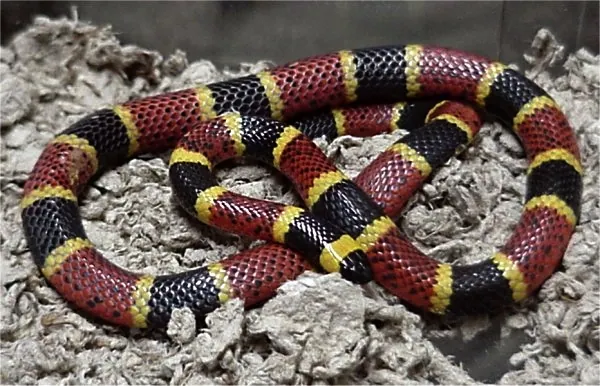
 So erkennst du es
- Black, yellow and red rings, with the rings running onto the belly.1
- Smooth scales, a rounded head and round pupils.1
- Somewhat larger and stouter than the eastern coral snake.1
- Males are typically smaller than females.1
- Shy and secretive, and mostly active at night.1
Oft verwechselt mit: Nonvenomous snakes copy the coral snake's colours as a form of Batesian mimicry. In the United States, the venomous coral snakes can be told apart by red rings touching yellow rings. The common rhyme "red and yellow, kill a fellow" is not always accurate because colours vary, and relying on it is dangerous.1
Giftkraft
Das Gift kommt beim Beißen durch die Giftzähne oder Zähne heraus.
Was macht sein Gift, wenn es beißt oder sticht?
The snake has a pair of fixed, grooved fangs at the front of the upper jaw, and venom is injected through them. Its venom contains a neurotoxin, which attacks the nerves, and a myotoxin, which damages muscle. Bite victims may experience paralysis or myolysis (muscle breakdown), which can be potentially lethal.1
Wie gefährlich ist es für Menschen?
Gefahr für Menschen: ErnstEin Biss gehört zum Arzt. Todesfälle sind sehr selten.Before antivenom was available, the fatality rate of coral snake bites was estimated at 10%. Deaths were mainly caused by breathing or heart failure from paralysis. A single bite can deliver 10–12 mg of dry venom, about twice the lethal dose for an adult human of 5–7 mg. Many bites deliver no venom at all, known as dry bites.1
 Gute Nachricht: Ärzte haben dafür ein Medikament (Gegengift) oder eine Behandlung.1
Was macht es, wenn es Angst hat?
When grabbed suddenly, or sometimes just when touched, it may thrash about, swing around and bite.1
 Wenn es beißt
- Remove any jewellery from a bitten limb, in case of severe swelling. Wrap the bite area moderately tightly in a wide cloth, and move the bitten limb as little as possible. Take the bite victim to the nearest hospital as soon as possible for advanced treatment, such as antivenom.1
- Halte die Person still und ruhig und bring sie schnell in ein Krankenhaus, auch wenn der Biss klein aussieht: Die Beschwerden können erst Stunden später beginnen.
Ruf immer zuerst deine Notrufnummer an (112, 000, 911). Das sind allgemeine Erste-Hilfe-Hinweise, keine ärztliche Beratung. Erste-Hilfe-Grundlagen
 Bleib sicher
- Fass ein wildes Tier niemals an, fang es nicht und ärgere es nicht, auch kein kleines, und auch nicht, wenn es schlafend aussieht oder tot.
- Halte Abstand. Wenn du einem begegnest, bleib ruhig, geh langsam zurück und lass es seiner Wege gehen.
- Wenn dich eines beißt: Bleib ruhig, halt still, ruf deine Notrufnummer an (112, 000, 911) oder fahr schnell in ein Krankenhaus. Merk dir, wie es aussah, ein Foto hilft.
Es hat es nicht auf dich abgesehen. Es benutzt sein Gift, um Futter zu fangen oder sich zu schützen, und versteckt sich viel lieber. Mehr über Sicherheit
Wo auf der Welt?
Wie groß ist es?
Wie lang ist es?
 so lang wie 2,5 Hauskatzen von Nase bis Schwanz
 so lang wie 7 Bananen hintereinander
 könnte 100 Meter in 73 Sekunden schaffen (der schnellste Mensch braucht 9,6)
Wie groß ist Texas coral snake im Vergleich zu DIR?
Nur Rechnen in deinem Browser. Nichts wird gespeichert oder irgendwohin geschickt.
Wie schnell ist es?


Fakten
A single bite can deliver about twice the lethal dose for an adult human, yet many bites inject no venom at all.1
The Texas coral snake eats other snakes, including venomous ones, and will even eat its own kind.1
Colour variants exist in the wild, including albino, anerythristic, pastel and completely black (melanistic) snakes.1
Mythen-Check
Mythos: "Red and yellow, kill a fellow. Red on black, friend of Jack" is a reliable way to tell a coral snake from a harmless look-alike.
Wahrheit: The rhyme is not always accurate because colour patterns vary, and relying on it is dangerous to both people and snakes.1
Woher die Fakten kommen
- Texas coral snake (Wikipedia (CC BY-SA 4.0))
- Micrurus tener (iNaturalist): Namen und Klassifikation.
- Venom Wiki: die Gefahrenstufe, die typische Größe und die geschätzte Geschwindigkeit sind von uns. So berechnen wir sie: So bewerten wir die Gefahr.
Jeder Fakt auf dieser Seite hat eine Nummer, die auf seine Quelle zeigt. Wenn wir etwas falsch haben: Entschuldigung, wir sind Tierfans, keine Fachzeitschrift. Schreib uns an [email protected] und wir korrigieren es.
 Der Skorpion hat Hunger! Venom Wiki ist ein Ein-Mann-Projekt: kostenlos, ohne Werbung und ohne Tracker. Ein kleines Trinkgeld hilft, es online zu halten.Füttere den Skorpion
 Eastern coral snake
 Central American coral snake
 Sonoran coral snake
 Allen's coral snake
 Brown's coral snake
 Dumeril's coral snake
 Terciopelo-Lanzenotter
 Eastern diamondback rattlesnake
 Eyelash viper
 Timber rattlesnake
 Western diamondback rattlesnake
 Arizona bark scorpion