
 Afrika
 Asien
Asien Europa
 Südamerika
 Australien & Ozeanien
 Antarktis
 Pazifischer Ozean
 Atlantischer Ozean
 Indischer Ozean
 Nordpolarmeer
 Mittelmeer
 Rotes Meer
 Karibisches Meer
 Korallenmeer
 Südchinesisches Meer
 Philippinensee
 Andamanensee
 Nordsee
 Timorsee & Arafurasee
 Golf von Bengalen
 Golf von Kalifornien
Toxic zoanthid
 Gift in der Haut
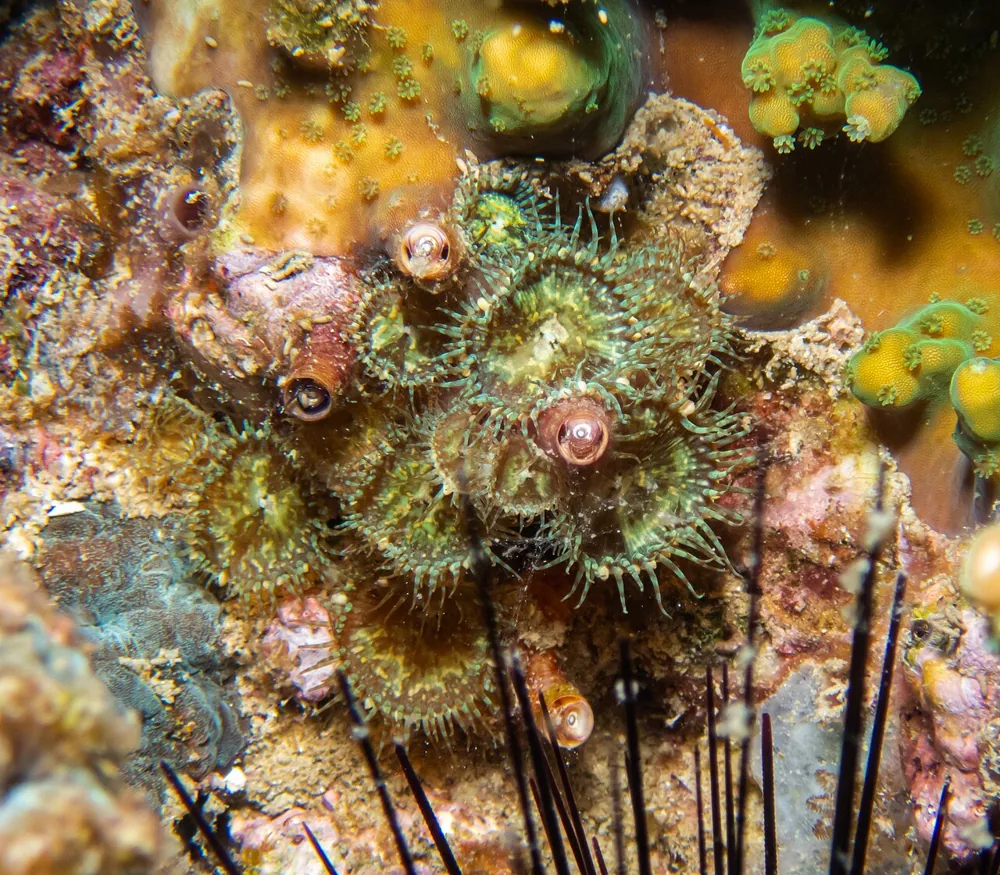
Palythoa toxica is a small, crust-like sea animal, called a zoanthid, that grows on rocks. It lives in Hawaii and is special because it is the species from which the very poisonous substance palytoxin was first discovered and isolated.1
 So erkennst du es
- It grows as a flat, encrusting layer over rock.1
- It has a firm, tough outer covering.1
- Its polyps are partly sunk into a cushiony mat that spreads across the rock and contains sand grains and bits of debris.1
- Each polyp has a broad mouth disc with a fringe of tentacles.1
- Its colour varies but is usually cream, grey or pale brown.1
Giftkraft
Seine Haut ist giftig. Es ist gefährlich, es anzufassen, abzulecken oder zu essen.
Was macht sein Gift, wenn man es anfasst oder isst?
It is not venomous in the sense of injecting venom with a bite or sting. It contains palytoxin, one of the most poisonous substances known.1
Wie gefährlich ist es für Menschen?
Gefahr für Menschen: Sehr gefährlichEs kann einen Menschen töten, der keine Behandlung bekommt.Palytoxin is one of the most poisonous substances known, and people have been poisoned by handling this animal in reef aquariums.1
 Wenn jemand es angefasst oder gegessen hat
- Wenn jemand es gegessen hat oder nach dem Essen Beschwerden hat: Ruf sofort deine Notrufnummer oder den Giftnotruf an.
Ruf immer zuerst deine Notrufnummer an (112, 000, 911). Das sind allgemeine Erste-Hilfe-Hinweise, keine ärztliche Beratung. Erste-Hilfe-Grundlagen
 Bleib sicher
- Fass ein wildes Tier niemals an, fang es nicht und ärgere es nicht, auch kein kleines, und auch nicht, wenn es schlafend aussieht oder tot.
- Halte Abstand. Wenn du einem begegnest, bleib ruhig, geh langsam zurück und lass es seiner Wege gehen.
- Wenn du es angefasst oder gegessen hast: Reib dir nicht die Augen oder den Mund, wasch dir die Hände und hol ärztliche Hilfe.
Es hat es nicht auf dich abgesehen. Sein Gift ist nur dazu da, dass es niemand frisst. Mehr über Sicherheit
Wo auf der Welt?
Wie groß ist es?
Wie lang ist es?
 kürzer als dein kleiner Finger
Wie groß ist Toxic zoanthid im Vergleich zu DIR?
Nur Rechnen in deinem Browser. Nichts wird gespeichert oder irgendwohin geschickt.
Wie schnell ist es?


Fakten
Early Hawaiians used this animal to poison the tips of their weapons, and a legend says warriors could break a taboo and dip their spear tips into its pool when under severe threat.1
In 1961 researchers took specimens from the pool despite local advice, and the laboratories of the Hawaiian Institute of Marine Biology on Coconut Island were destroyed by fire on that same day.1
Palythoa toxica is the species in which palytoxin was first discovered and first isolated.1
Unlike a related species, P. toxica is equally toxic all year round rather than changing with the seasons.1
Palytoxin has also been found in other Palythoa species, some algae, and certain crabs and fish, and it has been suggested that a dinoflagellate in the genus Ostreopsis produces the toxin.1
Woher die Fakten kommen
- Palythoa toxica (Wikipedia (CC BY-SA 4.0))
- Palythoa toxica (iNaturalist): Namen und Klassifikation.
- Venom Wiki: die Gefahrenstufe, die typische Größe und die geschätzte Geschwindigkeit sind von uns. So berechnen wir sie: So bewerten wir die Gefahr.
Jeder Fakt auf dieser Seite hat eine Nummer, die auf seine Quelle zeigt. Wenn wir etwas falsch haben: Entschuldigung, wir sind Tierfans, keine Fachzeitschrift. Schreib uns an [email protected] und wir korrigieren es.
 Der Skorpion hat Hunger! Venom Wiki ist ein Ein-Mann-Projekt: kostenlos, ohne Werbung und ohne Tracker. Ein kleines Trinkgeld hilft, es online zu halten.Füttere den Skorpion
Mehr aus derselben Gruppe: Andere passiv giftige Tiere
 Japanese pufferfishAndere passiv giftige TiereTödlich
 Hawksbill sea turtleAndere passiv giftige TiereKann töten
 Greenland sharkAndere passiv giftige TiereTut nur weh
 Silver-cheeked toadfishAndere passiv giftige TiereTödlich
 Blackspotted pufferAndere passiv giftige TiereKann töten
 White-spotted pufferAndere passiv giftige TiereKann töten
Lebt auch in: Pazifischer Ozean
 Australian box jellyfishQuallen & Nesseltiere im MeerTödlichNicht anfassen
 Geography coneKegelschnecken & KrakenTödlich
 Greater blue-ringed octopusKegelschnecken & KrakenTödlich
 Southern blue-ringed octopusKegelschnecken & KrakenTödlich
 Irukandji jellyfishQuallen & Nesseltiere im MeerKann tötenNicht anfassen
 Reef stonefishGiftfischeKann tötenNicht anfassen