
 África
 Asia
Asia Europa
 Sudamérica
 Australia y Oceanía
 Antártida
 Océano Pacífico
 Océano Atlántico
 Océano Índico
 Océano Ártico
 Mar Mediterráneo
 Mar Rojo
 Mar Caribe
 Mar del Coral
 Mar de China Meridional
 Mar de Filipinas
 Mar de Andamán
 Mar del Norte
 Mar de Timor y de Arafura
 Golfo de Bengala
 Golfo de California
Green and black poison dart frog
 Veneno en la piel
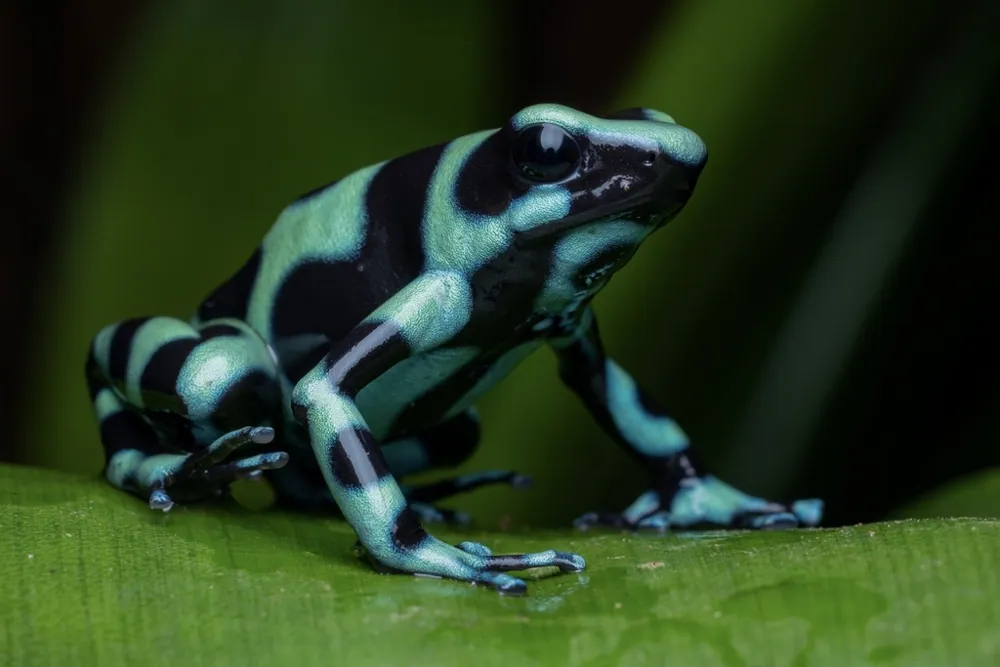
The green-and-black poison dart frog is a small, brightly coloured frog from the forests of southern Central America and north-western Colombia. It is poisonous, not venomous: it gets its toxins from the tiny insects it eats. It is also one of the most variable poison frogs in colour and pattern.1

 Cómo reconocerlo
- Usually a mint-green background with a spotted or banded pattern1
- Dark or dull splotches, most often blackish, that can look like large spots, blotches or a splashed pattern1
- Colour varies a lot: some are darker green, lime, emerald, turquoise, blue, whitish or pale yellow, and some have no green or no black1
- Some variants are entirely black, or dark with only a few small green spots or streaks1
- Small adults: males about 1.9 cm, females about 2.5 cm or longer1
Poder tóxico
Su piel es venenosa. Es peligroso tocarlo, lamerlo o comerlo.
¿Qué hace su toxina?
Its skin holds alkaloid poisons, which are not venom injected by a bite. These poisons interfere with the ion channels and nicotinic acetylcholine receptors that nerves and muscles rely on. In extreme cases, this can cause numbness, loss of muscle control, convulsions, cardiac arrest and death.1
¿Qué peligro tiene para las personas?
Peligro para las personas: DolorosoPuede doler de verdad, pero casi nunca es grave.Its poisons can cause serious effects, including death, in cases of extreme poisoning.1
 Si alguien lo tocó o se lo comió
- Si alguien tocó uno: lávale bien las manos y que no se toque los ojos ni la boca. Si un niño o una mascota lo lamió o se lo comió: llama al centro de toxicología o a emergencias.
Llama siempre primero a tu número de emergencias (112, 000, 911). Esto son pautas generales de primeros auxilios, no consejo médico. Primeros auxilios básicos
 Mantente a salvo
- Nunca toques, atrapes ni molestes a un animal salvaje, aunque sea pequeño y aunque parezca dormido o muerto.
- Déjale espacio. Si te encuentras uno, mantén la calma, retrocede despacio y deja que siga su camino.
- Si lo tocaste o te lo comiste: no te frotes los ojos ni la boca, lávate las manos y busca ayuda médica.
No va a por ti. Su veneno solo está ahí para que nadie se lo coma. Más sobre cómo protegerte
¿En qué parte del mundo?
¿Qué tamaño tiene?
¿Cuánto mide?
 más o menos lo que mide un clip
 podría recorrer 100 metros en 97 segundos (el humano más rápido necesita 9,6)
¿Qué tamaño tiene Green and black poison dart frog comparado contigo?
Solo cálculos en tu navegador. No se guarda ni se envía nada a ningún sitio.
¿Qué velocidad alcanza?


Datos
Hundreds of different alkaloid poisons have been identified in this frog.1
Parents carry tadpoles into the treetops and place them in bromeliad pools, where the tadpoles sometimes eat each other because food is scarce.1
Unlike other poison frogs, it gathers in large groups before mating, and males fight over small patches of ground.1
It was intentionally introduced to Oahu, Hawaii, in 1932 to help control mosquitoes.1
Its toe pads have small sucker-like discs that give it a mildly sticky grip when climbing.1
Cazamitos
Mito: Poison dart frogs are poisonous in every case, because of their own nature.
Verdad: They are not poisonous by nature. They become poisonous from the alkaloids in their diet of ants and mites. Captive frogs fed on crickets and fruit flies are non-toxic.1
Para expertos en veneno
- Nombre científico
- Dendrobates auratus
- Grupo
- Ranas venenosas, sapos y tritones
- Familia
- Dendrobatidae2
- Orden
- Anura
- Continentes
- Norteamérica, Sudamérica
- Crías
- The female lays eggs at a site chosen by the male, and he fertilises them. The eggs hatch into tadpoles in about 14 days, and the parent, typically the male, carries them up into the canopy.1
- Cómo le va en la naturaleza
- Least Concern (IUCN)1
- Peligro para las personas
- 2 / 5: Doloroso3
De dónde salen los datos
- Green and black poison dart frog (Wikipedia (CC BY-SA 4.0))
- Dendrobates auratus (iNaturalist): nombres y clasificación.
- Venom Wiki: el nivel de peligro, el tamaño típico y la velocidad estimada son nuestros. Mira cómo los calculamos: Cómo valoramos el peligro.
Cada dato de esta página tiene un número que lleva a su fuente. Si nos hemos equivocado en algo, perdón, somos fans de los animales, no una revista científica. Escríbenos a [email protected] y lo arreglamos.
 ¡El escorpión tiene hambre! Venom Wiki es un proyecto de una sola persona: gratis, sin anuncios y sin rastreadores. Una pequeña propina ayuda a mantenerlo en línea.Alimenta al escorpión
Más del mismo grupo: Ranas venenosas, sapos y tritones
 Rana dardo doradaRanas venenosas, sapos y tritonesMortalNo tocar
 Cane toadRanas venenosas, sapos y tritonesNecesita médicoNo tocar
 Dyeing poison dart frogRanas venenosas, sapos y tritonesSolo dueleNo tocar
 Strawberry poison-dart frogRanas venenosas, sapos y tritonesSolo dueleNo tocar
 Black-legged poison frogRanas venenosas, sapos y tritonesPuede matarNo tocar
 California newtRanas venenosas, sapos y tritonesPuede matarNo tocar
 Terciopelo
 Eastern coral snake
 Eastern diamondback rattlesnake
 Eyelash viper
 Timber rattlesnake
 Western diamondback rattlesnake