
 África
 Asia
Asia Europa
 Sudamérica
 Australia y Oceanía
 Antártida
 Océano Pacífico
 Océano Atlántico
 Océano Índico
 Océano Ártico
 Mar Mediterráneo
 Mar Rojo
 Mar Caribe
 Mar del Coral
 Mar de China Meridional
 Mar de Filipinas
 Mar de Andamán
 Mar del Norte
 Mar de Timor y de Arafura
 Golfo de Bengala
 Golfo de California
Habu
 Mordeduras
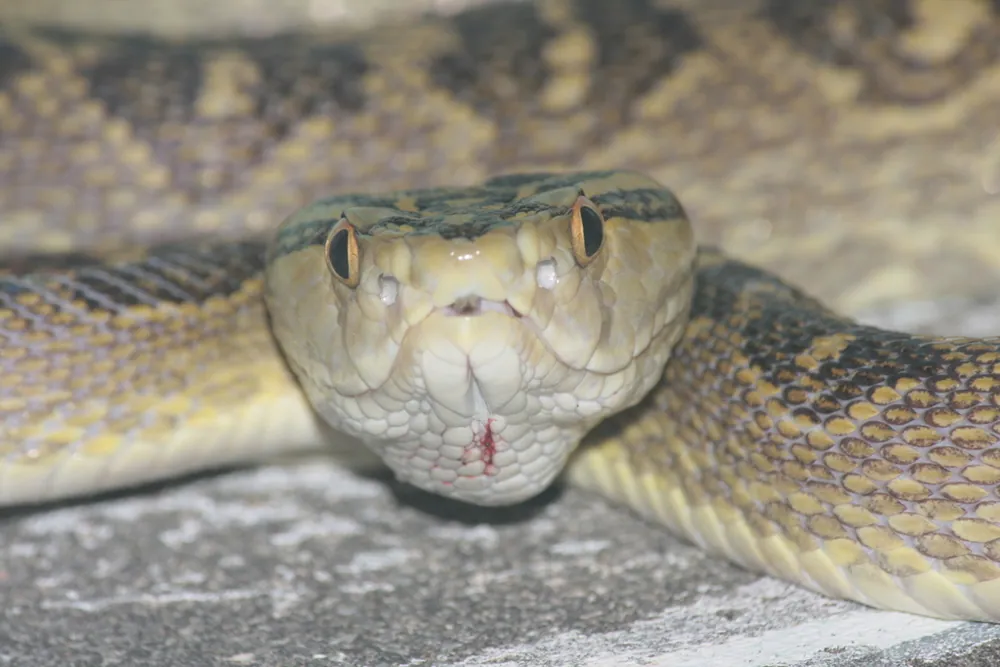
The habu is a venomous pit viper that lives on the Ryukyu Islands of Japan, including Okinawa and the Amami Islands. It is the largest member of its genus, Protobothrops. Its bite is serious, so it is important to know what it looks like.1

 Cómo reconocerlo
- Typically 120 to 150 cm long, including the tail, and slender with a large head1
- Light olive or brown body with elongated dark green or brownish blotches1
- Blotches have yellow edges, sometimes yellow spots, and often join to form wavy stripes1
- Whitish belly with dark edges1
- Crown of the head covered with small scales1
Se confunde a menudo con: In Okinawa Prefecture, the name habu can also refer to the Sakishima habu (Protobothrops elegans), also called the elegant pit viper. This is a different species.1
Poder del veneno
El veneno sale por sus colmillos o dientes cuando muerde.
¿Qué hace su veneno?
The venom is highly toxic and contains cytotoxin, which damages body cells, and hemorrhagin, which damages blood vessels and causes bleeding. A bite can cause nausea, vomiting and low blood pressure, and it can possibly cause death. Some victims have lost movement in their hands and legs, even after treatment.1
¿Qué peligro tiene para las personas?
Peligro para las personas: Muy peligrosoPuede matar a una persona que no recibe tratamiento.The Amami Islands have about two snakebites per 1,000 people, which is considered very high. The fatality rate is less than 1%. Bites are not life-threatening if the victim receives medical care promptly, but 6 to 8% of victims suffer permanent disability.1
¿Qué hace cuando se asusta?
The habu is bold and irritable, and it can strike quickly from a long reach.1
 Si muerde
- Get medical care promptly. With prompt medical care, bites are not life-threatening.1
- Mantén a la persona quieta y tranquila, la extremidad mordida a la altura del corazón, quítale anillos y cosas apretadas y llévala rápido a un hospital.
Llama siempre primero a tu número de emergencias (112, 000, 911). Esto son pautas generales de primeros auxilios, no consejo médico. Primeros auxilios básicos
 Mantente a salvo
- Nunca toques, atrapes ni molestes a un animal salvaje, aunque sea pequeño y aunque parezca dormido o muerto.
- Déjale espacio. Si te encuentras uno, mantén la calma, retrocede despacio y deja que siga su camino.
- Si te muerde: mantén la calma, no te muevas, llama a tu número de emergencias (112, 000, 911) o ve rápido a un hospital. Recuerda cómo era, una foto ayuda.
No va a por ti. Usa su veneno para cazar o defenderse, y prefiere mil veces esconderse. Más sobre cómo protegerte
¿En qué parte del mundo?
¿Qué tamaño tiene?
¿Cuánto mide?
 mide como 5 gatos domésticos de la nariz a la cola
 mide como 13 plátanos puestos en fila
 podría recorrer 100 metros en 86 segundos (el humano más rápido necesita 9,6)
¿Qué tamaño tiene Habu comparado contigo?
Solo cálculos en tu navegador. No se guarda ni se envía nada a ningún sitio.
¿Qué velocidad alcanza?


Datos
On Okinawa, habus are heavily collected to make habushu, a liquor made from awamori sake, which is said to have medicinal properties.1
Unlike most pit vipers, the habu lays eggs rather than giving birth to live young.1
Hatchlings are about 25 cm long and look the same as the adults.1
The small Indian mongoose was introduced to Okinawa in 1910 to reduce the habu population. The effects of this have not been studied, but similar introductions have harmed native wildlife.1
The habu is the largest member of its genus, Protobothrops.1
Para expertos en veneno
- Nombre científico
- Protobothrops flavoviridis
- Grupo
- Víboras de foseta
- Familia
- Viperidae2
- Orden
- Squamata
- Continentes
- Asia
- Crías
- Unlike most pit vipers, the habu lays eggs. Up to 18 eggs are laid in mid-summer, and the hatchlings are about 25 cm long and look like adults.1
- Peligro para las personas
- 4 / 5: Muy peligroso3
De dónde salen los datos
- Protobothrops flavoviridis (Wikipedia (CC BY-SA 4.0))
- Protobothrops flavoviridis (iNaturalist): nombres y clasificación.
- Venom Wiki: el nivel de peligro, el tamaño típico y la velocidad estimada son nuestros. Mira cómo los calculamos: Cómo valoramos el peligro.
Cada dato de esta página tiene un número que lleva a su fuente. Si nos hemos equivocado en algo, perdón, somos fans de los animales, no una revista científica. Escríbenos a [email protected] y lo arreglamos.
 ¡El escorpión tiene hambre! Venom Wiki es un proyecto de una sola persona: gratis, sin anuncios y sin rastreadores. Una pequeña propina ayuda a mantenerlo en línea.Alimenta al escorpión
 Brown spotted pit viper
 Hump-nosed viper
 Hundred-pace viper
 Malayan pit viper
 Mamushi
 Mangshan pit viper
 Deathstalker
 Indian cobra
 Indian saw-scaled viper
 King cobra
 Víbora bufadora
 Víbora de Russell