
 África
 Asia
Asia Europa
 Sudamérica
 Australia y Oceanía
 Antártida
 Océano Pacífico
 Océano Atlántico
 Océano Índico
 Océano Ártico
 Mar Mediterráneo
 Mar Rojo
 Mar Caribe
 Mar del Coral
 Mar de China Meridional
 Mar de Filipinas
 Mar de Andamán
 Mar del Norte
 Mar de Timor y de Arafura
 Golfo de Bengala
 Golfo de California
King brown snake
 Mordeduras
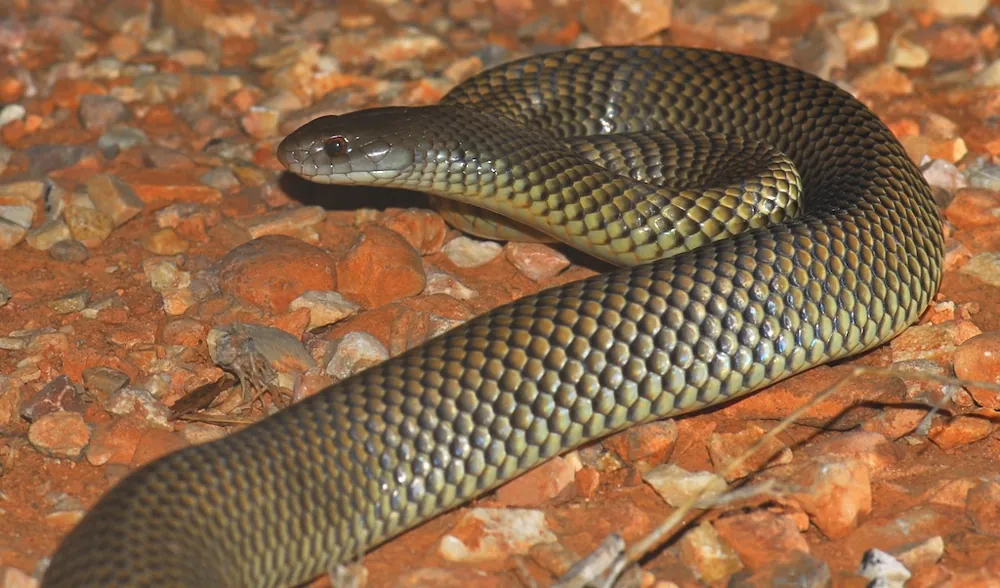
The king brown snake is a highly venomous snake and the largest land-dwelling venomous snake in Australia. It lives across northern, western and Central Australia. Its size and venom make it one of the most important snakes to recognise in the region.1



 Cómo reconocerlo
- A large, robust snake that can reach 2.0 to 2.5 m, with a maximum confirmed length of 3.3 m.1
- Colour varies by area: tan in the north, and darker brown to blackish in the south.1
- Scales are two-toned, giving the upper body a reticulated (net-like) pattern.1
- The belly is cream, white or salmon, and often has orange marks.1
- The head is slightly wider than the body, with small eyes that have red-brown irises and a dark tongue.1
Se confunde a menudo con: King brown snakes can be confused with brown snakes of the genus Pseudonaja, olive pythons, water pythons, spotted mulga snakes and coastal taipans. In eastern brown snakes, the temporolabial scale and last supralabial scale (scales above the mouth) are fused. In king brown snakes, they are separate.1
Poder del veneno
El veneno sale por sus colmillos o dientes cuando muerde.
¿Qué hace su veneno?
The venom is not as potent as that of Australia's other dangerous snakes, but it can cause severe effects if delivered in large enough amounts. Its main effect is on striated (skeletal) muscle, which can cause paralysis through muscle damage. It also commonly affects blood clotting (coagulopathy).1
¿Qué peligro tiene para las personas?
Peligro para las personas: Muy peligrosoPuede matar a una persona que no recibe tratamiento.Deaths from its bites have been recorded, with the most recent in 1969. Extensive pain and swelling often occur at the bite site, and necrosis (death of tissue) occurs rarely.1
 Buena noticia: los médicos tienen un medicamento (antídoto) o un tratamiento para esto.1
 Si muerde
- Victims are treated with black snake (not brown snake) antivenom.1
- Inmovilización con presión: envuelve con una venda elástica firme la mordedura y luego toda la extremidad, ponle una férula y mantén a la persona totalmente quieta hasta que llegue la ayuda.
- No laves la mordedura: en el hospital pueden analizar el veneno que queda en la piel para elegir el antídoto correcto.
Llama siempre primero a tu número de emergencias (112, 000, 911). Esto son pautas generales de primeros auxilios, no consejo médico. Primeros auxilios básicos
 Mantente a salvo
- Nunca toques, atrapes ni molestes a un animal salvaje, aunque sea pequeño y aunque parezca dormido o muerto.
- Déjale espacio. Si te encuentras uno, mantén la calma, retrocede despacio y deja que siga su camino.
- Si te muerde: mantén la calma, no te muevas, llama a tu número de emergencias (112, 000, 911) o ve rápido a un hospital. Recuerda cómo era, una foto ayuda.
No va a por ti. Usa su veneno para cazar o defenderse, y prefiere mil veces esconderse. Más sobre cómo protegerte
¿En qué parte del mundo?
¿Qué tamaño tiene?
¿Cuánto mide?
¿Cuánto pesa?
 mide como 3 perros de la nariz a la cola
 mide como 18 plátanos puestos en fila
 más o menos lo que pesa un gato doméstico
 podría recorrer 100 metros en 41 segundos (el humano más rápido necesita 9,6)
¿Qué tamaño tiene King brown snake comparado contigo?
Solo cálculos en tu navegador. No se guarda ni se envía nada a ningún sitio.
¿Qué velocidad alcanza?


Datos
Its name causes a real problem: its venom is not neutralised by brown snake antivenom, so the name has been criticised by medical researchers.1
It is the largest terrestrial venomous snake in Australia.1
In the Kaytetye language of Central Australia, it is called atetherr-ayne-wene, meaning "budgerigar-eater".1
Despite its common name, it belongs to the black snake genus Pseudechis and is only distantly related to true brown snakes.1
Males are around 20% larger than females.1
It has been reported to live up to 25 years in captivity.1
Cazamitos
Mito: Because it is called a brown snake, brown snake antivenom will treat its bite.
Verdad: Its venom is not neutralised by brown snake antivenom. Victims are treated with black snake antivenom.1
Para expertos en veneno
- Nombre científico
- Pseudechis australis
- Grupo
- Serpientes australianas
- Familia
- Elapidae2
- Orden
- Squamata
- Continentes
- Australia y Oceanía
- Crías
- King brown snakes lay eggs. A female produces a clutch of four to 19 eggs, usually around 10, which take 70 to 100 days to hatch.1
- Esperanza de vida
- unos 25 años1
- Cómo le va en la naturaleza
- Least concern (IUCN), though its numbers may have declined with the spread of the cane toad.1
- Peligro para las personas
- 4 / 5: Muy peligroso3
De dónde salen los datos
- King brown snake (Wikipedia (CC BY-SA 4.0))
- Pseudechis australis (iNaturalist): nombres y clasificación.
- Venom Wiki: el nivel de peligro, el tamaño típico y la velocidad estimada son nuestros. Mira cómo los calculamos: Cómo valoramos el peligro.
Cada dato de esta página tiene un número que lleva a su fuente. Si nos hemos equivocado en algo, perdón, somos fans de los animales, no una revista científica. Escríbenos a [email protected] y lo arreglamos.
 ¡El escorpión tiene hambre! Venom Wiki es un proyecto de una sola persona: gratis, sin anuncios y sin rastreadores. Una pequeña propina ayuda a mantenerlo en línea.Alimenta al escorpión
Más del mismo grupo: Serpientes australianas
 Coastal taipan
 Common death adder
 Eastern brown snake
 Taipán del interior
 Serpiente tigre
 Collett's snake
También vive en: Australia y Oceanía
 Sydney funnel-web spiderTarántulas y arañas de tela en embudoMortal
 Redback spiderArañasNecesita médico
 Brown tree snakeSerpientes de colmillos traserosSolo duele
 Hooded pitohuiOtros animales tóxicosSolo dueleNo tocar
 PlatypusMamíferos venenososSolo duele
 Northern tree-dwelling funnel-web spiderTarántulas y arañas de tela en embudoMortal