
 África
 Asia
Asia Europa
 Sudamérica
 Australia y Oceanía
 Antártida
 Océano Pacífico
 Océano Atlántico
 Océano Índico
 Océano Ártico
 Mar Mediterráneo
 Mar Rojo
 Mar Caribe
 Mar del Coral
 Mar de China Meridional
 Mar de Filipinas
 Mar de Andamán
 Mar del Norte
 Mar de Timor y de Arafura
 Golfo de Bengala
 Golfo de California
Northern tree-dwelling funnel-web spider
 Mordeduras
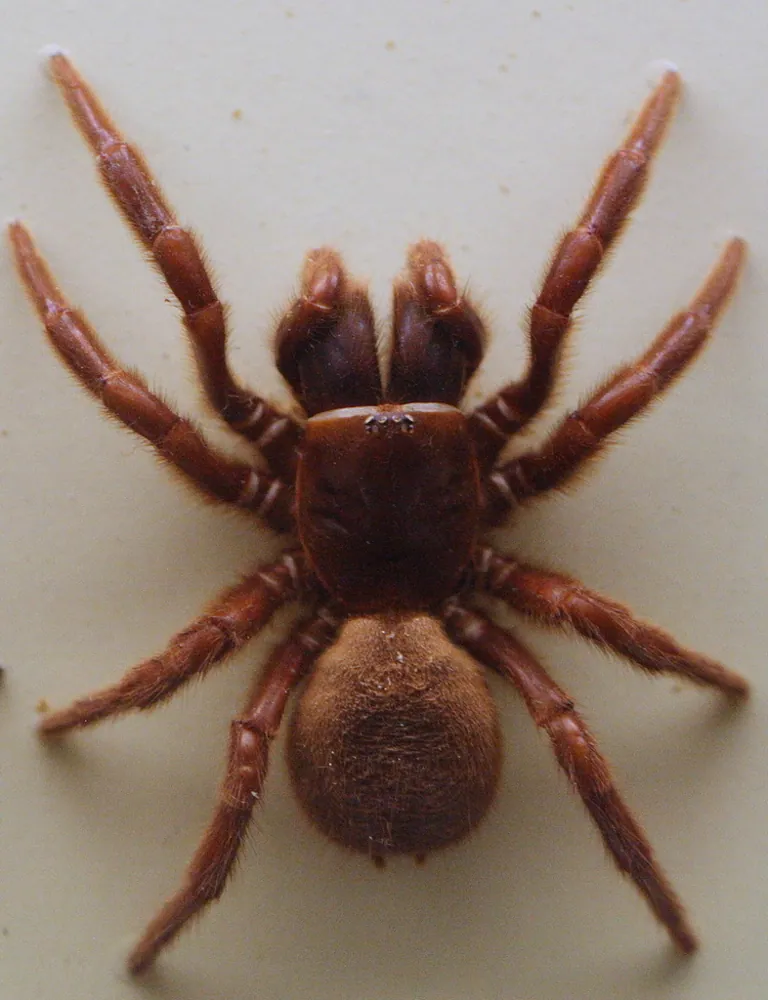
The northern tree-dwelling funnel-web spider is a large spider from eastern Australia. It lives mostly in trees, from South East Queensland to the Hunter River in New South Wales. Its venom can be deadly to people, so it is important to know what it looks like.1

 Cómo reconocerlo
- Has a glossy black carapace (the hard upper shell of the body).1
- Chelicerae (fang-bearing parts), legs and abdomen are matte black or dark brown.1
- The top of the abdomen may have a plum or purplish tinge.1
- Body length is 40-50 mm, the largest of the funnel-web subfamily Atracinae.1
- Cannot jump.1
Se confunde a menudo con: The ground-dwelling Darling Downs funnel-web spider (Hadronyche infensa) is very similar. Male northern tree-dwelling funnel-web spiders have a knobby spur on the tibia (a leg segment) of the second pair of legs, which male Darling Downs funnel-web spiders lack. Trapdoor spiders are browner overall.1
Poder del veneno
El veneno sale por sus colmillos o dientes cuando muerde.
¿Qué hace su veneno?
The venom is potentially deadly to humans and is regarded as the most toxic of the venoms in the family Atracidae. Symptoms can start within 15 to 20 minutes. Common symptoms include sweating, high blood pressure, a fast heart rate, muscle spasms, nausea, vomiting, changes in consciousness and pain at the bite site. Fluid in the lungs (pulmonary oedema) is frequent and comes on early.1
¿Qué peligro tiene para las personas?
Peligro para las personas: MortalUno de los animales más peligrosos del mundo.The venom is potentially deadly. Of eight recorded bites, five caused severe symptoms of envenomation. Because the spider is larger than the Sydney funnel-web, it may inject more venom, which could make it possibly the deadliest venomous spider in the world per volume of venom.1
 Buena noticia: los médicos tienen un medicamento (antídoto) o un tratamiento para esto.1
¿Qué hace cuando se asusta?
When threatened, it rears up, displays its fangs, and drops of venom appear on the fang tips.1
 Si muerde
- Pressure bandages and immobilising the patient can significantly delay the onset of symptoms. This remains a critical part of managing a bite from an Australian funnel-web spider.1
- Lava la mordedura y enfríala. Busca ayuda médica si el dolor es fuerte o la persona se encuentra mal.
- En Australia, trata cualquier mordedura de araña negra grande como una de araña de tela en embudo: Inmovilización con presión: envuelve con una venda elástica firme la mordedura y luego toda la extremidad, ponle una férula y mantén a la persona totalmente quieta hasta que llegue la ayuda.
Llama siempre primero a tu número de emergencias (112, 000, 911). Esto son pautas generales de primeros auxilios, no consejo médico. Primeros auxilios básicos
 Mantente a salvo
- Nunca toques, atrapes ni molestes a un animal salvaje, aunque sea pequeño y aunque parezca dormido o muerto.
- Déjale espacio. Si te encuentras uno, mantén la calma, retrocede despacio y deja que siga su camino.
- Si te muerde: mantén la calma, no te muevas, llama a tu número de emergencias (112, 000, 911) o ve rápido a un hospital. Recuerda cómo era, una foto ayuda.
No va a por ti. Usa su veneno para cazar o defenderse, y prefiere mil veces esconderse. Más sobre cómo protegerte
¿En qué parte del mundo?
¿Qué tamaño tiene?
¿Cuánto mide?
 más corto que tu dedo meñique
 podría recorrer 100 metros en 260 segundos (el humano más rápido necesita 9,6)
¿Qué tamaño tiene Northern tree-dwelling funnel-web spider comparado contigo?
Solo cálculos en tu navegador. No se guarda ni se envía nada a ningún sitio.
¿Qué velocidad alcanza?


Datos
It may be possibly the deadliest venomous spider in the world per volume of venom, because it is larger than the Sydney funnel-web and may inject more venom.1
It is the largest member of the funnel-web subfamily Atracinae, with a body length of 40-50 mm.1
It has been recorded living in trees 30 m above the ground.1
It is one of only two Australian funnel-web species that live mostly in trees. The other is the southern tree-dwelling funnel-web.1
It cannot jump.1
De dónde salen los datos
- Hadronyche formidabilis (Wikipedia (CC BY-SA 4.0))
- Hadronyche formidabilis (iNaturalist): nombres y clasificación.
- Venom Wiki: el nivel de peligro, el tamaño típico y la velocidad estimada son nuestros. Mira cómo los calculamos: Cómo valoramos el peligro.
Cada dato de esta página tiene un número que lleva a su fuente. Si nos hemos equivocado en algo, perdón, somos fans de los animales, no una revista científica. Escríbenos a [email protected] y lo arreglamos.
 ¡El escorpión tiene hambre! Venom Wiki es un proyecto de una sola persona: gratis, sin anuncios y sin rastreadores. Una pequeña propina ayuda a mantenerlo en línea.Alimenta al escorpión
Más del mismo grupo: Tarántulas y arañas de tela en embudo
 Araña de tela en embudo de SídneyTarántulas y arañas de tela en embudoMortal
 Red-headed mouse spiderTarántulas y arañas de tela en embudoNecesita médico
 Queensland whistling tarantulaTarántulas y arañas de tela en embudoSolo duele
 Blue Mountains funnel-web spiderTarántulas y arañas de tela en embudoPuede matar
 Darling Downs funnel-web spiderTarántulas y arañas de tela en embudoPuede matar
 Illawarra funnel-web spiderTarántulas y arañas de tela en embudoPuede matar
 Taipán costero
 Víbora de la muerte común
 Serpiente marrón oriental
 Taipán del interior
 Serpiente tigre
 Redback spider