
 África
 Asia
Asia Europa
 Sudamérica
 Australia y Oceanía
 Antártida
 Océano Pacífico
 Océano Atlántico
 Océano Índico
 Océano Ártico
 Mar Mediterráneo
 Mar Rojo
 Mar Caribe
 Mar del Coral
 Mar de China Meridional
 Mar de Filipinas
 Mar de Andamán
 Mar del Norte
 Mar de Timor y de Arafura
 Golfo de Bengala
 Golfo de California
Mottled cup moth
 Pelos urticantes
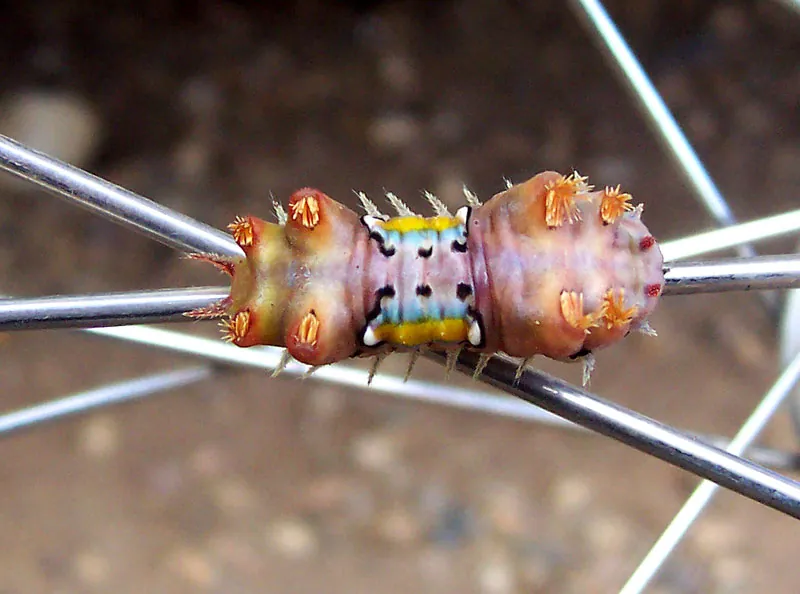
The mottled cup moth is a small Australian moth. Its caterpillar is the part to know about, because it has yellow stinging spines that release painful toxins when touched. The caterpillar's bright bands warn that it is dangerous.1

 Cómo reconocerlo
- The adult moth has a rust-coloured body and a white area around its antennae.1
- Its two pairs of legs have white bands on the front pair.1
- The forewings are shiny rust-coloured with silvery edges, and the hindwings are dull white.1
- The caterpillar is only about 2 cm long, grey with many dark spots and streaks.1
- Each side of the caterpillar has a clear yellow band lined with green, and it has spiny projections at both ends.1
Poder del veneno
Pelitos o cerdas diminutas se rompen dentro de la piel y pican.
¿Qué hace su veneno?
The caterpillar's yellow needle-like spines contain a mixture of at least 151 toxins, which are proteins or protein-like substances. The spines cause pain and can induce severely inflamed swellings. The toxins are released when the spine tips break on contact.1
¿Qué peligro tiene para las personas?
Peligro para las personas: DolorosoPuede doler de verdad, pero casi nunca es grave.Contact with the spines causes painful, severely inflamed swellings.1
¿Qué hace cuando se asusta?
The caterpillar raises up to eight projections, each with about a hundred stinging spines, but only when it is disturbed or agitated. Its banded colours warn predators that it is dangerous.1
 Si tocas sus pelos
- Para los pelos urticantes de orugas: quítalos con cinta adhesiva y luego lava la piel. No frotes.
- Para mordeduras: lava y enfría. Busca ayuda médica si la persona se encuentra mal o sangra con facilidad.
Llama siempre primero a tu número de emergencias (112, 000, 911). Esto son pautas generales de primeros auxilios, no consejo médico. Primeros auxilios básicos
 Mantente a salvo
- Nunca toques, atrapes ni molestes a un animal salvaje, aunque sea pequeño y aunque parezca dormido o muerto.
- Déjale espacio. Si te encuentras uno, mantén la calma, retrocede despacio y deja que siga su camino.
- Si tocas sus pelos: mantén la calma, no te muevas, llama a tu número de emergencias (112, 000, 911) o ve rápido a un hospital. Recuerda cómo era, una foto ayuda.
No va a por ti. Usa su veneno para cazar o defenderse, y prefiere mil veces esconderse. Más sobre cómo protegerte
¿En qué parte del mundo?
¿Qué tamaño tiene?
¿Cuánto mide?
 más corto que tu dedo meñique
 más lento que un caracol de jardín
¿Qué tamaño tiene Mottled cup moth comparado contigo?
Solo cálculos en tu navegador. No se guarda ni se envía nada a ningún sitio.
¿Qué velocidad alcanza?

Datos
Researchers at the University of Queensland reported in 2021 that the caterpillar's venom contains at least 151 different toxins.1
The toxin cecropin causes the pain and also breaks down the cell membranes of bacteria and worms.1
A protein called DV33 can kill Haemonchus contortus, a roundworm that affects sheep.1
Some of the toxins have medicinal properties, such as the ability to kill harmful bacteria and parasitic worms.1
Some of the nervous-system proteins in the venom may have beneficial effects, such as in epilepsy.1
De dónde salen los datos
- Doratifera vulnerans (Wikipedia (CC BY-SA 4.0))
- Doratifera vulnerans (iNaturalist): nombres y clasificación.
- Venom Wiki: el nivel de peligro, el tamaño típico y la velocidad estimada son nuestros. Mira cómo los calculamos: Cómo valoramos el peligro.
Cada dato de esta página tiene un número que lleva a su fuente. Si nos hemos equivocado en algo, perdón, somos fans de los animales, no una revista científica. Escríbenos a [email protected] y lo arreglamos.
 ¡El escorpión tiene hambre! Venom Wiki es un proyecto de una sola persona: gratis, sin anuncios y sin rastreadores. Una pequeña propina ayuda a mantenerlo en línea.Alimenta al escorpión
Más del mismo grupo: Orugas y bichos
 Bag-shelter mothOrugas y bichosSolo dueleNo tocar
 Common Australian assassin bugOrugas y bichosInofensivo
 Giant silkworm moth caterpillarOrugas y bichosPuede matarNo tocar
 Vinchuca kissing bugOrugas y bichosNecesita médico
 Giant water bugOrugas y bichosSolo duele
 Oak processionaryOrugas y bichosSolo dueleNo tocar
 Coastal taipan
 Common death adder
 Eastern brown snake
 Taipán del interior
 Sydney funnel-web spider
 Serpiente tigre