
 África
 Asia
Asia Europa
 Sudamérica
 Australia y Oceanía
 Antártida
 Océano Pacífico
 Océano Atlántico
 Océano Índico
 Océano Ártico
 Mar Mediterráneo
 Mar Rojo
 Mar Caribe
 Mar del Coral
 Mar de China Meridional
 Mar de Filipinas
 Mar de Andamán
 Mar del Norte
 Mar de Timor y de Arafura
 Golfo de Bengala
 Golfo de California
Pygmy copperhead
 Mordeduras
The pygmy copperhead is a small, venomous snake found only in South Australia, mainly on Kangaroo Island and in the Fleurieu Peninsula and Mount Lofty Ranges. It is the smallest of the Australian copperheads. Its venom is dangerous, so prompt medical treatment matters.1


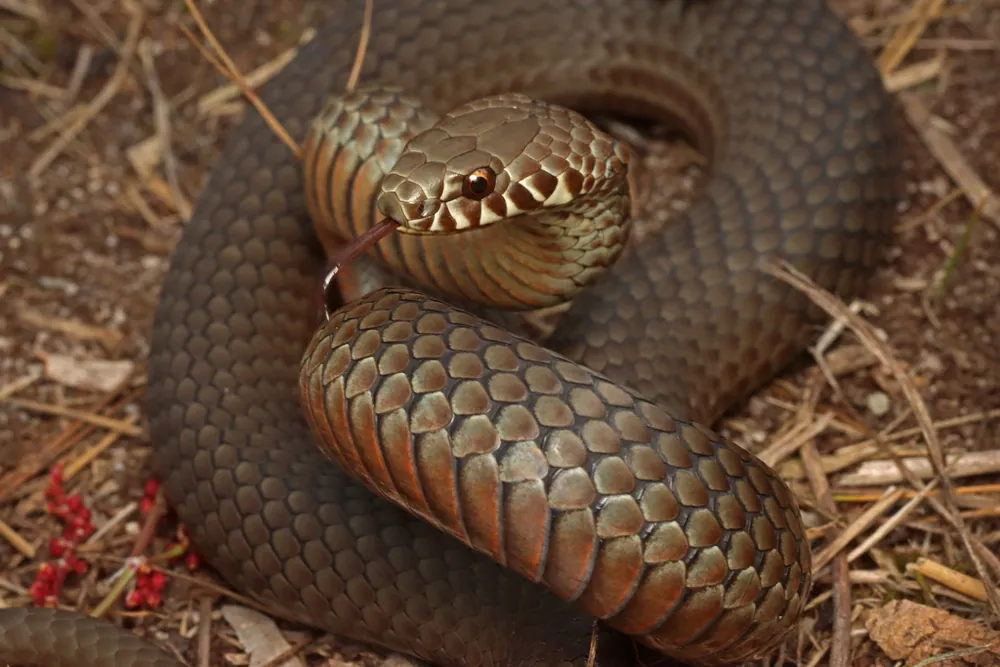
 Cómo reconocerlo
- Dorsal scales are brown to grey, with a darker stripe along the spine.1
- The belly is cream to light grey, with red along the edges that fades to a brown-grey underside.1
- The lip scales are barred with dark colour.1
- Adults average about 80 cm long, with males usually larger than females.1
- Newborns often have paler backsides than adults.1
Se confunde a menudo con: The highland and lowland copperheads are larger, and the pygmy copperhead is the smallest of the Australian copperheads. It is not closely related to the American copperhead, Agkistrodon contortrix.1
Poder del veneno
El veneno sale por sus colmillos o dientes cuando muerde.
¿Qué hace su veneno?
The venom is strongly neurotoxic, which means it attacks the nerves, and its toxicity is similar to that of the Indian cobra. It is weakly coagulant and strongly anticoagulant, meaning it can both disrupt blood clotting and destroy blood and muscle. Without prompt treatment, a bite can cause possibly irreversible damage to nerve endings.1
¿Qué peligro tiene para las personas?
Peligro para las personas: GraveUna mordedura necesita médico. Las muertes son muy raras.Bites are considered possibly lethal. The snake is not known for being aggressive and is unlikely to attack unless it is stepped on or purposely provoked.1
 Buena noticia: los médicos tienen un medicamento (antídoto) o un tratamiento para esto.1
¿Qué hace cuando se asusta?
It is generally unobtrusive and usually hides under leaf litter, old iron and haystacks.1
 Si muerde
- Prompt antivenom treatment is essential, because bites are considered lethal without it. Antivenom developed from tiger snake venom cannot completely neutralise the neurotoxicity of pygmy copperhead venom.1
- Inmovilización con presión: envuelve con una venda elástica firme la mordedura y luego toda la extremidad, ponle una férula y mantén a la persona totalmente quieta hasta que llegue la ayuda.
- No laves la mordedura: en el hospital pueden analizar el veneno que queda en la piel para elegir el antídoto correcto.
Llama siempre primero a tu número de emergencias (112, 000, 911). Esto son pautas generales de primeros auxilios, no consejo médico. Primeros auxilios básicos
 Mantente a salvo
- Nunca toques, atrapes ni molestes a un animal salvaje, aunque sea pequeño y aunque parezca dormido o muerto.
- Déjale espacio. Si te encuentras uno, mantén la calma, retrocede despacio y deja que siga su camino.
- Si te muerde: mantén la calma, no te muevas, llama a tu número de emergencias (112, 000, 911) o ve rápido a un hospital. Recuerda cómo era, una foto ayuda.
No va a por ti. Usa su veneno para cazar o defenderse, y prefiere mil veces esconderse. Más sobre cómo protegerte
¿En qué parte del mundo?
¿Qué tamaño tiene?
¿Cuánto mide?
 mide como 2,5 gatos domésticos de la nariz a la cola
 mide como 7 plátanos puestos en fila
 podría recorrer 100 metros en 56 segundos (el humano más rápido necesita 9,6)
¿Qué tamaño tiene Pygmy copperhead comparado contigo?
Solo cálculos en tu navegador. No se guarda ni se envía nada a ningún sitio.
¿Qué velocidad alcanza?


Datos
Sightings on islands near Tasmania are probably the result of snakes stowing away on boats.1
It is the only snake endemic to South Australia.1
It is the smallest of the Australian copperhead snakes.1
Its litter size is about half that of the other Australian copperheads, which is linked to its smaller body size.1
In field research, only about two thirds of surveyed adult females were reproductive, which suggests females do not breed every year.1
Cazamitos
Mito: Because it is small and not aggressive, the pygmy copperhead is harmless.
Verdad: Its venom is strongly neurotoxic, and its bite is considered possibly lethal without prompt antivenom treatment.1
De dónde salen los datos
- Pygmy copperhead (Wikipedia (CC BY-SA 4.0))
- Austrelaps labialis (iNaturalist): nombres y clasificación.
- Venom Wiki: el nivel de peligro, el tamaño típico y la velocidad estimada son nuestros. Mira cómo los calculamos: Cómo valoramos el peligro.
Cada dato de esta página tiene un número que lleva a su fuente. Si nos hemos equivocado en algo, perdón, somos fans de los animales, no una revista científica. Escríbenos a [email protected] y lo arreglamos.
 ¡El escorpión tiene hambre! Venom Wiki es un proyecto de una sola persona: gratis, sin anuncios y sin rastreadores. Una pequeña propina ayuda a mantenerlo en línea.Alimenta al escorpión
Más del mismo grupo: Serpientes australianas
 Coastal taipan
 Common death adder
 Eastern brown snake
 Taipán del interior
 Serpiente tigre
 Collett's snake
También vive en: Australia y Oceanía
 Sydney funnel-web spiderTarántulas y arañas de tela en embudoMortal
 Redback spiderArañasNecesita médico
 Brown tree snakeSerpientes de colmillos traserosSolo duele
 Hooded pitohuiOtros animales tóxicosSolo dueleNo tocar
 PlatypusMamíferos venenososSolo duele
 Northern tree-dwelling funnel-web spiderTarántulas y arañas de tela en embudoMortal