
 África
 Asia
Asia Europa
 Sudamérica
 Australia y Oceanía
 Antártida
 Océano Pacífico
 Océano Atlántico
 Océano Índico
 Océano Ártico
 Mar Mediterráneo
 Mar Rojo
 Mar Caribe
 Mar del Coral
 Mar de China Meridional
 Mar de Filipinas
 Mar de Andamán
 Mar del Norte
 Mar de Timor y de Arafura
 Golfo de Bengala
 Golfo de California
Spotted ratfish
 Púas venenosas
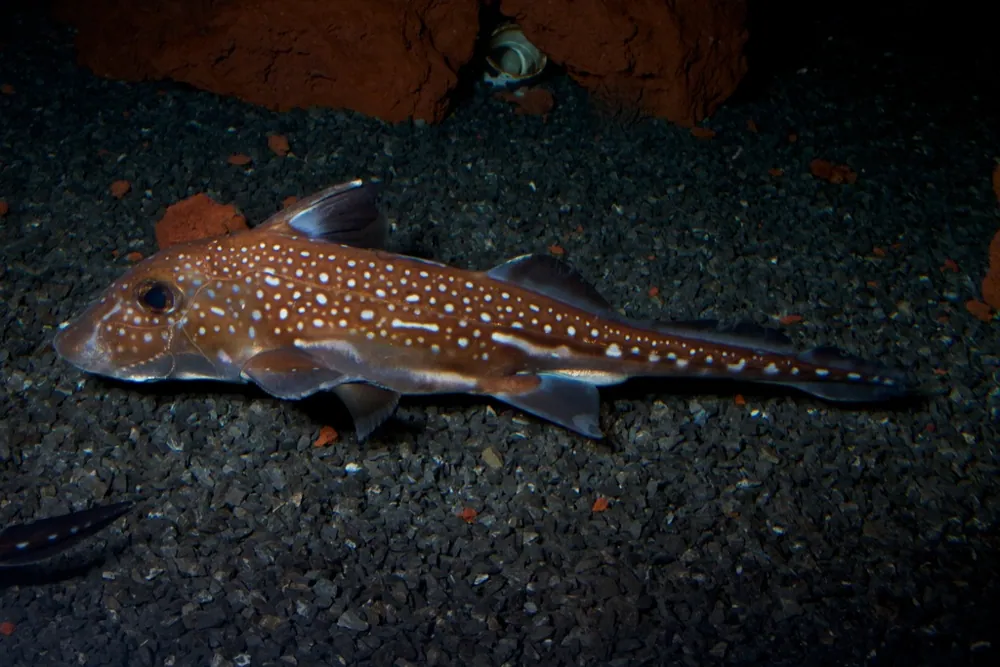
The spotted ratfish is a chimaera, a cartilage fish related to sharks and rays. It lives in the northeastern Pacific Ocean, and divers often see it at night in the Pacific Northwest. It gets its name from its pointed, rat-like tail.1



 Cómo reconocerlo
- Smooth, scaleless skin that is silvery-bronze, often with gold, blue and green shine1
- Speckled white spots along the back1
- Large, triangular pectoral fins that stick straight out from the sides, like airplane wings1
- A pointed, rat-like tail that makes up almost half of its total length1
- Large emerald green eyes and a duckbill-shaped snout1
Poder del veneno
Unas púas afiladas llevan el veneno. Pisarlo o agarrarlo duele.
¿Qué hace su veneno?
The spine on the leading edge of its dorsal fin is grooved and connected to a venom gland at its base. The venom is mildly toxic. A sting from the spine causes a painful wound.1
¿Qué peligro tiene para las personas?
Peligro para las personas: DolorosoPuede doler de verdad, pero casi nunca es grave.It does not present a serious danger to humans, but its spines can cause painful wounds. Harbor seals have been known to die after swallowing spotted ratfish, when a spine pierced the stomach or esophagus.1
¿Qué hace cuando se asusta?
It usually keeps a safe distance from divers and is not aggressive, but it will defend its territory with the spine on its dorsal fin if it feels invaded.1
 Si sus púas se te clavan
- Mete la herida en agua caliente, tan caliente como la persona aguante sin quemarse (pruébala con tu propia mano), de 30 a 90 minutos. Busca ayuda médica, sobre todo con peces piedra y rayas.
Llama siempre primero a tu número de emergencias (112, 000, 911). Esto son pautas generales de primeros auxilios, no consejo médico. Primeros auxilios básicos
 Mantente a salvo
- Nunca toques, atrapes ni molestes a un animal salvaje, aunque sea pequeño y aunque parezca dormido o muerto.
- Déjale espacio. Si te encuentras uno, mantén la calma, retrocede despacio y deja que siga su camino.
- Si sus púas se te clavan: mantén la calma, no te muevas, llama a tu número de emergencias (112, 000, 911) o ve rápido a un hospital. Recuerda cómo era, una foto ayuda.
No va a por ti. Usa su veneno para cazar o defenderse, y prefiere mil veces esconderse. Más sobre cómo protegerte
¿En qué parte del mundo?
¿Qué tamaño tiene?
¿Cuánto mide?
 mide como 2 gatos domésticos de la nariz a la cola
 mide como 5 plátanos puestos en fila
 podría nadar el largo de una piscina grande (50 m) en 12 segundos
¿Qué tamaño tiene Spotted ratfish comparado contigo?
Solo cálculos en tu navegador. No se guarda ni se envía nada a ningún sitio.
¿Qué velocidad alcanza?

Datos
Adult males have a club-like cephalic clasper on the head, an organ not found in any other vertebrate, which they use to hold on to females during courtship.1
Its large eyes reflect light, much like the eyes of a cat.1
It swims with its large pectoral fins, and its barrel rolls and corkscrew turns have been described as aquatic flight.1
Its teeth are plate-shaped, mineralised and permanent, unlike the easily replaced teeth of sharks, and they help it grind prey.1
Its ampullary organs on the head detect electric fields, and they are homologous to the ampullae of Lorenzini found in sharks and rays.1
Its meat is not typically eaten by humans and it is not commercially caught.1
Para expertos en veneno
- Nombre científico
- Hydrolagus colliei
- Grupo
- Peces venenosos
- Familia
- Chimaeridae2
- Orden
- Chimaeriformes
- Continentes
- Océano Pacífico, Golfo de California, Los océanos
- Crías
- Like some sharks, it lays eggs; the female releases up to two fertilised eggs every 10–14 days in spring to autumn, and development can take up to a year.1
- Peligro para las personas
- 2 / 5: Doloroso3
De dónde salen los datos
- Spotted ratfish (Wikipedia (CC BY-SA 4.0))
- Hydrolagus colliei (iNaturalist): nombres y clasificación.
- Venom Wiki: el nivel de peligro, el tamaño típico y la velocidad estimada son nuestros. Mira cómo los calculamos: Cómo valoramos el peligro.
Cada dato de esta página tiene un número que lleva a su fuente. Si nos hemos equivocado en algo, perdón, somos fans de los animales, no una revista científica. Escríbenos a [email protected] y lo arreglamos.
 ¡El escorpión tiene hambre! Venom Wiki es un proyecto de una sola persona: gratis, sin anuncios y sin rastreadores. Una pequeña propina ayuda a mantenerlo en línea.Alimenta al escorpión
Más del mismo grupo: Peces venenosos
 Reef stonefishPeces venenososPuede matarNo tocar
 Red lionfishPeces venenososNecesita médicoNo tocar
 Estuarine stonefishPeces venenososPuede matarNo tocar
 Short-tail stingrayPeces venenososPuede matar
 Striped eel catfishPeces venenososPuede matarNo tocar
 Bluespotted ribbontail rayPeces venenososNecesita médico
También vive en: Océano Pacífico
 Australian box jellyfishMedusas y picadores marinosMortalNo tocar
 Geography coneCaracoles cono y pulposMortal
 Greater blue-ringed octopusCaracoles cono y pulposMortal
 Japanese pufferfishOtros animales tóxicosMortal
 Southern blue-ringed octopusCaracoles cono y pulposMortal
 Hawksbill sea turtleOtros animales tóxicosPuede matar