
 África
 Asia
Asia Europa
 Sudamérica
 Australia y Oceanía
 Antártida
 Océano Pacífico
 Océano Atlántico
 Océano Índico
 Océano Ártico
 Mar Mediterráneo
 Mar Rojo
 Mar Caribe
 Mar del Coral
 Mar de China Meridional
 Mar de Filipinas
 Mar de Andamán
 Mar del Norte
 Mar de Timor y de Arafura
 Golfo de Bengala
 Golfo de California
Trinidad chevron tarantula
 Mordeduras
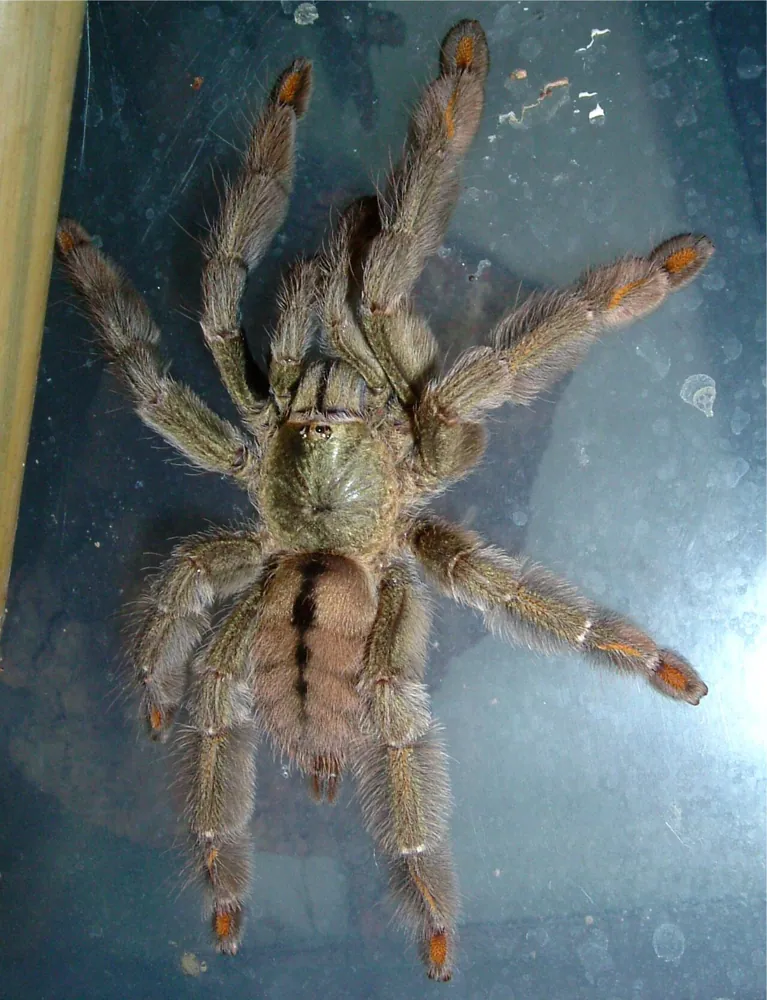
The Trinidad chevron tarantula is a large hairy spider that lives only on the island of Trinidad. It spends much of its life in tree bark and crevices, and it is also a popular pet in many countries because it is easy to breed in captivity.1

 Cómo reconocerlo
- Females have dark, chevron-shaped (V-shaped) markings on the abdomen.1
- Females are green, tan or brown, with orange markings on the legs.1
- Males are a more uniform grey or brown, with long legs in proportion to their body.1
- Males keep orange markings on the latter part of their legs.1
- Spiderlings are mostly dark, with pale orange bands on the legs that look like leg warmers. These bands fade as the spider grows.1
Se confunde a menudo con: The female's orange leg markings are similar to those of P. irminia, another species in the same genus.1
Poder del veneno
El veneno sale por sus colmillos o dientes cuando muerde.
¿Qué hace su veneno?
The venom has been studied for possible medical uses, including pain relief and the management of glioma, breast cancer and stroke. It is also of interest for managing cartilage damage in rheumatoid arthritis. The main active compound studied is psalmotoxin.1
¿Qué peligro tiene para las personas?
Peligro para las personas: DolorosoPuede doler de verdad, pero casi nunca es grave. Si muerde
- Lava la mordedura y enfríala. Busca ayuda médica si el dolor es fuerte o la persona se encuentra mal.
Llama siempre primero a tu número de emergencias (112, 000, 911). Esto son pautas generales de primeros auxilios, no consejo médico. Primeros auxilios básicos
 Mantente a salvo
- Nunca toques, atrapes ni molestes a un animal salvaje, aunque sea pequeño y aunque parezca dormido o muerto.
- Déjale espacio. Si te encuentras uno, mantén la calma, retrocede despacio y deja que siga su camino.
- Si te muerde: mantén la calma, no te muevas, llama a tu número de emergencias (112, 000, 911) o ve rápido a un hospital. Recuerda cómo era, una foto ayuda.
No va a por ti. Usa su veneno para cazar o defenderse, y prefiere mil veces esconderse. Más sobre cómo protegerte
¿En qué parte del mundo?
¿Qué tamaño tiene?
¿Cuánto mide?
 mide como 5 piezas de construcción de juguete en fila
 podría recorrer 100 metros en 200 segundos (el humano más rápido necesita 9,6)
¿Qué tamaño tiene Trinidad chevron tarantula comparado contigo?
Solo cálculos en tu navegador. No se guarda ni se envía nada a ningún sitio.
¿Qué velocidad alcanza?


Datos
The venom is being studied for possible uses in medicine, including pain relief and treatments for some cancers and stroke.1
Spiderlings have pale orange bands on their legs that look like leg warmers. These fade as they grow.1
Males have a much shorter lifespan than females. Their life ends soon after they mature and reproduce.1
P. cambridgei has stridulatory setae (called lyra) on its maxillae. This trait was once seen only in Asian and African species.1
De dónde salen los datos
- Psalmopoeus cambridgei (Wikipedia (CC BY-SA 4.0))
- Psalmopoeus cambridgei (iNaturalist): nombres y clasificación.
- Venom Wiki: el nivel de peligro, el tamaño típico y la velocidad estimada son nuestros. Mira cómo los calculamos: Cómo valoramos el peligro.
Cada dato de esta página tiene un número que lleva a su fuente. Si nos hemos equivocado en algo, perdón, somos fans de los animales, no una revista científica. Escríbenos a [email protected] y lo arreglamos.
 ¡El escorpión tiene hambre! Venom Wiki es un proyecto de una sola persona: gratis, sin anuncios y sin rastreadores. Una pequeña propina ayuda a mantenerlo en línea.Alimenta al escorpión
Más del mismo grupo: Tarántulas y arañas de tela en embudo
 Mexican redknee tarantulaTarántulas y arañas de tela en embudoInofensivo
 Arizona blond tarantulaTarántulas y arañas de tela en embudoInofensivo
 Ravine trapdoor spiderTarántulas y arañas de tela en embudoInofensivo
 Antilles pinktoe tarantulaTarántulas y arañas de tela en embudoInofensivo
 California trapdoor spiderTarántulas y arañas de tela en embudoInofensivo
 Costa Rican zebra tarantulaTarántulas y arañas de tela en embudoInofensivo
 Terciopelo
 Eastern coral snake
 Eastern diamondback rattlesnake
 Eyelash viper
 Timber rattlesnake
 Western diamondback rattlesnake