
 Afrika
 Asia
Asia Europa
 Hego Amerika
 Australia eta Ozeania
 Antartika
 Ozeano Barea
 Ozeano Atlantikoa
 Ozeano Indikoa
 Ozeano Artikoa
 Mediterraneo itsasoa
 Itsaso Gorria
 Karibe itsasoa
 Koralen itsasoa
 Hego Txinako itsasoa
 Filipinetako itsasoa
 Andaman itsasoa
 Ipar itsasoa
 Timor eta Arafura itsasoak
 Bengalako golkoa
 Kaliforniako golkoa
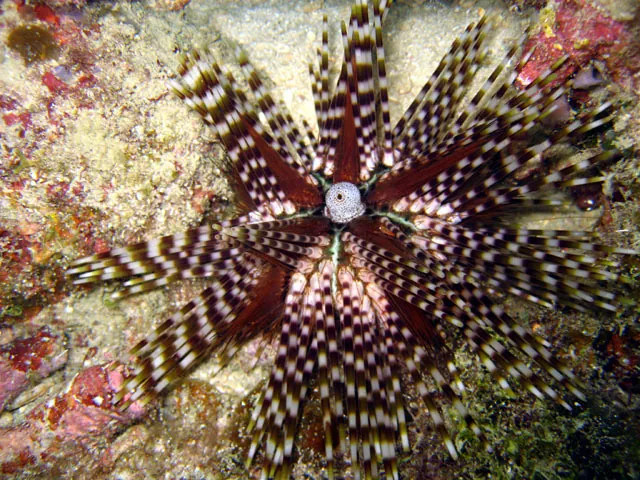
Banded sea urchin
 Arantza pozoitsuak
The banded sea urchin is a spiny sea animal that lives on tropical reefs and in lagoons across the Indo-Pacific. It is active at night and hides in cracks or under rocks during the day. Its thin spines can deliver a sting, although the sting is not dangerous.1
 Nola ezagutu
- It has a slightly oval shell (test) about 5 cm across.1
- It has two kinds of spines: short, slender spines that run from yellow to dark, and longer, thicker spines that are often banded with light and dark colour.1
- The longer spines reach 10 to 15 cm and can be blunt and hollow.1
- Five bare zones in a star pattern show on the middle of the shell, and these can look blue.1
Askotan honekin nahasten da: Dark forms can look like Diadema setosum or Diadema savignyi. Diadema savignyi is bigger, more uniformly black, and has five white spots on top of its shell and an orange ring around its anus. The most common mix-up is Echinothrix diadema, which can have banded spines when young. Echinothrix diadema has a very small, all-black anal papilla and blue-sheened spines, and its spines do not crush easily, unlike the spines of the banded sea urchin.1
Pozoi-ahalmena
Arantza zorrotzek daramate pozoia. Zapaltzeak edo heltzeak min ematen du.
Zer egiten du bere pozoiak?
The thinner, short spines are venomous, meaning they deliver venom through a sting. The sting is nasty, but the venom is not dangerous.1
Zein arriskutsua da pertsonentzat?
Arriskua pertsonentzat: MingarriaBenetan min handia eman dezake, baina ia inoiz ez da larria.The thinner spines are venomous but not dangerous.1
 Bere arantzek zulatzen bazaituzte
- Sartu zauria ur beroan, pertsonak erre gabe jasan dezakeen bezain beroan, eta lortu mediku-laguntza arantzak kentzeko. Ez saiatu zuk zeuk ateratzen.
Deitu beti lehenik zure larrialdi-zenbakira (112, 000, 911). Lehen sorospenei buruzko orientabide orokorra da hau, ez mediku-aholkua. Lehen sorospenen oinarriak
 Egon seguru
- Ez ukitu, ez harrapatu eta ez zirikatu inoiz animalia basati bat, txikia izan arren, eta lo edo hilda dagoela badirudi ere.
- Utzi tartea. Bat aurkitzen baduzu, egon lasai, egin atzera poliki eta utzi bere bidetik joaten.
- Bere arantzek zulatzen bazaituzte: egon lasai, egon geldi, deitu zure larrialdi-zenbakira (112, 000, 911) edo joan ospitalera azkar. Gogoratu nolakoa zen, argazki batek laguntzen du.
Ez dabil zure atzetik. Pozoia janaria harrapatzeko edo bere burua babesteko erabiltzen du, eta askoz nahiago du ezkutatu. Seguru egoteari buruz gehiago
Munduko zein tokitan?
Zein handia da?
Zein luzea da?
 5 eraikuntza-bloke ilaran jarrita bezain luzea
 lorategiko barraskilo bat baino motelagoa
Zein handia da Banded sea urchin ZUREKIN alderatuta?
Matematika hutsa zure nabigatzailean. Ez da ezer gordetzen, ezta inora bidaltzen ere.
Zein azkarra da?

Datuak
Its anal papilla is large and whitish with black and white dots, and a ring of visual receptors around it gives it basic vision.1
Young cardinal fish from the family Apogonidae often hide among the spines for protection.1
In Hawaii, this sea urchin often carries a symbiotic crab, Echinoecus pentagonus, that lives with it.1
It is active at night and spends the day hidden in crevices or under rocks.1
Pozoi-adituentzat
Datuak nondik datozen
- Echinothrix calamaris (Wikipedia (CC BY-SA 4.0))
- Echinothrix calamaris (iNaturalist): izenak eta sailkapena.
- Venom Wiki: arrisku-maila, ohiko tamaina eta abiadura-kalkulua geureak dira. Ikusi nola kalkulatzen ditugun: Nola baloratzen dugun arriskua.
Orrialde honetako datu bakoitzak zenbaki bat du, bere iturrira eramaten zaituena. Zerbait gaizki badugu, barkatu, animalien zaleak gara, ez zientzia-aldizkari bat. Esaiguzu [email protected] helbidean eta konponduko dugu.
 Eskorpioia gose da! Venom Wiki pertsona bakar baten proiektua da: doakoa, iragarkirik eta jarraitzailerik gabe. Eskupeko txiki batek sarean mantentzen laguntzen du.Elikatu eskorpioia
Talde bereko gehiago: Trikuak, izarrak eta harrak
 Crown-of-thorns starfishTrikuak, izarrak eta harrakMedikua behar duEz ukitu
 Flower urchinTrikuak, izarrak eta harrakHil dezake
 Fire urchinTrikuak, izarrak eta harrakMedikua behar duEz ukitu
 Bearded firewormTrikuak, izarrak eta harrakMin ematen du, besterik ezEz ukitu
 Black long-spined urchinTrikuak, izarrak eta harrakMin ematen du, besterik ezEz ukitu
 BloodwormTrikuak, izarrak eta harrakMin ematen du, besterik ez
Hemen ere bizi da: Ozeano Indikoa
 Australian box jellyfishMarmokak eta itsasoko izaki ziztatzaileakHilgarriaEz ukitu
 Geography coneKono-barraskiloak eta olagarroakHilgarria
 Greater blue-ringed octopusKono-barraskiloak eta olagarroakHilgarria
 Southern blue-ringed octopusKono-barraskiloak eta olagarroakHilgarria
 Hawksbill sea turtleBeste animalia toxiko batzukHil dezake
 Irukandji jellyfishMarmokak eta itsasoko izaki ziztatzaileakHil dezakeEz ukitu