
 Afrika
 Asia
Asia Europa
 Hego Amerika
 Australia eta Ozeania
 Antartika
 Ozeano Barea
 Ozeano Atlantikoa
 Ozeano Indikoa
 Ozeano Artikoa
 Mediterraneo itsasoa
 Itsaso Gorria
 Karibe itsasoa
 Koralen itsasoa
 Hego Txinako itsasoa
 Filipinetako itsasoa
 Andaman itsasoa
 Ipar itsasoa
 Timor eta Arafura itsasoak
 Bengalako golkoa
 Kaliforniako golkoa
Blue blubber jellyfish
 Tentakulu ziztatzaileak
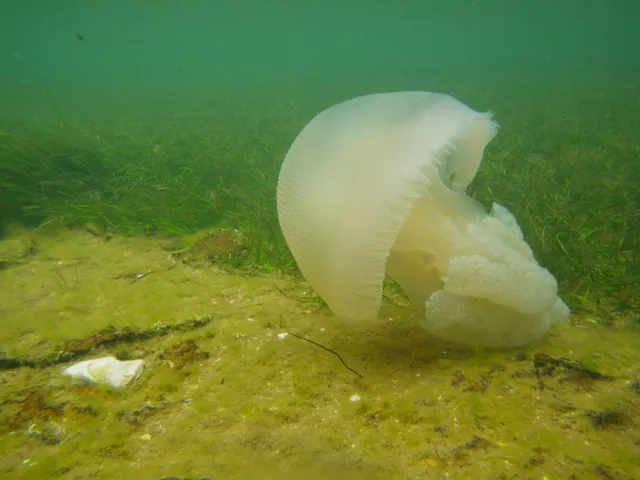
The blue blubber jellyfish is a large, rounded jellyfish that lives along the coast of Eastern Australia. It is blue to purple and pulses slowly as it swims. Its arms carry stings, and it can form huge blooms in estuaries and shallow bays.1


 Nola ezagutu
- Colour ranges from light blue to dark blue or purple.1
- Large, rounded bell, about 25 to 30 cm across.1
- The bell pulses in a rapid, staccato rhythm.1
- Found along the Eastern Australian coast, often in large numbers.1
Askotan honekin nahasten da: Two forms are recognised on the Eastern Australian coast. Catostylus mosaicus mosaicus, found in New South Wales and southern Queensland, has small or no papillae (small projections) and a larger bell. Catostylus mosaicus conservitus, found in the Bass Strait, has clear papillae, is blue or white, and has a smaller bell.1
Pozoi-ahalmena
Milaka zelula ziztatzaile txikik tiro egiten dute zerbaitek ukitzen dituenean.
Zer egiten du bere pozoiak?
Its arms carry stinging cells and can produce a mild but irritating sting. The sting is described as mild, and no further effects on the body are described.1
Zein arriskutsua da pertsonentzat?
Arriskua pertsonentzat: MingarriaBenetan min handia eman dezake, baina ia inoiz ez da larria.Its sting is described as mild but irritating. The main problem is the large blooms, which can interrupt recreation in coastal areas.1
Zer egiten du beldurtzen denean?
Its stinging cells on the arms are used to defend it from threats.1
 Ziztatzen badu
- Atera uretatik eta kendu tentakuluak (eskularruekin edo oihal batekin).
- Kubomedusa tropikalak: bota ozpina ziztadetan gutxienez 30 segundoz, eskatu laguntza eta egon prest BBS (bihotz-biriketako suspertzea) egiteko. Fisaliak eta beste gehienak: garbitu itsasoko urarekin, eta gero ur beroarekin minerako.
Deitu beti lehenik zure larrialdi-zenbakira (112, 000, 911). Lehen sorospenei buruzko orientabide orokorra da hau, ez mediku-aholkua. Lehen sorospenen oinarriak
 Egon seguru
- Ez ukitu, ez harrapatu eta ez zirikatu inoiz animalia basati bat, txikia izan arren, eta lo edo hilda dagoela badirudi ere.
- Utzi tartea. Bat aurkitzen baduzu, egon lasai, egin atzera poliki eta utzi bere bidetik joaten.
- Batek ziztatzen bazaitu: egon lasai, egon geldi, deitu zure larrialdi-zenbakira (112, 000, 911) edo joan ospitalera azkar. Gogoratu nolakoa zen, argazki batek laguntzen du.
Ez dabil zure atzetik. Pozoia janaria harrapatzeko edo bere burua babesteko erabiltzen du, eta askoz nahiago du ezkutatu. Seguru egoteari buruz gehiago
Munduko zein tokitan?
Zein handia da?
Zein luzea da?
 9 eraikuntza-bloke ilaran jarrita bezain luzea
Zein handia da Blue blubber jellyfish ZUREKIN alderatuta?
Matematika hutsa zure nabigatzailean. Ez da ezer gordetzen, ezta inora bidaltzen ere.
Zein azkarra da?


Datuak
Its stinging venom is being studied for possible anticancer effects against lung cancer cells in laboratory research.1
It is harvested for food and is considered a delicacy in some countries, including China and Japan.1
A small copepod lives on its oral arms and is thought to feed on mucus the jellyfish produces.1
Blooms can be very dense, and they can take food away from other animals such as fish.1
Sea turtles and jellyfish-eating fish, including tuna, butterfish, sunfish and spiny dogfish, prey on it.1
It has a partnership with photosynthetic algae, though it has less of these algae than many other jellyfish.1
Pozoi-adituentzat
- Izen zientifikoa
- Catostylus mosaicus
- Taldea
- Marmokak eta itsasoko izaki ziztatzaileak
- Familia
- Catostylidae2
- Ordena
- Rhizostomeae
- Kontinenteak
- Ozeano Indikoa, Ozeano Barea, Koralen itsasoa, Ozeanoak
- Kumeak
- Fertilised eggs develop into free-swimming planula larvae, which settle on the seabed and grow into a polyp stage. The polyp then produces young jellyfish (ephyrae), which mature into the free-swimming medusa.1
- Arriskua pertsonentzat
- 2 / 5: Mingarria3
Datuak nondik datozen
- Jelly blubber (Wikipedia (CC BY-SA 4.0))
- Catostylus mosaicus (iNaturalist): izenak eta sailkapena.
- Venom Wiki: arrisku-maila, ohiko tamaina eta abiadura-kalkulua geureak dira. Ikusi nola kalkulatzen ditugun: Nola baloratzen dugun arriskua.
Orrialde honetako datu bakoitzak zenbaki bat du, bere iturrira eramaten zaituena. Zerbait gaizki badugu, barkatu, animalien zaleak gara, ez zientzia-aldizkari bat. Esaiguzu [email protected] helbidean eta konponduko dugu.
 Eskorpioia gose da! Venom Wiki pertsona bakar baten proiektua da: doakoa, iragarkirik eta jarraitzailerik gabe. Eskupeko txiki batek sarean mantentzen laguntzen du.Elikatu eskorpioia
Talde bereko gehiago: Marmokak eta itsasoko izaki ziztatzaileak
 Australian box jellyfishMarmokak eta itsasoko izaki ziztatzaileakHilgarriaEz ukitu
 Irukandji jellyfishMarmokak eta itsasoko izaki ziztatzaileakHil dezakeEz ukitu
 Portuguese man o' warMarmokak eta itsasoko izaki ziztatzaileakMedikua behar duEz ukitu
 Lion's mane jellyfishMarmokak eta itsasoko izaki ziztatzaileakMin ematen du, besterik ezEz ukitu
 Moon jellyfishMarmokak eta itsasoko izaki ziztatzaileakKaltegabea
 Common kingslayerMarmokak eta itsasoko izaki ziztatzaileakHil dezakeEz ukitu
Hemen ere bizi da: Ozeano Indikoa
 Geography coneKono-barraskiloak eta olagarroakHilgarria
 Greater blue-ringed octopusKono-barraskiloak eta olagarroakHilgarria
 Southern blue-ringed octopusKono-barraskiloak eta olagarroakHilgarria
 Hawksbill sea turtleBeste animalia toxiko batzukHil dezake
 Reef stonefishArrain pozoitsuakHil dezakeEz ukitu
 Crown-of-thorns starfishTrikuak, izarrak eta harrakMedikua behar duEz ukitu