
 Afrika
 Asia
Asia Europa
 Hego Amerika
 Australia eta Ozeania
 Antartika
 Ozeano Barea
 Ozeano Atlantikoa
 Ozeano Indikoa
 Ozeano Artikoa
 Mediterraneo itsasoa
 Itsaso Gorria
 Karibe itsasoa
 Koralen itsasoa
 Hego Txinako itsasoa
 Filipinetako itsasoa
 Andaman itsasoa
 Ipar itsasoa
 Timor eta Arafura itsasoak
 Bengalako golkoa
 Kaliforniako golkoa
Chinese black earth tiger tarantula
 Koska
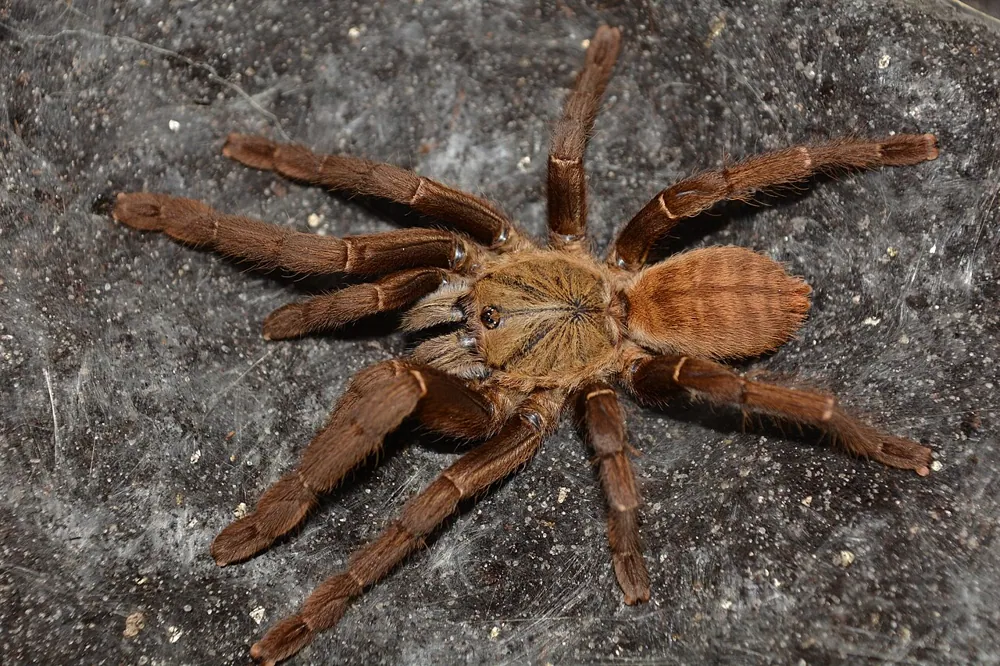
KoskaThe Chinese black earth tiger tarantula is a large, dark spider that lives in burrows on the island of Hainan, off southern China. It is one of several spiders from China and Vietnam known as the Chinese bird spider. Scientists study its venom because it is considered highly venomous.1

 Nola ezagutu
- Dark black-brown body1
- Abdomen (rear body) is dark brown with six black stripes running across it and a black stripe down the centre of the upper surface1
- Carapace (upper front body) is black-brown, and the underside of the front body is red-brown1
- Females are about 60 mm long (body plus chelicerae, the fang-bearing mouthparts), with longer legs than males1
- Males are smaller, about 34 mm long, but have legs of a similar length to the female's1
Askotan honekin nahasten da: It resembles Cyriopagopus schmidti. The Chinese black earth tiger tarantula can be told apart by its dark black-brown body and by the longer thorns on the forward-facing side of the maxillae (the mouthparts that hold the fangs).1
Pozoi-ahalmena
Pozoia letaginetatik edo hortzetatik ateratzen da kosk egiten duenean.
Zer egiten du bere pozoiak?
Its venom is a complex neurotoxin, meaning it attacks the nervous system. It contains many compounds that block neurotransmitters, the chemical messengers that carry signals between nerves, including neurotoxic peptides called hainantoxins. The effects of its bite on humans are not well documented.1
Zein arriskutsua da pertsonentzat?
Arriskua pertsonentzat: LarriaKoska batek medikua behar du. Heriotzak oso arraroak dira.The effects of its bite on people are not well documented. In laboratory tests, its venom is often lethal to mice and rats in small doses, so it is generally regarded as a highly venomous species.1
Zer egiten du beldurtzen denean?
It stays hidden in its silk-lined burrow during the day, and its silk alarm lines radiate from the burrow mouth.1
 Kosk egiten badu
- Garbitu koska eta hoztu. Lortu mediku-laguntza mina handia bada edo pertsona gaizki sentitzen bada.
Deitu beti lehenik zure larrialdi-zenbakira (112, 000, 911). Lehen sorospenei buruzko orientabide orokorra da hau, ez mediku-aholkua. Lehen sorospenen oinarriak
 Egon seguru
- Ez ukitu, ez harrapatu eta ez zirikatu inoiz animalia basati bat, txikia izan arren, eta lo edo hilda dagoela badirudi ere.
- Utzi tartea. Bat aurkitzen baduzu, egon lasai, egin atzera poliki eta utzi bere bidetik joaten.
- Batek kosk egiten badizu: egon lasai, egon geldi, deitu zure larrialdi-zenbakira (112, 000, 911) edo joan ospitalera azkar. Gogoratu nolakoa zen, argazki batek laguntzen du.
Ez dabil zure atzetik. Pozoia janaria harrapatzeko edo bere burua babesteko erabiltzen du, eta askoz nahiago du ezkutatu. Seguru egoteari buruz gehiago
Munduko zein tokitan?
Zein handia da?
Zein luzea da?
 2 eraikuntza-bloke ilaran jarrita bezain luzea
 100 metro 200 segundotan egin litzake (gizakirik azkarrenak 9,6 behar ditu)
Zein handia da Chinese black earth tiger tarantula ZUREKIN alderatuta?
Matematika hutsa zure nabigatzailean. Ez da ezer gordetzen, ezta inora bidaltzen ere.
Zein azkarra da?


Datuak
Although the effects of its bite on humans are poorly recorded, its venom is often lethal to laboratory mice and rats in small doses.1
Its venom contains neurotoxic peptides called hainantoxins, which block the chemical signals that nerves use to communicate.1
It lives on very steep, south-facing mountain slopes, at angles of 75 to 85 degrees.1
Despite the male being much smaller than the female, his legs are nearly as long as hers.1
Datuak nondik datozen
- Cyriopagopus hainanus (Wikipedia (CC BY-SA 4.0))
- Cyriopagopus hainanus (iNaturalist): izenak eta sailkapena.
- Venom Wiki: arrisku-maila, ohiko tamaina eta abiadura-kalkulua geureak dira. Ikusi nola kalkulatzen ditugun: Nola baloratzen dugun arriskua.
Orrialde honetako datu bakoitzak zenbaki bat du, bere iturrira eramaten zaituena. Zerbait gaizki badugu, barkatu, animalien zaleak gara, ez zientzia-aldizkari bat. Esaiguzu [email protected] helbidean eta konponduko dugu.
 Eskorpioia gose da! Venom Wiki pertsona bakar baten proiektua da: doakoa, iragarkirik eta jarraitzailerik gabe. Eskupeko txiki batek sarean mantentzen laguntzen du.Elikatu eskorpioia
Talde bereko gehiago: Tarantulak eta inbutu-sareko armiarmak
 Gooty sapphire tarantulaTarantulak eta inbutu-sareko armiarmakMedikua behar du
 Indian ornamental tarantulaTarantulak eta inbutu-sareko armiarmakMedikua behar du
 Cobalt blue tarantulaTarantulak eta inbutu-sareko armiarmakMin ematen du, besterik ez
 Chinese bird spiderTarantulak eta inbutu-sareko armiarmakMedikua behar du
 Fringed ornamental tarantulaTarantulak eta inbutu-sareko armiarmakMedikua behar du
 Japanese funnel-web spiderTarantulak eta inbutu-sareko armiarmakMedikua behar du
 Deathstalker
 Indian cobra
 Indian saw-scaled viper
 King cobra
 Puff adder
 Russell's viper