
 Afrika
 Asia
Asia Europa
 Hego Amerika
 Australia eta Ozeania
 Antartika
 Ozeano Barea
 Ozeano Atlantikoa
 Ozeano Indikoa
 Ozeano Artikoa
 Mediterraneo itsasoa
 Itsaso Gorria
 Karibe itsasoa
 Koralen itsasoa
 Hego Txinako itsasoa
 Filipinetako itsasoa
 Andaman itsasoa
 Ipar itsasoa
 Timor eta Arafura itsasoak
 Bengalako golkoa
 Kaliforniako golkoa
Kuhl's maskray
 Ziztadak
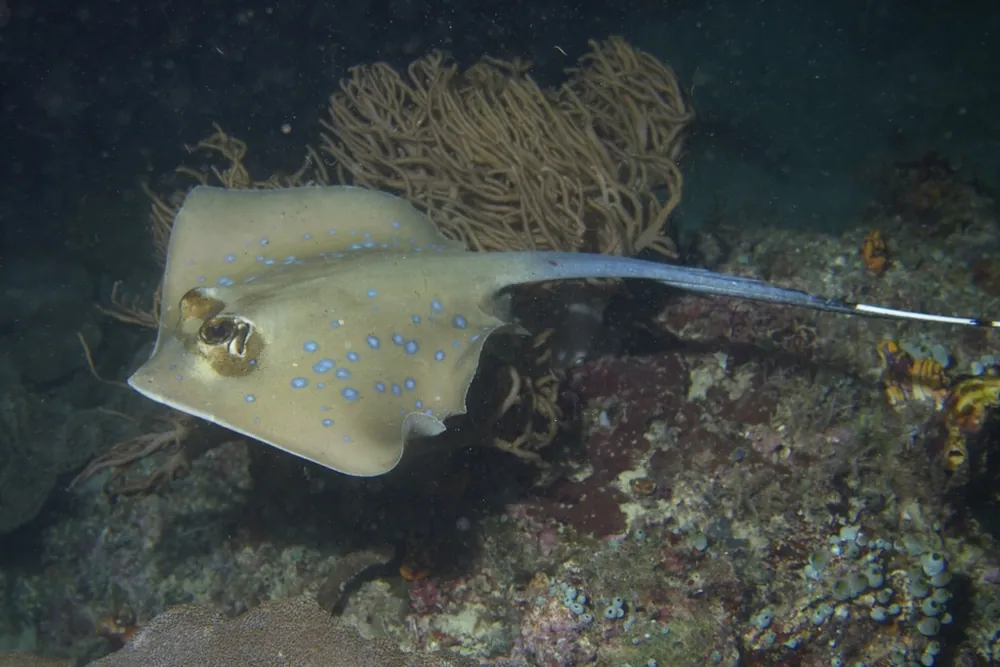
Kuhl's maskray is a flat, diamond-shaped stingray with green skin and blue spots. It lives on sandy and muddy seabeds in warm coastal waters from Indonesia to Japan and around most of Australia. Its tail has venomous spines, so it is important to know what it looks like and to keep a safe distance.1



 Nola ezagutu
- Flat, diamond-shaped (rhomboid) body that is dark green with blue spots1
- Light white underside1
- Very short snout with an angular disc1
- Bright yellow eyes1
- Long tail, about twice the length of the body, with two venomous spines at its base, one large and one medium in size1
Askotan honekin nahasten da: It is often confused with the blue-spotted ribbontail ray, which is common in aquaria. The ribbontail has a rounded body, brighter green colouring and more vivid spots. Kuhl's maskray is larger.1
Pozoi-ahalmena
Pozoia ezten batetik ateratzen da.
Zer egiten du bere pozoiak?
The venom contains serotonin, 5' nucleotidase and phosphodiesterase. These are active compounds that act on the body's tissues.1
Zein arriskutsua da pertsonentzat?
Arriskua pertsonentzat: LarriaZiztada batek medikua behar du. Heriotzak oso arraroak dira.It is very venomous. Its barb can be about 30 cm long.1
Zer egiten du beldurtzen denean?
Its bright colouring warns predators of its venomous spines. It buries itself in sand to hide from predators.1
 Ziztatzen badu
- Sartu zauria ur beroan, pertsonak erre gabe jasan dezakeen bezain beroan (probatu zure eskuarekin), 30 eta 90 minutu artean. Lortu mediku-laguntza, batez ere harri-arrain eta bastangen kasuan.
Deitu beti lehenik zure larrialdi-zenbakira (112, 000, 911). Lehen sorospenei buruzko orientabide orokorra da hau, ez mediku-aholkua. Lehen sorospenen oinarriak
 Egon seguru
- Ez ukitu, ez harrapatu eta ez zirikatu inoiz animalia basati bat, txikia izan arren, eta lo edo hilda dagoela badirudi ere.
- Utzi tartea. Bat aurkitzen baduzu, egon lasai, egin atzera poliki eta utzi bere bidetik joaten.
- Batek ziztatzen bazaitu: egon lasai, egon geldi, deitu zure larrialdi-zenbakira (112, 000, 911) edo joan ospitalera azkar. Gogoratu nolakoa zen, argazki batek laguntzen du.
Ez dabil zure atzetik. Pozoia janaria harrapatzeko edo bere burua babesteko erabiltzen du, eta askoz nahiago du ezkutatu. Seguru egoteari buruz gehiago
Munduko zein tokitan?
Zein handia da?
Zein luzea da?
 4 banana bata bestearen atzetik jarrita bezain luzea
 igerileku handi baten luzera (50 m) igerian egin lezake 12 segundotan
Zein handia da Kuhl's maskray ZUREKIN alderatuta?
Matematika hutsa zure nabigatzailean. Ez da ezer gordetzen, ezta inora bidaltzen ere.
Zein azkarra da?

Datuak
Large sharks such as hammerhead sharks prey on it. A hammerhead pins it down with its head while the ray is in shock and much weaker.1
Its tail is about twice as long as its body and carries two venomous spines.1
Unlike most stingrays, which bury themselves to hunt, Kuhl's maskray buries itself in sand only to hide from predators.1
Its skin is used to make drums, such as the Arab and Turkish darbuka goblet drum and the riq tambourine.1
Two short peptides found in its hydrolysed proteins have shown protective effects against the oxidation of lipids, DNA and proteins. They may be useful as functional food ingredients or nutraceuticals.1
Pozoi-adituentzat
- Izen zientifikoa
- Neotrygon kuhlii
- Taldea
- Arrain pozoitsuak
- Familia
- Dasyatidae2
- Ordena
- Myliobatiformes
- Kontinenteak
- Ozeano Indikoa, Ozeano Barea, Koralen itsasoa, Andaman itsasoa, Hego Txinako itsasoa, Filipinetako itsasoa, Timor eta Arafura itsasoak, Bengalako golkoa, Ozeanoak
- Kumeak
- It gives birth to live young. The embryos develop inside eggs held in the mother's body and are fed by uterine fluid. A litter can have up to seven pups, each 15 to 33 cm long at birth.1
- Bizi-iraupena
- 13 urte inguru1
- Arriskua pertsonentzat
- 3 / 5: Larria3
Datuak nondik datozen
- Kuhl's maskray (Wikipedia (CC BY-SA 4.0))
- Neotrygon kuhlii (iNaturalist): izenak eta sailkapena.
- Venom Wiki: arrisku-maila, ohiko tamaina eta abiadura-kalkulua geureak dira. Ikusi nola kalkulatzen ditugun: Nola baloratzen dugun arriskua.
Orrialde honetako datu bakoitzak zenbaki bat du, bere iturrira eramaten zaituena. Zerbait gaizki badugu, barkatu, animalien zaleak gara, ez zientzia-aldizkari bat. Esaiguzu [email protected] helbidean eta konponduko dugu.
 Eskorpioia gose da! Venom Wiki pertsona bakar baten proiektua da: doakoa, iragarkirik eta jarraitzailerik gabe. Eskupeko txiki batek sarean mantentzen laguntzen du.Elikatu eskorpioia
Talde bereko gehiago: Arrain pozoitsuak
 Reef stonefishArrain pozoitsuakHil dezakeEz ukitu
 Red lionfishArrain pozoitsuakMedikua behar duEz ukitu
 Estuarine stonefishArrain pozoitsuakHil dezakeEz ukitu
 Short-tail stingrayArrain pozoitsuakHil dezake
 Striped eel catfishArrain pozoitsuakHil dezakeEz ukitu
 Bluespotted ribbontail rayArrain pozoitsuakMedikua behar du
Hemen ere bizi da: Ozeano Indikoa
 Australian box jellyfishMarmokak eta itsasoko izaki ziztatzaileakHilgarriaEz ukitu
 Geography coneKono-barraskiloak eta olagarroakHilgarria
 Greater blue-ringed octopusKono-barraskiloak eta olagarroakHilgarria
 Southern blue-ringed octopusKono-barraskiloak eta olagarroakHilgarria
 Hawksbill sea turtleBeste animalia toxiko batzukHil dezake
 Irukandji jellyfishMarmokak eta itsasoko izaki ziztatzaileakHil dezakeEz ukitu