
 Afrika
 Asia
Asia Europa
 Hego Amerika
 Australia eta Ozeania
 Antartika
 Ozeano Barea
 Ozeano Atlantikoa
 Ozeano Indikoa
 Ozeano Artikoa
 Mediterraneo itsasoa
 Itsaso Gorria
 Karibe itsasoa
 Koralen itsasoa
 Hego Txinako itsasoa
 Filipinetako itsasoa
 Andaman itsasoa
 Ipar itsasoa
 Timor eta Arafura itsasoak
 Bengalako golkoa
 Kaliforniako golkoa
Striped pyjama squid
 Pozoia azalean
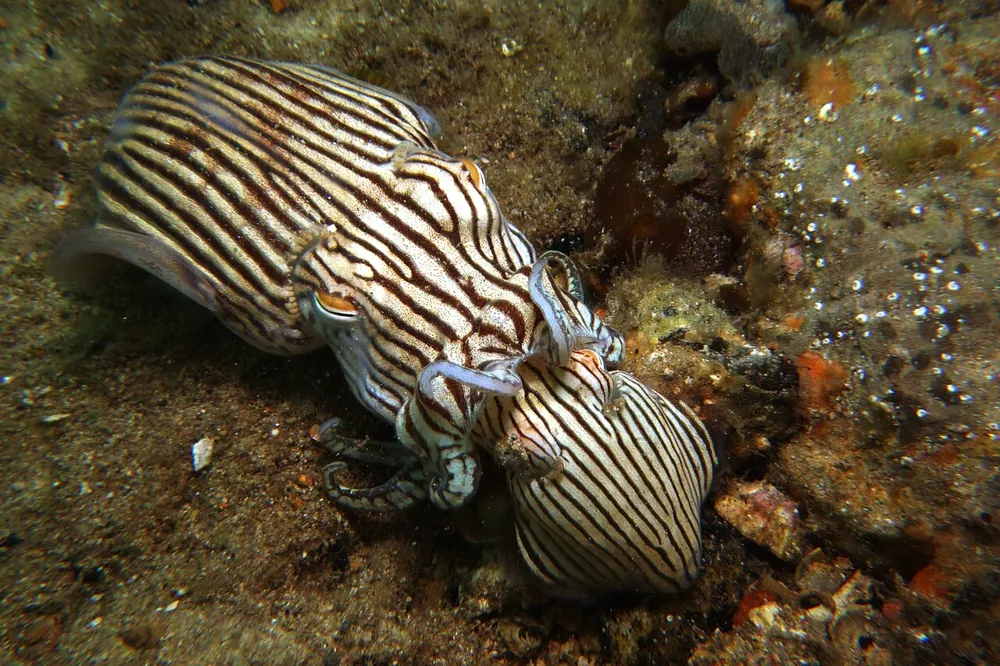
The striped pyjama squid is a small squid that lives on the seafloor in the Indo-Pacific waters of Australia. It hides by burying itself in the sand, with only the top of its head and its yellow eye showing. Its saliva contains a toxin, which makes it a squid to leave alone.1



 Nola ezagutu
- White and brown stripes run across its whole body.1
- It can change to dark brown or purple, to match its surroundings or when attacked.1
- It has a yellow eye, and only the top of its head shows above the sand.1
- It has two feeding tentacles and eight arms, with finger-like tendrils around the mantle opening.1
- Adults are about 7 to 8 cm long. It has no shell.1
Pozoi-indarra
Bere azala toxikoa da. Arriskutsua da ukitzea, miazkatzea edo jatea.
Zer egiten du bere toxinak?
Its saliva contains tetrodotoxin, a neurotoxin, which is a poison that attacks the nerves. The squid also has glands under its body that release a toxic slime when it is attacked.1
Zein arriskutsua da pertsonentzat?
Arriskua pertsonentzat: ArinaErle-ziztada bat bezala edo gutxiago. Ia kaltegabea pertsonentzat.Zer egiten du beldurtzen denean?
When attacked, it can release toxic slime to scare off predators or give it time to escape, and it can release ink that can mimic its shape to distract a predator.1
 Norbaitek ukitu edo jan badu
- Presio-immobilizazioa: bildu benda elastiko sendo bat koskaren gainean eta gero gorputz-adar osoan gora, immobilizatu ferula batekin, eta eutsi pertsona guztiz geldi laguntza iritsi arte.
- Eraztun urdineko olagarro batek edo kono-barraskilo batek pertsona baten arnasketa gelditu dezake, pertsona hori oraindik esna dagoela: eskatu laguntza eta egon prest erreskate-arnasketak emateko anbulantziak ardura hartu arte.
Deitu beti lehenik zure larrialdi-zenbakira (112, 000, 911). Lehen sorospenei buruzko orientabide orokorra da hau, ez mediku-aholkua. Lehen sorospenen oinarriak
 Egon seguru
- Ez ukitu, ez harrapatu eta ez zirikatu inoiz animalia basati bat, txikia izan arren, eta lo edo hilda dagoela badirudi ere.
- Utzi tartea. Bat aurkitzen baduzu, egon lasai, egin atzera poliki eta utzi bere bidetik joaten.
- Ukitu edo jan baduzu: ez igurtzi begiak edo ahoa, garbitu eskuak eta lortu mediku-laguntza.
Ez dabil zure atzetik. Pozoia ezerk jan ez dezan baino ez du. Seguru egoteari buruz gehiago
Munduko zein tokitan?
Zein handia da?
Zein luzea da?
 2,5 eraikuntza-bloke ilaran jarrita bezain luzea
 igerileku handi baten luzera (50 m) igerian egin lezake 12 segundotan
Zein handia da Striped pyjama squid ZUREKIN alderatuta?
Matematika hutsa zure nabigatzailean. Ez da ezer gordetzen, ezta inora bidaltzen ere.
Zein azkarra da?


Datuak
The male uses a spoon-shaped arm to remove sperm from another male if he finds it in the female.1
It can change its colour to dark brown or purple when attacked or to blend in with its surroundings.1
Its white stripes reflect white light, while its dark stripes are tiny pigment sacs called chromatophores that it can flash.1
It buries itself in the sand during the day and keeps flicking sand over its body to stay hidden.1
Worm-like parasites called dicyemids live inside it and feed on its urine.1
Like many members of its order, the male usually dies after mating.1
Pozoi-adituentzat
- Izen zientifikoa
- Sepioloidea lineolata
- Taldea
- Kono-barraskiloak eta olagarroak
- Familia
- Sepiadariidae2
- Ordena
- Sepiolida
- Kontinenteak
- Ozeano Indikoa, Ozeano Barea, Koralen itsasoa, Ozeanoak
- Kumeak
- Females lay their eggs in batches or clumps under coral on the seafloor, soon after mating.1
- Arriskua pertsonentzat
- 1 / 5: Arina3
Datuak nondik datozen
- Sepioloidea lineolata (Wikipedia (CC BY-SA 4.0))
- Sepioloidea lineolata (iNaturalist): izenak eta sailkapena.
- Venom Wiki: arrisku-maila, ohiko tamaina eta abiadura-kalkulua geureak dira. Ikusi nola kalkulatzen ditugun: Nola baloratzen dugun arriskua.
Orrialde honetako datu bakoitzak zenbaki bat du, bere iturrira eramaten zaituena. Zerbait gaizki badugu, barkatu, animalien zaleak gara, ez zientzia-aldizkari bat. Esaiguzu [email protected] helbidean eta konponduko dugu.
 Eskorpioia gose da! Venom Wiki pertsona bakar baten proiektua da: doakoa, iragarkirik eta jarraitzailerik gabe. Eskupeko txiki batek sarean mantentzen laguntzen du.Elikatu eskorpioia
Talde bereko gehiago: Kono-barraskiloak eta olagarroak
 Geography coneKono-barraskiloak eta olagarroakHilgarria
 Greater blue-ringed octopusKono-barraskiloak eta olagarroakHilgarria
 Southern blue-ringed octopusKono-barraskiloak eta olagarroakHilgarria
 Blue sea dragonKono-barraskiloak eta olagarroakMin ematen du, besterik ez
 Common octopusKono-barraskiloak eta olagarroakKaltegabea
 Giant Pacific octopusKono-barraskiloak eta olagarroakKaltegabea
Hemen ere bizi da: Ozeano Indikoa
 Australian box jellyfishMarmokak eta itsasoko izaki ziztatzaileakHilgarriaEz ukitu
 Hawksbill sea turtleBeste animalia toxiko batzukHil dezake
 Irukandji jellyfishMarmokak eta itsasoko izaki ziztatzaileakHil dezakeEz ukitu
 Reef stonefishArrain pozoitsuakHil dezakeEz ukitu
 Crown-of-thorns starfishTrikuak, izarrak eta harrakMedikua behar duEz ukitu
 Portuguese man o' warMarmokak eta itsasoko izaki ziztatzaileakMedikua behar duEz ukitu