
 Afirik
 Aazi
Aazi Orop
Orop Amerik Sud
 Ostarali e Oseyani
 Antarktik
 Geeci Pasifik
 Geeci Atlantik
 Geeci Enndo
 Geeci Arktik
 Geeci Mediteraane
 Geeci Boɗeewi
 Geeci Karayib
 Geeci Korayl
 Geeci Siin Sud
 Geeci Filipiin
 Geeci Andaman
 Geeci Nord
 Geeci Timor e Arafura
 Gulf Bengal
 Gulf Kaliforni
Field's horned viper
 Ŋatgol
Field's horned viper is a venomous snake from the viper family. It lives in the deserts of the Middle East. Its venom is unusual because it attacks the nerves, while most vipers' venom damages tissue and blood vessels.1
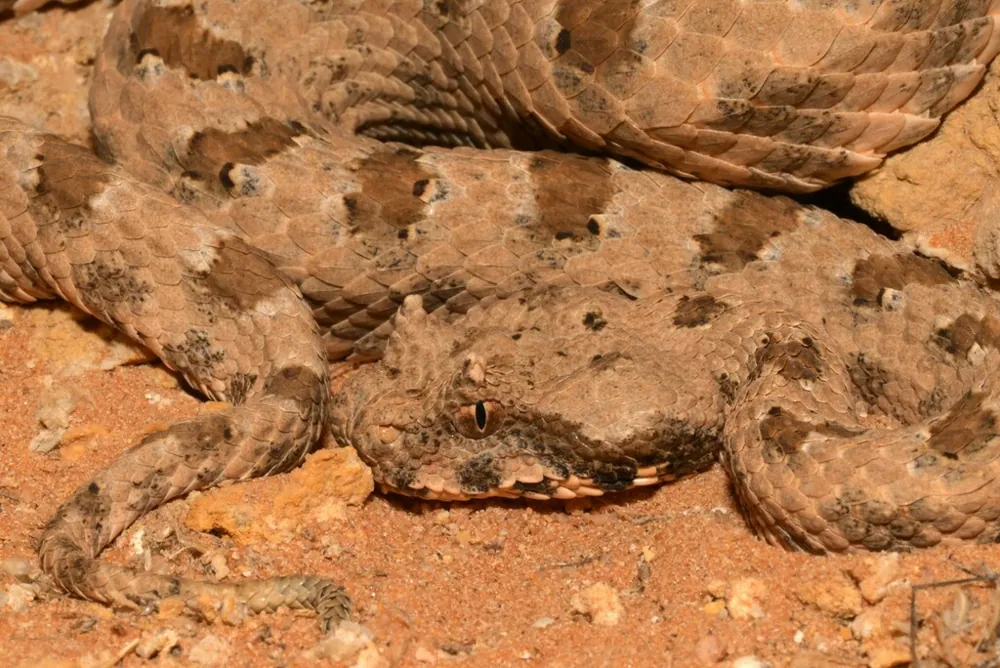
 Hono anndirtee ngal
- It has fewer scales in certain counts than the Persian horned viper.1
- Its tail is much shorter compared with its overall body length.1
- Several rows of its side scales are almost smooth.1
No jiibondiree e: It is most often confused with the Persian horned viper. The Persian horned viper has strongly keeled (ridged) scales on its back and sides, while Field's horned viper has smooth side scales. Its tail is also much shorter.1
Doole tooke ŋatgol
Tooke no yaltira ñiiƴe mum tuma ngal ŋatata.
Ko honɗun tooke mum waɗata (ŋatgol walla jukkugol)?
Its venom contains several fractions with marked neurotoxic activity, which means it attacks the nerves. This differs from the Persian horned viper, whose venom causes strong bleeding and tissue damage typical of most vipers. Its venom is venomous, so bites are a medical emergency.1
Hono musiiba mum heewiri e yimɓe?
Musiiba e yimɓe: Musiiba mawɗoŊatgol no haani doktoro. Maayde no famɗi sanne. Si no ŋata
- No antivenom is available for bites from this snake. A polyvalent antiserum may offer some protection against its blood-damaging toxins, but none against the nerve-attacking effects of its venom.1
- Haɗu neɗɗo on dillagol, deeƴnu mo, jogo koyngal walla jungo ŋataaɗo on e toownde ɓernde, ittu baagiiji e ko tiiɗi fow, yahra mo lopitaan law.
Adii fow noddu nimero ballal (112, 000, 911). Ɗum ko anndinal ballal adiingal, wanaa saaraangal doktoro. Ko adii nder ballal adiingal
 Reen hoore maa
- Wota a meem, wota a nanngu, wota a jalnu kullal ladde haa abada, hay si ko tokooso, hay si no yi'ee no ɗaanii walla maayii.
- Accu ngal nokku. Si a fotti e ngal, deeƴu, ruttu ɓaawo seeɗa seeɗa, accu ngal yaha laawol mum.
- Si gooto e majji ŋatii ma: deeƴu, wota a dillu, noddu nimero ballal (112, 000, 911) walla yahu lopitaan law. Jogo e hakkille no ngal nanndi, natal no walla.
Ngal faalaaka gaañugol ma. Ngal no huutora tooke mum ngam nanngugol ñaamdu walla reenugol hoore mum, ngal ɓuri yiɗugol suuɗaade. Ko ɓeydi fii reenugol hoore maa
Hoto nder aduna?
Hono mawniri?
Hono juutiri?
 juuti no banaanaaji 3 jokkondirɗi
 no waawi taccugol meeteruuji 100 nder segonde 110 (neɗɗo ɓurɗo yaawugol sokli 9,6)
Hono Field's horned viper mawniri, si fooɗondiraama e AN?
Ko limoore tun nder navigateur maa. Alaa ko danndetee walla ko neldetee ka nokku woo.
Hono yaawiri?


Humpito
Bonnoowo fenaandeeji
Fenaande: It is just a subspecies of the Persian horned viper.
Goonga: Most sources now classify it as a separate species, Pseudocerastes fieldi.1
Ɗo humpitooji ɗin iwri
- Field's horned viper (Wikipedia (CC BY-SA 4.0))
- Pseudocerastes fieldi (iNaturalist): inɗe e ŋoordingol (classification).
- Venom Wiki: tolno musiiba, mawnugol aadaajo e miijo yaawugol ko amen. Ndaar no min ƴeewtirta ɗum: Hono min tolnirta musiiba.
Kala humpito nder ngoo hello no jogii limoore hollirnde iwdi mum. Si min juumii, yaafo, min ko yiɗɓe kulle, wanaa jaaynde ganndal. Haalan min e [email protected], min feewnitan.
 Yaare nden no weelaa! Venom Wiki ko golle neɗɗo gooto: ko yoɓetaake, alaa piiblisite, alaa reweteeɓe. Kopporde tokooso no walla heddingol ɗum e enternet.Ñaamnu yaare nden
 Wipeeri cerkeeje siy Enndo
 Wipeeri fuufoowndi
 Bowngal Russell
 Common European adder
 Eastern Russell's viper
 Northeast African carpet viper
 Yaare oolnde maayde
 Kobra Enndo
 Kobra laamɗo
 Asian giant hornet
 Komodo dragon
 Spanish fly