
 Afirik
 Aazi
Aazi Orop
Orop Amerik Sud
 Ostarali e Oseyani
 Antarktik
 Geeci Pasifik
 Geeci Atlantik
 Geeci Enndo
 Geeci Arktik
 Geeci Mediteraane
 Geeci Boɗeewi
 Geeci Karayib
 Geeci Korayl
 Geeci Siin Sud
 Geeci Filipiin
 Geeci Andaman
 Geeci Nord
 Geeci Timor e Arafura
 Gulf Bengal
 Gulf Kaliforni
McMahon's viper
 Ŋatgol
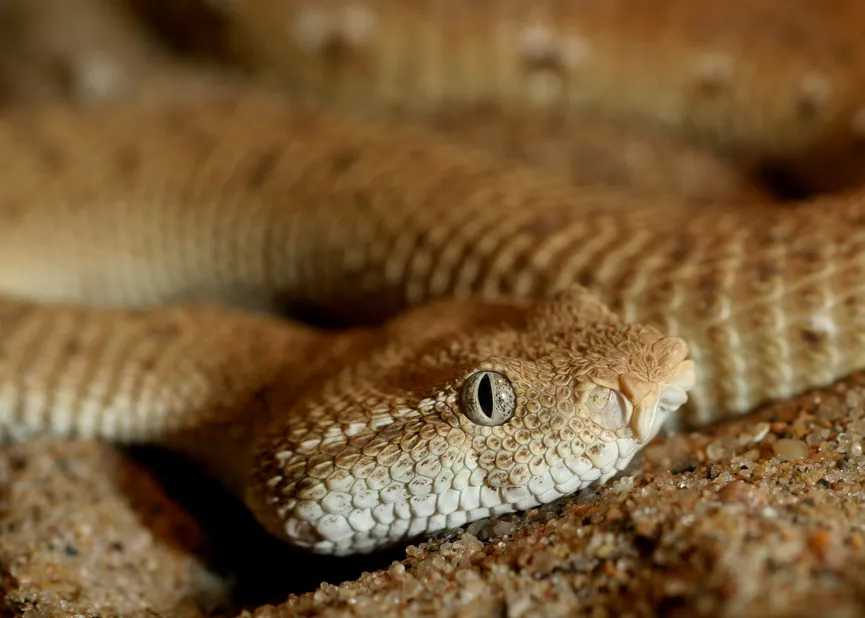
McMahon's viper is a small, venomous snake that lives in the sandy deserts of Balochistan, near the borders of Iran, Pakistan and Afghanistan. It is well known for its habit of sinking into loose sand so that only its snout and eyes stay uncovered. Scientists have also studied a protein from its venom for its possible use against melanoma, a type of skin cancer.1



 Hono anndirtee ngal
- Reddish to yellowish brown body with a regular series of 20 to 25 dark spots, each bordered partly or fully with white scales1
- A white stripe runs from the back of the eye to the corner of the mouth1
- Large, broad, flat, wedge-shaped head that is clearly distinct from the neck1
- Short tail with a yellow tip and distinct crossbands1
- Adults are under 1 m (39 in) in total length, tail included1
Doole tooke ŋatgol
Tooke no yaltira ñiiƴe mum tuma ngal ŋatata.
Ko honɗun tooke mum waɗata (ŋatgol walla jukkugol)?
Relatively few data are available on its venom. The species is regarded as potentially dangerous, and its venom is said to be similar to that of snakes in the genus Echis. A venom protein called eristostatin has been reported to help in the fight against melanoma.1
Hono musiiba mum heewiri e yimɓe?
Musiiba e yimɓe: Musiiba mawɗoŊatgol no haani doktoro. Maayde no famɗi sanne.It is regarded as a potentially dangerous species. It is described as bad-tempered, hissing very loudly and deeply, and it will strike aggressively when threatened.1
Ko honɗun ngal waɗata si ngal hulii?
It hisses very loudly and deeply, raises the front of its body off the ground in a loop and strikes aggressively. It may also sink into sand and cover its head, leaving only its snout and eyes uncovered.1
 Si no ŋata
- Haɗu neɗɗo on dillagol, deeƴnu mo, jogo koyngal walla jungo ŋataaɗo on e toownde ɓernde, ittu baagiiji e ko tiiɗi fow, yahra mo lopitaan law.
Adii fow noddu nimero ballal (112, 000, 911). Ɗum ko anndinal ballal adiingal, wanaa saaraangal doktoro. Ko adii nder ballal adiingal
 Reen hoore maa
- Wota a meem, wota a nanngu, wota a jalnu kullal ladde haa abada, hay si ko tokooso, hay si no yi'ee no ɗaanii walla maayii.
- Accu ngal nokku. Si a fotti e ngal, deeƴu, ruttu ɓaawo seeɗa seeɗa, accu ngal yaha laawol mum.
- Si gooto e majji ŋatii ma: deeƴu, wota a dillu, noddu nimero ballal (112, 000, 911) walla yahu lopitaan law. Jogo e hakkille no ngal nanndi, natal no walla.
Ngal faalaaka gaañugol ma. Ngal no huutora tooke mum ngam nanngugol ñaamdu walla reenugol hoore mum, ngal ɓuri yiɗugol suuɗaade. Ko ɓeydi fii reenugol hoore maa
Hoto nder aduna?
Hono mawniri?
Hono juutiri?
 juuti no banaanaaji 4 jokkondirɗi
 no waawi taccugol meeteruuji 100 nder segonde 110 (neɗɗo ɓurɗo yaawugol sokli 9,6)
Hono McMahon's viper mawniri, si fooɗondiraama e AN?
Ko limoore tun nder navigateur maa. Alaa ko danndetee walla ko neldetee ka nokku woo.
Hono yaawiri?


Humpito
A protein in its venom, called eristostatin, has been reported to help in the fight against melanoma.1
It can sink down into loose sand using a rocking or wave-like motion, then shake its head to cover it with sand.1
Its enlarged nasorostral scales are thought to keep sand out of its nostrils.1
It moves by sidewinding when crossing loose sand or when alarmed.1
Its short tail is prehensile, and it sometimes climbs into bushes with it.1
Ɗo humpitooji ɗin iwri
- Eristicophis (Wikipedia (CC BY-SA 4.0))
- Venom Wiki: tolno musiiba, mawnugol aadaajo e miijo yaawugol ko amen. Ndaar no min ƴeewtirta ɗum: Hono min tolnirta musiiba.
Kala humpito nder ngoo hello no jogii limoore hollirnde iwdi mum. Si min juumii, yaafo, min ko yiɗɓe kulle, wanaa jaaynde ganndal. Haalan min e [email protected], min feewnitan.
 Yaare nden no weelaa! Venom Wiki ko golle neɗɗo gooto: ko yoɓetaake, alaa piiblisite, alaa reweteeɓe. Kopporde tokooso no walla heddingol ɗum e enternet.Ñaamnu yaare nden
 Wipeeri cerkeeje siy Enndo
 Wipeeri fuufoowndi
 Bowngal Russell
 Common European adder
 Eastern Russell's viper
 Northeast African carpet viper
 Yaare oolnde maayde
 Kobra Enndo
 Kobra laamɗo
 Asian giant hornet
 Komodo dragon
 Spanish fly