
 Afrik
Afrik Aazi
Aazi Orop
Orop Amerik Worgo
 Ostaraali e Oseyaani
 Antarktik
 Geec Pasifik
 Geec Atlantik
 Geec Enndo
 Geec Arktik
 Geec Mediteraane
 Geec Boɗeejo
 Geec Karayib
 Geec Korayl
 Geec Siin Worgo
 Geec Filipiin
 Geec Andaman
 Geec Rewo
 Geec Timor e Arafura
 Gulf Bengal
 Gulf Kaliforni
Garden tiger moth
 Leɓɓe jukkooje
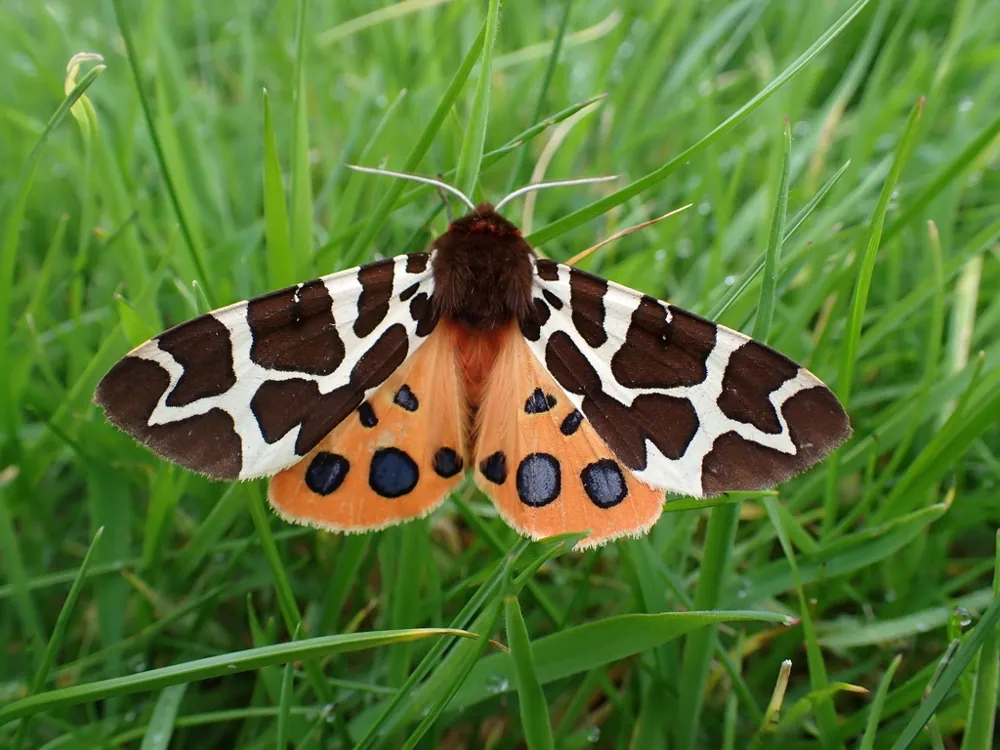
The garden tiger moth is a moth with bold patterned wings that warn predators it is unsafe to eat. It lives in cool, temperate parts of the northern United States, Canada, Europe and Asia. Its caterpillars are known as 'woolly bears' because of their fuzzy look.1

 No anndirte ngal
- Adults have a wingspan of 4.5 to 6.5 cm.1
- The front wings are brown with a white pattern, which is sometimes missing.1
- The back wings are orange with dark blue dots that have black outlines.1
- The moth often hides its orange hindwings under its brown forewings when resting.1
- Caterpillars are fuzzy and can grow up to 6 cm long.1
Doole tooke
Leɓɓe tokooso ina pelloo e nguru, ina njukka.
Hol ko tooke ŋatgol mum waɗata?
This moth does not inject venom. Its body fluids are poisonous and contain neurotoxic choline esters, which are nerve-affecting chemicals that interfere with the acetylcholine receptor. The full effects of these toxins are not yet known. Caterpillars have hollow hairs that often contain irritating compounds.1
Hol no bone mum heewiri e yimɓe?
Bone e yimɓe: HoyɗoNo jukkugol ñaaki walla ko ɓuri famɗude. Ko ɓuri heewde alaa bone e yimɓe.Hol ko ngal waɗata so ina hula?
When threatened, adults can spray an irritating compound from glands that are exposed at that moment, and their bright wing patterns warn predators.1
 So a meemii leɓɓe mum
- Ngam leɓɓe ngooɓuuli jukkooje: ittu ɗe e skots ɓataaɗo, refti loot nguru ngu. Wota a moomtu.
- Ngam ŋatgol: loot nokku oo, ɓuuɓnu. Heɓ ballal cafrol so neɗɗo oo ina wiya wonaa e jam, walla ina ƴiiɗa ko newii.
Adii fof noddu nimero urgence (112, 000, 911). Ɗum ko anndinal ballal adiingal, wonaa saaraangal doktoor. Ko adii e ballal adiingal
 Reen hoore maa
- Wota a meem, wota a nanngu, wota a ñiŋŋu kullal ladde haa abada, hay so ngal ina famɗi, hay so ina nanndi e ɗaaniingal walla maayngal.
- Accu ngal nokku. So a fotti e ngal, deƴƴu, ruttu ɓaawo seeɗa seeɗa, accu ngal yaha laawol mum.
- So a meemii leɓɓe mum: deƴƴu, wota a dillu, noddu nimero urgence (112, 000, 911) walla yahu opitaal law. Jogo e hakkille no ngal nanndi, natal ina walla.
Ngal faalaaka gaañde ma. Ina huutoroo tooke mum ngam nanngude ñaamdu walla reenaade, ina ɓuri yiɗde suuɗaade. Ɓeydu anndude no reentortoo
Hol to e aduna?
Hol no mawniri?
Hol no juutiri?
 juutde no kaaɗe mahirɗe 2 ɗaɓɓondiraaɗe
 ɓuri kokiyaas ngesa leelde
Hol no Garden tiger moth mawniri, so fooɗondiraama e AN?
Limgal tan e navigatoor maa. Alaa ko danndetee walla ko neldetee.
Hol no yaawiri?

Humpito
Adults can make rasping sounds with their wings and high-pitched squeaks that people can hear, and bats tend to avoid them.1
Caterpillars can break down the toxins in their host plants and reuse them in altered form for their own protection.1
The French entomologist Oberthür described about 500 different wing pattern and colour variants.1
Adults are mostly active at night, from June to September.1
Ngam ganduɓe tooke
- Innde ganndal
- Arctia caja
- Fedde
- Ngooɓuuli e ɓuuɓuuli
- Ɓesngu
- Erebidae2
- Ordre
- Lepidoptera
- Leyɗe mawɗe
- Orop, Aazi, Amerik Rewo
- Ɓiɓɓe tokooso
- Eggs are laid on the surfaces of leaves, and the caterpillars hatch and begin feeding soon after.1
- Hol no ngal woniri e ladde
- Protected in the UK under the Biodiversity Action Plan, after its UK numbers fell by 89% over 30 years1
- Bone e yimɓe
- 1 / 5: Hoyɗo3
Ɗo humpito iwri
- Garden tiger moth (Wikipedia (CC BY-SA 4.0))
- Arctia caja (iNaturalist): inɗe e ceergal.
- Venom Wiki: tolno bone, mawnude heewnde e miijo yaawde ko amen. Yiy no men keɓirta ɗum: No men tolnirta bone.
Kala humpito e ngoo hello ina jogii limoore hollirnde iwdi mum. So men juumii, yaafo, men ko yiɗɓe kulle, wonaa jaaynde ganndal. Wiy men e [email protected], men feewnita.
 Yaare nden ina weelaa! Venom Wiki ko golle neɗɗo gooto: yoɓetaake, alaa ko jeeyetee, alaa rewɓe. Ndokkal seeɗa ina walla ngam heddude e enternet.Ñaam yaare nden
Goɗɗe e nder fedde wootere: Ngooɓuuli e ɓuuɓuuli
 Giant water bugNgooɓuuli e ɓuuɓuuliIna muusi tan
 Oak processionaryNgooɓuuli e ɓuuɓuuliIna muusi tanWota a meem
 Pine processionaryNgooɓuuli e ɓuuɓuuliIna muusi tanWota a meem
 Puss caterpillarNgooɓuuli e ɓuuɓuuliIna muusi tanWota a meem
 Saddleback caterpillarNgooɓuuli e ɓuuɓuuliIna muusi tanWota a meem
 Wheel bugNgooɓuuli e ɓuuɓuuliIna muusi tan
Ina wuuri kadi e: Orop
 Common European adderƁoɗɗi wipeerIna sokli doktoor
 Spanish flyKulle goɗɗe jogiiɗe tooke ɓannduIna sokli doktoorWota a meem
 Common waspÑaaki, ɗuggi e ɗuggi mawɗiIna muusi tan
 European hornetÑaaki, ɗuggi e ɗuggi mawɗiIna muusi tan
 Fire salamanderÑaari tooke, ñaari e newtsIna muusi tanWota a meem
 Western honey beeÑaaki, ɗuggi e ɗuggi mawɗiIna muusi tan