
 Afrik
Afrik Aazi
Aazi Orop
Orop Amerik Worgo
 Ostaraali e Oseyaani
 Antarktik
 Geec Pasifik
 Geec Atlantik
 Geec Enndo
 Geec Arktik
 Geec Mediteraane
 Geec Boɗeejo
 Geec Karayib
 Geec Korayl
 Geec Siin Worgo
 Geec Filipiin
 Geec Andaman
 Geec Rewo
 Geec Timor e Arafura
 Gulf Bengal
 Gulf Kaliforni
Geography cone
 Jukkugol
The geography cone is a predatory sea snail that lives on shallow tropical reefs in the Indo-Pacific. It hunts small fish. Its venom is strong enough to kill a person, which makes it one of the most dangerous cone snails.1


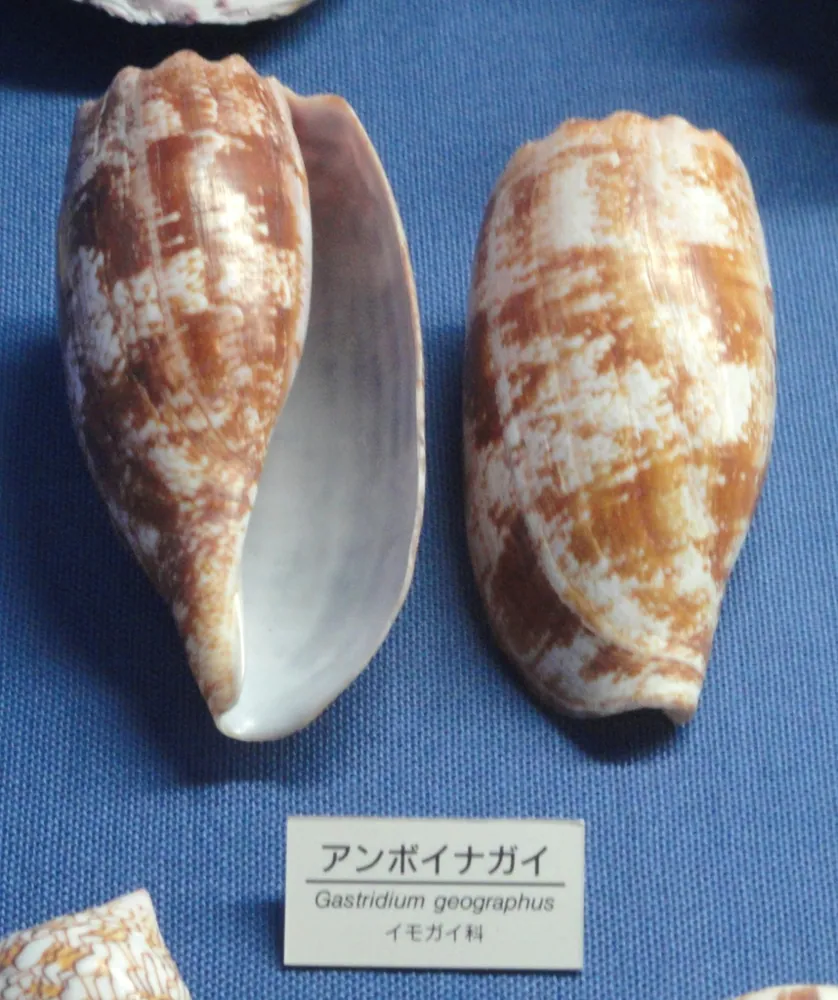
 No anndirte ngal
- Broad, thin shell that is cylindrically inflated, usually 10 to 15 cm long1
- Ground colour is pink or violet-white, sometimes reddish1
- Mottled pattern of chestnut or chocolate brown, usually forming two irregular bands1
- Wide pink or violet-white opening and numerous shoulder ridges or spines1
Ina heewi waylondireede e: Compared with other cone shells of a similar size, the geography cone has a noticeably wider, more convex middle and a flattened spire. Its walls are also thinner and lighter.1
Doole tooke
Tooke ngal ina yaltira jukkirgal.
Hol ko tooke ŋatgol mum waɗata?
Its venom is a complex mix of hundreds of different toxins, delivered through the harpoon-like tooth. It has the most toxic sting known among cone snails. Even the most venomous cone snails take about one to five hours to kill a healthy adult, but medical care must still be prompt.1
Hol no bone mum heewiri e yimɓe?
Bone e yimɓe: BareejoWootere e kulle ɓurɗe bone e aduna.There are reports of about 36 human deaths over the past 300 years. Live specimens should be handled with extreme caution.1
Hol ko ngal waɗata so ina hula?
Most of the venom's toxic compounds are believed to be used for defence rather than feeding.1
 So ina jukka
- There is no antivenom for a cone snail sting. Treatment consists of keeping the victim alive until the symptoms wear off, so prompt medical care is essential.1
- Habbugol ɗiwɗiingol (immobilisation): taarnu bando elastik tiiɗɗo e dow nokku ŋataaɗo, refti yawnu e dow terɗe ndee fof, haɓɓu attel, haɗ neɗɗo oo dillaade fey haa ballal hewta.
- Pulp koode bulaaje walla kokiyaas kone ina waawi haɗde neɗɗo foofaade tawa himo finii: noddu ballal, heblo foofnude mo (bouche-à-bouche) haa ambilaas ŋoo hewta, ɓe nanngoo.
Adii fof noddu nimero urgence (112, 000, 911). Ɗum ko anndinal ballal adiingal, wonaa saaraangal doktoor. Ko adii e ballal adiingal
 Reen hoore maa
- Wota a meem, wota a nanngu, wota a ñiŋŋu kullal ladde haa abada, hay so ngal ina famɗi, hay so ina nanndi e ɗaaniingal walla maayngal.
- Accu ngal nokku. So a fotti e ngal, deƴƴu, ruttu ɓaawo seeɗa seeɗa, accu ngal yaha laawol mum.
- So gooto jukkii ma: deƴƴu, wota a dillu, noddu nimero urgence (112, 000, 911) walla yahu opitaal law. Jogo e hakkille no ngal nanndi, natal ina walla.
Ngal faalaaka gaañde ma. Ina huutoroo tooke mum ngam nanngude ñaamdu walla reenaade, ina ɓuri yiɗde suuɗaade. Ɓeydu anndude no reentortoo
Hol to e aduna?
Hol no mawniri?
Hol no juutiri?
 juutde no kaaɗe mahirɗe 5 ɗaɓɓondiraaɗe
 ɓuri kokiyaas ngesa leelde
Hol no Geography cone mawniri, so fooɗondiraama e AN?
Limgal tan e navigatoor maa. Alaa ko danndetee walla ko neldetee.
Hol no yaawiri?

Humpito
Its venom contains a form of insulin, which it uses to stun fish. Once the venom passes through a fish's gills, the fish goes into hypoglycaemic shock (a dangerous drop in blood sugar).1
Apart from the tulip cone snail, no other known living thing is known to use its own biological insulin as a weapon.1
Research shows that some proteins from cone snail venom can be up to 10,000 times more effective than morphine as painkillers, without morphine's addictive properties and side effects.1
Of the venom's 100 to 200 toxic peptides, only 15 to 20 are used for feeding.1
Adult geography cones can fall prey to sea turtles, rays, birds and human shell collectors.1
Feññinoowo fenaande
Fenaande: The nickname 'cigarette snail' means a sting gives you just enough time to smoke a cigarette before you die.
Goonga: This is a gallows humour exaggeration. Even the most venomous cone snails take about one to five hours to kill a healthy human.1
Ɗo humpito iwri
- Conus geographus (Wikipedia (CC BY-SA 4.0))
- Conus geographus (iNaturalist): inɗe e ceergal.
- Venom Wiki: tolno bone, mawnude heewnde e miijo yaawde ko amen. Yiy no men keɓirta ɗum: No men tolnirta bone.
Kala humpito e ngoo hello ina jogii limoore hollirnde iwdi mum. So men juumii, yaafo, men ko yiɗɓe kulle, wonaa jaaynde ganndal. Wiy men e [email protected], men feewnita.
 Yaare nden ina weelaa! Venom Wiki ko golle neɗɗo gooto: yoɓetaake, alaa ko jeeyetee, alaa rewɓe. Ndokkal seeɗa ina walla ngam heddude e enternet.Ñaam yaare nden
Goɗɗe e nder fedde wootere: Kokiyaas kone e pulpuuji
 Greater blue-ringed octopusKokiyaas kone e pulpuujiBareejo
 Southern blue-ringed octopusKokiyaas kone e pulpuujiBareejo
 Blue sea dragonKokiyaas kone e pulpuujiIna muusi tan
 Common octopusKokiyaas kone e pulpuujiAlaa bone
 Giant Pacific octopusKokiyaas kone e pulpuujiAlaa bone
 Blue-lined octopusKokiyaas kone e pulpuujiBareejo
Ina wuuri kadi e: Geec Enndo
 Australian box jellyfishMeduusaaji e kulle geec jukkoojeBareejoWota a meem
 Hawksbill sea turtleKulle goɗɗe jogiiɗe tooke ɓannduIna waawi warde
 Irukandji jellyfishMeduusaaji e kulle geec jukkoojeIna waawi wardeWota a meem
 Reef stonefishLiƴƴi jogiiɗi tookeIna waawi wardeWota a meem
 Crown-of-thorns starfishƁuuɓuuli geec gaaɗe, koode geec e ngilnooɗeIna sokli doktoorWota a meem
 Portuguese man o' warMeduusaaji e kulle geec jukkoojeIna sokli doktoorWota a meem