
 Afrik
Afrik Aazi
Aazi Orop
Orop Amerik Worgo
 Ostaraali e Oseyaani
 Antarktik
 Geec Pasifik
 Geec Atlantik
 Geec Enndo
 Geec Arktik
 Geec Mediteraane
 Geec Boɗeejo
 Geec Karayib
 Geec Korayl
 Geec Siin Worgo
 Geec Filipiin
 Geec Andaman
 Geec Rewo
 Geec Timor e Arafura
 Gulf Bengal
 Gulf Kaliforni
Goldenrod crab spider
 Ŋatgol
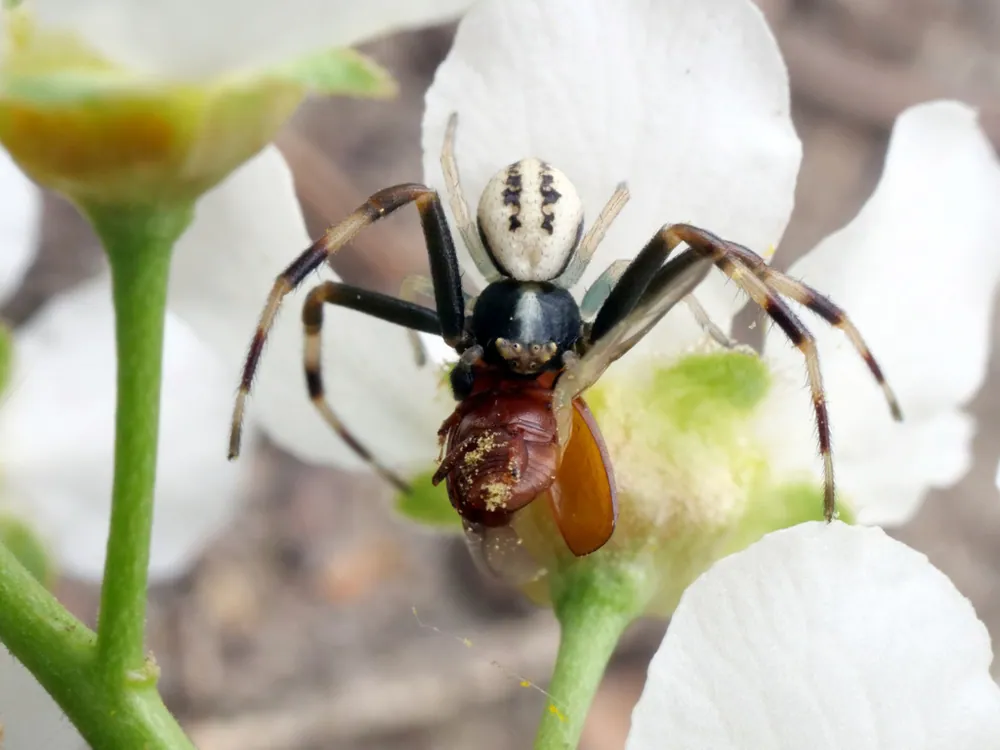
The goldenrod crab spider is a small, flat spider that hides on flowers and waits for insects to land nearby. It lives in Europe and North America. It is named for the way it walks, and it can change its colour to match the flower it sits on.1



 No anndirte ngal
- Wide, flat, short body that is shaped like a crab.1
- Usually yellow or white, or a pattern of these two colours. It can also be pale green or pink, with white.1
- Females have white or yellow legs. Males are darker, with red or brown outer shells and red and white bands.1
- Holds its first two pairs of legs open, which are the longest, ready to grab prey.1
- Can walk sideways, forwards and backwards.1
Ina heewi waylondireede e: Mecaphesa asperata is similar in size and shape, but it is light grey to brown with pink stripes on its abdomen and cephalothorax. Diaea crab spiders can be lime green, and some Xysticus and Coriarchne species are brown.1
Doole tooke
Tooke ngal ina yaltira ñiiƴe mum so ina ŋata.
Hol ko tooke ŋatgol mum waɗata?
Its venom is paralysing, which means it stops prey from moving. The spider injects digestive enzymes with its fangs to break down the insides of its prey. The venom is too weak to harm larger animals.1
Hol no bone mum heewiri e yimɓe?
Bone e yimɓe: HoyɗoNo jukkugol ñaaki walla ko ɓuri famɗude. Ko ɓuri heewde alaa bone e yimɓe.This spider is harmless to humans. Its fangs are not strong enough to pierce human skin, and its venom is too weak to harm larger animals.1
 So ina ŋata
- Loot nokku ŋataaɗo oo, waɗ galaas e mum ngam muusu ngu. Heɓ ballal cafrol so muusu ngu ina tiiɗi, ina saakoo walla neɗɗo oo ina wiya wonaa e jam.
Adii fof noddu nimero urgence (112, 000, 911). Ɗum ko anndinal ballal adiingal, wonaa saaraangal doktoor. Ko adii e ballal adiingal
 Reen hoore maa
- Wota a meem, wota a nanngu, wota a ñiŋŋu kullal ladde haa abada, hay so ngal ina famɗi, hay so ina nanndi e ɗaaniingal walla maayngal.
- Accu ngal nokku. So a fotti e ngal, deƴƴu, ruttu ɓaawo seeɗa seeɗa, accu ngal yaha laawol mum.
- So gooto ŋatii ma: deƴƴu, wota a dillu, noddu nimero urgence (112, 000, 911) walla yahu opitaal law. Jogo e hakkille no ngal nanndi, natal ina walla.
Ngal faalaaka gaañde ma. Ina huutoroo tooke mum ngam nanngude ñaamdu walla reenaade, ina ɓuri yiɗde suuɗaade. Ɓeydu anndude no reentortoo
Hol to e aduna?
Hol no mawniri?
Hol no juutiri?
 tokooso haa ina waawi jooɗaade e dow ceŋol hondu maa
Hol no Goldenrod crab spider mawniri, so fooɗondiraama e AN?
Limgal tan e navigatoor maa. Alaa ko danndetee walla ko neldetee.
Hol no yaawiri?


Humpito
Females can change colour from yellow to white, or back again, to match the flower they sit on. This process can take up to 25 days.1
The spider can catch prey much larger than itself, because its paralysing venom works so well.1
Unlike many spiders, it does not wrap its prey in silk. It relies entirely on venom to hold its meals still.1
Females leave silk trails called draglines behind them as they move, and males follow these trails rather than pheromones.1
Females wait on flowers and do not travel far, while males roam over great distances to look for mates.1
Females live longer than males, on average.1
Feññinoowo fenaande
Fenaande: Because it is a venomous spider with a name like Whitedeath, it is dangerous to people.
Goonga: The goldenrod crab spider is harmless to humans. Its fangs cannot pierce human skin, and its venom is too weak to harm larger animals.1
Ɗo humpito iwri
- Misumena vatia (Wikipedia (CC BY-SA 4.0))
- Misumena vatia (iNaturalist): inɗe e ceergal.
- Venom Wiki: tolno bone, mawnude heewnde e miijo yaawde ko amen. Yiy no men keɓirta ɗum: No men tolnirta bone.
Kala humpito e ngoo hello ina jogii limoore hollirnde iwdi mum. So men juumii, yaafo, men ko yiɗɓe kulle, wonaa jaaynde ganndal. Wiy men e [email protected], men feewnita.
 Yaare nden ina weelaa! Venom Wiki ko golle neɗɗo gooto: yoɓetaake, alaa ko jeeyetee, alaa rewɓe. Ndokkal seeɗa ina walla ngam heddude e enternet.Ñaam yaare nden
Goɗɗe e nder fedde wootere: Araañeeji
 Brown recluse
 Southern black widow
 Mediterranean black widow
 Northern black widow
 Western black widow
 Diving bell spider
Ina wuuri kadi e: Orop
 Common European adderƁoɗɗi wipeerIna sokli doktoor
 Spanish flyKulle goɗɗe jogiiɗe tooke ɓannduIna sokli doktoorWota a meem
 Common waspÑaaki, ɗuggi e ɗuggi mawɗiIna muusi tan
 European hornetÑaaki, ɗuggi e ɗuggi mawɗiIna muusi tan
 Fire salamanderÑaari tooke, ñaari e newtsIna muusi tanWota a meem
 Western honey beeÑaaki, ɗuggi e ɗuggi mawɗiIna muusi tan