
 Afrikka
 Aasia
Aasia Eurooppa
 Etelä-Amerikka
 Australia ja Oseania
 Etelämanner
 Tyynimeri
 Atlantti
 Intian valtameri
 Pohjoinen jäämeri
 Välimeri
 Punainenmeri
 Karibianmeri
 Korallimeri
 Etelä-Kiinan meri
 Filippiinienmeri
 Andamaanienmeri
 Pohjanmeri
 Timorinmeri ja Arafuranmeri
 Bengalinlahti
 Kalifornianlahti
Golfodulcean poison frog
 Myrkkyä ihossaSyö: HyönteisetPassiivisesti myrkyllinen, ei aktiivisesti myrkyllinen
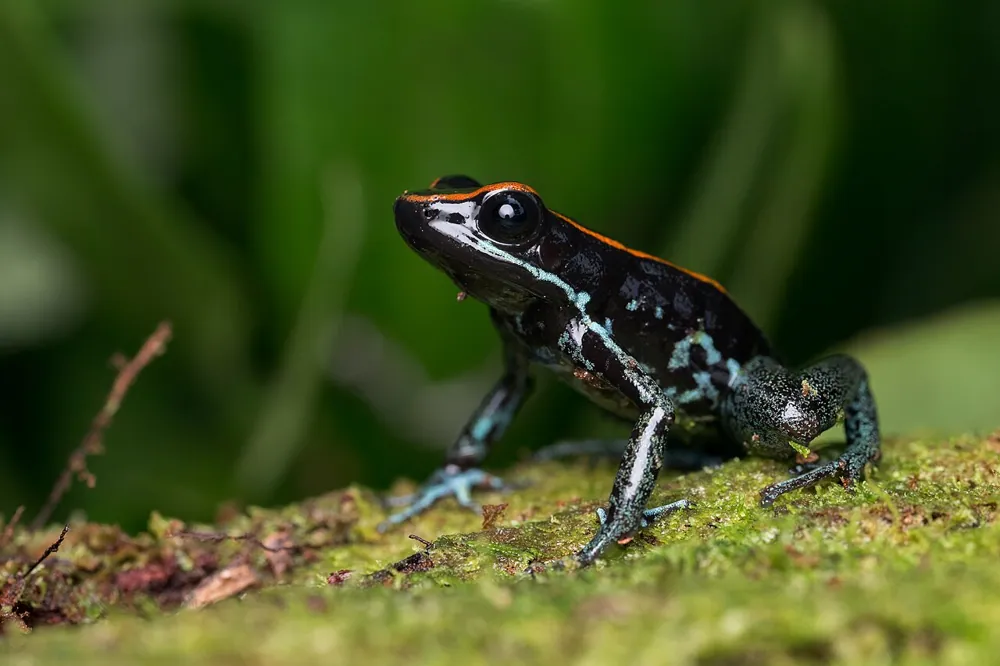
The Golfodulcean poison frog is a small, brightly marked frog that lives only in Costa Rica. Its skin contains a strong nerve poison, so it is one of the most toxic frogs in its genus, and it is a reminder that bright colours can be a warning. It lives in wet forests near streams.1

 Näin tunnistat sen
- The body is black, but it can look glittery because of pigments in the skin.1
- Two stripes run down the back from just above the vent to the tip of the nose. They are usually fire orange, but can be golden, yellow or green.1
- The legs are mottled blue, and the sides often have a blue or green marble pattern.1
- It is a fairly large poison frog for its genus, with a smooth, sloping back. Its shoulder blades are usually hidden under the skin, so it can look a little plump.1
- Females are typically larger than males. Adults reach about 3.5 cm long.1
Sekoitetaan usein: The related P. bicolor and P. terribilis have visible shoulder blades under the skin, which the Golfodulcean poison frog usually lacks, so it looks smoother and rounder.1
Myrkkyvoima
Sen iho on myrkyllinen. Siihen on vaarallista koskea, sitä on vaarallista nuolla tai syödä.
Mitä sen myrkky tekee, jos siihen koskee tai sen syö?
Its skin contains batrachotoxin, a neurotoxic alkaloid poison, which attacks the nerves. A large enough dose causes severe pain, then tonic-clonic seizures (violent convulsions) and paralysis.1
Kuinka vaarallinen se on ihmisille?
Vaara ihmisille: KivuliasSe voi sattua tosi paljon, mutta se ei ole juuri koskaan vakavaa.It is highly toxic, though it is only the fourth most toxic species in the genus Phyllobates. The poison is in the skin, so the risk comes from handling the frog or getting the poison from its skin into the body.1
Mitä se tekee, kun se pelästyy?
Its bright, multi-coloured body advertises its toxin as a warning to predators.1
 Jos joku koski siihen tai söi sitä
- Jos joku on koskenut sellaiseen: pese kädet hyvin äläkä koske silmiin tai suuhun. Jos lapsi tai lemmikki on nuollut tai syönyt sellaisen: soita Myrkytystietokeskukseen tai hätänumeroon.
Soita aina ensin hätänumeroon (112, 000, 911). Nämä ovat yleisiä ensiapuohjeita, eivät lääketieteellisiä neuvoja. Ensiavun perusteet
 Pysy turvassa
- Älä koskaan koske villieläimeen, pyydystä sitä tai kiusaa sitä, ei edes pientä, eikä silloinkaan, kun se näyttää nukkuvan tai olevan kuollut.
- Anna sille tilaa. Jos kohtaat sellaisen, pysy rauhallisena, peräänny hitaasti ja anna sen mennä omaa tietään.
- Jos kosketit sitä tai söit sitä: älä hiero silmiäsi tai suutasi, pese kätesi ja hae lääkärin apua.
Se ei ole sinun perässäsi. Sen myrkky on olemassa vain siksi, ettei kukaan söisi sitä. Lisää turvallisuudesta
Missä päin maailmaa?
Kuinka iso se on?
Kuinka pitkä se on?
 suunnilleen yhtä pitkä kuin paperiliitin
 voisi juosta 100 metriä 100 sekunnissa (nopein ihminen tarvitsee 9,6)
Kuinka iso Golfodulcean poison frog on SINUUN verrattuna?
Pelkkää matematiikkaa selaimessasi. Mitään ei tallenneta eikä lähetetä minnekään.
Kuinka nopea se on?


Faktat
It is one of the few frogs whose poison is named batrachotoxin, a potent nerve toxin.1
Its climbing toe pads stick to leaves in a similar way to geckos, and it can climb out of an unsealed container.1
Male frogs carry their tadpoles on their backs, often for 1 to 2 days, to puddles, pools in palm leaves, or water-filled tree holes.1
Frogs in captivity have no toxin, which shows that their poison comes from what they eat.1
Its skin holds a large amount of poison, because it is comparatively large for a poison dart frog.1
The tadpoles become frogs after about 45 days, and the young frogs become sexually mature after ten months.1
Myrkkyasiantuntijoille
- Tieteellinen nimi
- Phyllobates vittatus
- Ryhmä
- Nuolimyrkkysammakot, konnat ja vesiliskot
- Perhe
- Dendrobatidae2
- Järjestys
- Anura
- Maanosat
- Pohjois-Amerikka
- Vauvat
- During the breeding season, the female lays 7 to 21 eggs per clutch on leaves, about every one or two weeks, and the male guards the eggs and carries the hatched tadpoles on his back to water.1
- Vaara ihmisille
- 2 / 5: Kivulias3
Mistä tiedot ovat peräisin
- Golfodulcean poison frog (Wikipedia (CC BY-SA 4.0))
- Phyllobates vittatus (iNaturalist): nimet ja luokittelu.
- Venom Wiki: vaarataso, tyypillinen koko ja nopeusarvio ovat omia arvioitamme. Katso, miten laskemme ne: Näin arvioimme vaaran.
Jokaisella tämän sivun tiedolla on numero, joka viittaa sen lähteeseen. Jos jokin meni pieleen, anteeksi, olemme eläinfaneja emmekä tiedelehti. Kerro meille osoitteeseen [email protected], niin korjaamme sen.
 Skorpionilla on nälkä! Venom Wiki on yhden miehen projekti: ilmainen, ilman mainoksia ja ilman seurantaa. Pieni tippi auttaa pitämään sen verkossa.Ruoki skorpioni
Lisää samasta ryhmästä: Nuolimyrkkysammakot, konnat ja vesiliskot
 Cane toadNuolimyrkkysammakot, konnat ja vesiliskotVaatii lääkäriäÄlä koske
 Strawberry poison-dart frogNuolimyrkkysammakot, konnat ja vesiliskotSattuu vainÄlä koske
 California newtNuolimyrkkysammakot, konnat ja vesiliskotVoi tappaaÄlä koske
 Rough-skinned newtNuolimyrkkysammakot, konnat ja vesiliskotVoi tappaaÄlä koske
 Colorado River toadNuolimyrkkysammakot, konnat ja vesiliskotVaatii lääkäriäÄlä koske
 Panamanian golden frogNuolimyrkkysammakot, konnat ja vesiliskotVaatii lääkäriäÄlä koske
 Terciopelo
 Eastern coral snake
 Eastern diamondback rattlesnake
 Eyelash viper
 Timber rattlesnake
 Western diamondback rattlesnake