
 Afrique
 Asie
Asie Europe
 Amérique du Sud
 Australie et Océanie
 Antarctique
 Océan Pacifique
 Océan Atlantique
 Océan Indien
 Océan Arctique
 Mer Méditerranée
 Mer Rouge
 Mer des Caraïbes
 Mer de Corail
 Mer de Chine méridionale
 Mer des Philippines
 Mer d'Andaman
 Mer du Nord
 Mer de Timor et d'Arafura
 Golfe du Bengale
 Golfe de Californie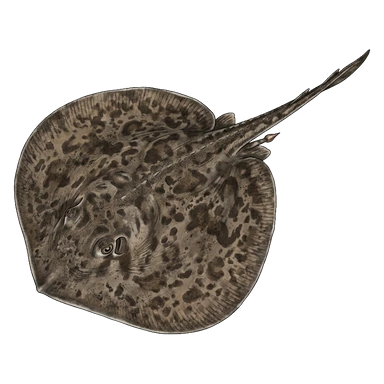
Giant freshwater stingray
 Piqûres
The giant freshwater stingray is a large ray that lives in big rivers and estuaries in Southeast Asia and Borneo. It is the widest freshwater fish in the world, and it is now endangered because of fishing and habitat loss. It has a long, whip-like tail with a sharp spine near the base.1



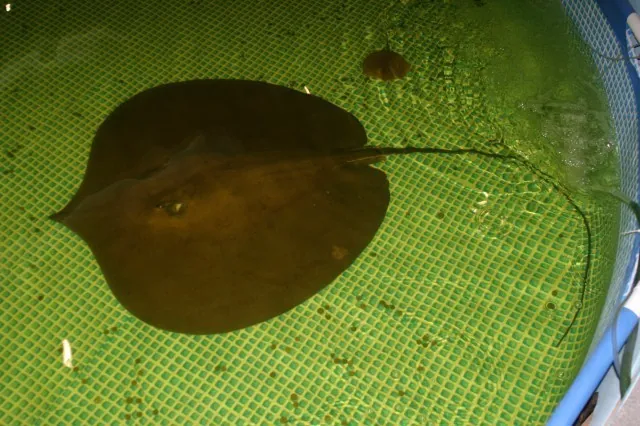
 Comment le reconnaître
- Plain grayish brown on top, often with a yellowish or pinkish tint towards the fin edges1
- White underside with broad dark bands on the rear edges of the pectoral and pelvic fins1
- Thin, whip-like tail that is black behind the spine and has no fin folds1
- Sharply pointed snout that projects beyond the disc1
- A single serrated stinging spine on the upper tail near its base, up to 38 cm long1
Souvent confondu avec : Similar freshwater stingrays in South Asia, Southeast Asia and Australasia were once tentatively grouped with this species. Some of them, such as the Australian Urogymnus dalyensis, are now described as separate species.1
Puissance du venin
Le venin sort par un dard.
Que fait son venin ?
Its sting is sheathed in toxic mucus. The sting is capable of piercing bone.1
À quel point est-il dangereux pour l'homme ?
Danger pour l'homme: GraveUne piqûre nécessite un médecin. Les décès sont très rares.The giant freshwater stingray is not aggressive. Its sting is strong enough to pierce bone and is coated in toxic mucus, so it should be treated with care.1
 S'il pique
- Plonge la plaie dans de l'eau chaude, aussi chaude que la personne peut supporter sans se brûler (teste avec ta propre main), pendant 30 à 90 minutes. Va voir un médecin, surtout pour les poissons-pierres et les raies.
Appelle toujours d'abord ton numéro d'urgence (112, 000, 911). Ce sont des conseils généraux de premiers secours, pas un avis médical. Les bases des premiers secours
 Reste en sécurité
- Ne touche, n'attrape et n'embête jamais un animal sauvage, même petit, et même s'il a l'air endormi ou mort.
- Laisse-lui de la place. Si tu en croises un, reste calme, recule doucement et laisse-le passer son chemin.
- S'il te pique : reste calme, ne bouge pas, appelle ton numéro d'urgence (112, 000, 911) ou va vite à l'hôpital. Souviens-toi de quoi il avait l'air, une photo aide.
Il ne t'en veut pas. Il utilise son venin pour attraper sa nourriture ou se protéger, et il préfère de loin se cacher. Plus d'infos pour rester en sécurité
Où dans le monde ?
Quelle taille fait-il ?
Quelle longueur fait-il ?
Combien pèse-t-il ?
 aussi long que 5 chiens du museau à la queue
 aussi long que 28 bananes mises bout à bout
 pourrait nager la longueur d'une grande piscine (50 m) en 6 secondes
Quelle taille fait Giant freshwater stingray comparé à TOI ?
Juste des calculs dans ton navigateur. Rien n'est enregistré ni envoyé nulle part.
À quelle vitesse va-t-il ?

Faits
In June 2022, a specimen caught in the Mekong River was reported as the largest strict freshwater fish ever documented, at about 300 kg.1
It is the widest freshwater fish in the world, growing up to 2.2 m across.1
Its tail spine is up to 38 cm long, the largest of any stingray species.1
Pups are nourished in the womb by a milk-like substance called histotroph, or 'uterine milk', made by the mother.1
In Cambodia, the average weight of a landed ray fell from 23.2 kg in 1980 to 6.9 kg in 2006.1
Pour les experts en venin
- Nom scientifique
- Urogymnus polylepis
- Groupe
- Poissons venimeux
- Famille
- Dasyatidae2
- Ordre
- Myliobatiformes
- Continents
- Asie
- Petits
- It gives birth to live young. Females have litters of one to four pups, each about 30 cm across at birth.1
- Comment il se porte dans la nature
- Endangered (IUCN overall); Critically Endangered in Thailand1
- Danger pour l'homme
- 3 / 5: Grave3
D'où viennent les faits
- Giant freshwater stingray (Wikipedia (CC BY-SA 4.0))
- Urogymnus polylepis (iNaturalist): noms et classification.
- Venom Wiki: le niveau de danger, la taille typique et la vitesse estimée sont les nôtres. Regarde comment on les calcule : Comment on évalue le danger.
Chaque fait sur cette page a un numéro qui renvoie à sa source. Si on s'est trompés, désolés, on est des fans d'animaux, pas une revue scientifique. Dis-le-nous à [email protected] et on corrigera.
 Le scorpion a faim ! Venom Wiki est le projet d'une seule personne : gratuit, sans pub et sans traceurs. Un petit pourboire aide à le garder en ligne.Nourris le scorpion
Plus du même groupe: Poissons venimeux
 Walking catfishPoissons venimeuxFait juste malNe pas toucher
 Asian stinging catfishPoissons venimeuxNécessite un médecinNe pas toucher
 Reef stonefishPoissons venimeuxPeut tuerNe pas toucher
 Red lionfishPoissons venimeuxNécessite un médecinNe pas toucher
 Estuarine stonefishPoissons venimeuxPeut tuerNe pas toucher
 Short-tail stingrayPoissons venimeuxPeut tuer
 Scorpion jaune de Palestine
 Cobra indien
 Vipère des pyramides indienne
 Cobra royal
 Vipère heurtante
 Vipère de Russell