
 Afrique
 Asie
Asie Europe
 Amérique du Sud
 Australie et Océanie
 Antarctique
 Océan Pacifique
 Océan Atlantique
 Océan Indien
 Océan Arctique
 Mer Méditerranée
 Mer Rouge
 Mer des Caraïbes
 Mer de Corail
 Mer de Chine méridionale
 Mer des Philippines
 Mer d'Andaman
 Mer du Nord
 Mer de Timor et d'Arafura
 Golfe du Bengale
 Golfe de Californie
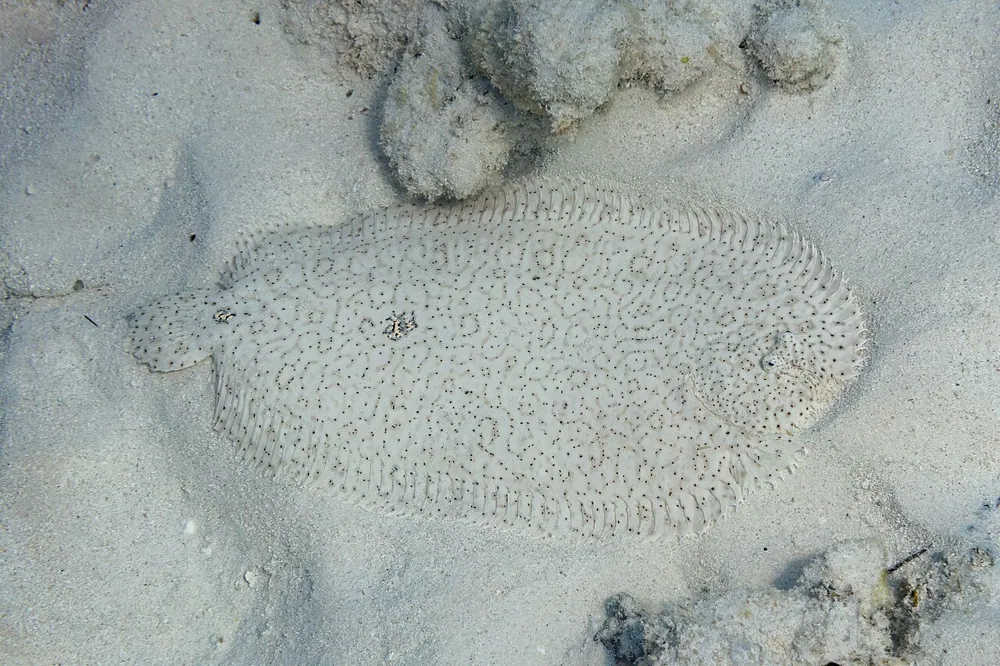
Moses sole
 Poison dans la peau
The Moses sole is a flatfish that lives in shallow coastal waters of the western Indian Ocean, from the Red Sea to Sri Lanka and along the east coast of Africa. It hides on the seabed and gives off a milky toxin from its fins to deter predators, including sharks.1

 Comment le reconnaître
- Colour is variable, often whitish, pale brown or pale grey, with irregular dark brown ring-shaped markings1
- Many dark brown spots cover the head, body and fins1
- Normally two brown dots containing yellow flecks sit along the lateral line1
- Adults have a highly compressed, flat-sided body, with both eyes on the right side of the head1
- The rounded tail fin is not joined to the dorsal or cloacal fin1
Souvent confondu avec : Mimic octopuses copy the finless sole by adapting their shape, colour and texture. They can also mimic venomous sea snakes and fish.1
Puissance du poison
Sa peau est toxique. Il est dangereux de le toucher, de le lécher ou de le manger.
Que fait son poison ?
The finless sole releases a milky toxin called an ichthyotoxin from the base of its dorsal and cloacal fins. The main toxin, pardaxin, damages cell membranes so that cells leak their contents. It irritates the sensitive gills of predator fish.1
À quel point est-il dangereux pour l'homme ?
Danger pour l'homme: LégerComme une piqûre d'abeille ou moins. Pratiquement inoffensif pour l'homme.It is caught for food and sold fresh, even though its skin secretion is poisonous.1
Que fait-il quand il a peur ?
When threatened, it releases its toxic milky secretion from its fins, and its colour helps it blend in with sandy or pebbled seabeds.1
 Si quelqu'un l'a touché ou mangé
- Si quelqu'un l'a mangé ou a des symptômes après en avoir mangé : appelle tout de suite ton numéro d'urgence ou le centre antipoison.
Appelle toujours d'abord ton numéro d'urgence (112, 000, 911). Ce sont des conseils généraux de premiers secours, pas un avis médical. Les bases des premiers secours
 Reste en sécurité
- Ne touche, n'attrape et n'embête jamais un animal sauvage, même petit, et même s'il a l'air endormi ou mort.
- Laisse-lui de la place. Si tu en croises un, reste calme, recule doucement et laisse-le passer son chemin.
- Si tu l'as touché ou mangé : ne frotte pas tes yeux ni ta bouche, lave-toi les mains et va voir un médecin.
Il ne t'en veut pas. Son poison ne sert qu'à ce que personne ne le mange. Plus d'infos pour rester en sécurité
Où dans le monde ?
Quelle taille fait-il ?
Quelle longueur fait-il ?
 aussi long que 6 briques de construction en ligne
Quelle taille fait Moses sole comparé à TOI ?
Juste des calculs dans ton navigateur. Rien n'est enregistré ni envoyé nulle part.
À quelle vitesse va-t-il ?


,_Zanz%C3%ADbar,_Tanzania,_2024-05-31,_DD_32.jpg)
Faits
One of its toxins, pardaxin-1, is 5 to 10 times more toxic than pardaxin-2 and has unusual shark-repelling properties.1
Its toxin, pardaxin, is used by the fish as a defence against sharks.1
Mimic octopuses copy its shape, colour and texture, and can also copy venomous sea snakes and fish.1
Juveniles have one eye on each side of the head, but as they mature the left eye moves to the right side.1
Eugenie Clark carried out much of the early research on this species.1
D'où viennent les faits
- Pardachirus marmoratus (Wikipedia (CC BY-SA 4.0))
- Pardachirus marmoratus (iNaturalist): noms et classification.
- Venom Wiki: le niveau de danger, la taille typique et la vitesse estimée sont les nôtres. Regarde comment on les calcule : Comment on évalue le danger.
Chaque fait sur cette page a un numéro qui renvoie à sa source. Si on s'est trompés, désolés, on est des fans d'animaux, pas une revue scientifique. Dis-le-nous à [email protected] et on corrigera.
 Le scorpion a faim ! Venom Wiki est le projet d'une seule personne : gratuit, sans pub et sans traceurs. Un petit pourboire aide à le garder en ligne.Nourris le scorpion
Plus du même groupe: Autres animaux vénéneux
 Japanese pufferfishAutres animaux vénéneuxMortel
 Hawksbill sea turtleAutres animaux vénéneuxPeut tuer
 Greenland sharkAutres animaux vénéneuxFait juste mal
 Silver-cheeked toadfishAutres animaux vénéneuxMortel
 Blackspotted pufferAutres animaux vénéneuxPeut tuer
 White-spotted pufferAutres animaux vénéneuxPeut tuer
Vit aussi en: Océan Pacifique
 Australian box jellyfishMéduses et piqueurs marinsMortelNe pas toucher
 Geography coneCônes et pieuvresMortel
 Greater blue-ringed octopusCônes et pieuvresMortel
 Southern blue-ringed octopusCônes et pieuvresMortel
 Irukandji jellyfishMéduses et piqueurs marinsPeut tuerNe pas toucher
 Reef stonefishPoissons venimeuxPeut tuerNe pas toucher