
 Afrique
 Asie
Asie Europe
 Amérique du Sud
 Australie et Océanie
 Antarctique
 Océan Pacifique
 Océan Atlantique
 Océan Indien
 Océan Arctique
 Mer Méditerranée
 Mer Rouge
 Mer des Caraïbes
 Mer de Corail
 Mer de Chine méridionale
 Mer des Philippines
 Mer d'Andaman
 Mer du Nord
 Mer de Timor et d'Arafura
 Golfe du Bengale
 Golfe de Californie
Natterjack toad
 Poison dans la peau
The natterjack toad is a toad that lives on sandy ground and heathland in Europe. It is easy to tell apart from other toads by the yellow line down its back, and it is known for its very loud mating call. In Ireland, it is the only native toad.1


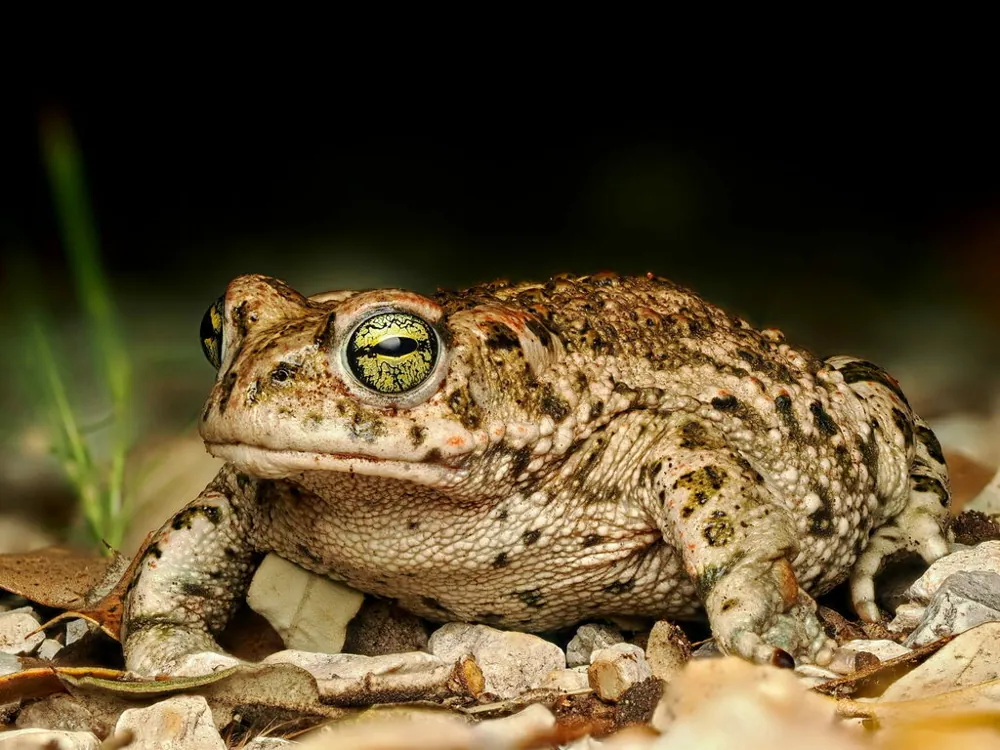
 Comment le reconnaître
- A yellow line runs down the middle of the back.1
- Parallel paratoid glands (the raised glands behind the eyes) are a key feature.1
- Adults are 60 to 70 mm long.1
- Short legs give it a distinctive walk, unlike the hopping of many other toads.1
- Males have a single vocal sac under the chin that amplifies a very loud, distinctive call.1
Souvent confondu avec : It is often confused with common toads. Natterjacks are told apart by the yellow line down the back and the parallel paratoid glands.1
Puissance du poison
Sa peau est toxique. Il est dangereux de le toucher, de le lécher ou de le manger.
À quel point est-il dangereux pour l'homme ?
Danger pour l'homme: LégerComme une piqûre d'abeille ou moins. Pratiquement inoffensif pour l'homme. Si quelqu'un l'a touché ou mangé
- Si quelqu'un en a touché un : lave-toi bien les mains et ne touche pas tes yeux ni ta bouche. Si un enfant ou un animal en a léché ou mangé un : appelle le centre antipoison ou ton numéro d'urgence.
Appelle toujours d'abord ton numéro d'urgence (112, 000, 911). Ce sont des conseils généraux de premiers secours, pas un avis médical. Les bases des premiers secours
 Reste en sécurité
- Ne touche, n'attrape et n'embête jamais un animal sauvage, même petit, et même s'il a l'air endormi ou mort.
- Laisse-lui de la place. Si tu en croises un, reste calme, recule doucement et laisse-le passer son chemin.
- Si tu l'as touché ou mangé : ne frotte pas tes yeux ni ta bouche, lave-toi les mains et va voir un médecin.
Il ne t'en veut pas. Son poison ne sert qu'à ce que personne ne le mange. Plus d'infos pour rester en sécurité
Où dans le monde ?
Quelle taille fait-il ?
Quelle longueur fait-il ?
 aussi long que 2 briques de construction en ligne
 pourrait parcourir 100 mètres en 180 secondes (l'humain le plus rapide met 9,6)
Quelle taille fait Natterjack toad comparé à TOI ?
Juste des calculs dans ton navigateur. Rien n'est enregistré ni envoyé nulle part.
À quelle vitesse va-t-il ?


Faits
Their loud mating calls matter because the toads are often present in low numbers, helping the sexes find each other.1
Natterjacks can live for up to 15 years.1
Natterjacks can only spawn in pools with a very slightly sloping bottom and sparse vegetation.1
They spread their breeding over a long summer period, so some young survive if temporary pools dry out.1
Some females spawn twice in one year.1
Pour les experts en venin
- Nom scientifique
- Epidalea calamita
- Groupe
- Grenouilles toxiques, crapauds et tritons
- Famille
- Bufonidae2
- Ordre
- Anura
- Continents
- Europe
- Petits
- It spawns from the end of April to July, laying strings of eggs in shallow, warm pools.1
- Durée de vie
- environ 15 ans1
- Comment il se porte dans la nature
- Endangered in Ireland1
- Danger pour l'homme
- 1 / 5: Léger3
D'où viennent les faits
- Natterjack toad (Wikipedia (CC BY-SA 4.0))
- Epidalea calamita (iNaturalist): noms et classification.
- Venom Wiki: le niveau de danger, la taille typique et la vitesse estimée sont les nôtres. Regarde comment on les calcule : Comment on évalue le danger.
Chaque fait sur cette page a un numéro qui renvoie à sa source. Si on s'est trompés, désolés, on est des fans d'animaux, pas une revue scientifique. Dis-le-nous à [email protected] et on corrigera.
 Le scorpion a faim ! Venom Wiki est le projet d'une seule personne : gratuit, sans pub et sans traceurs. Un petit pourboire aide à le garder en ligne.Nourris le scorpion
Plus du même groupe: Grenouilles toxiques, crapauds et tritons
 Fire salamanderGrenouilles toxiques, crapauds et tritonsFait juste malNe pas toucher
 Common toadGrenouilles toxiques, crapauds et tritonsFait juste malNe pas toucher
 European fire-bellied toadGrenouilles toxiques, crapauds et tritonsInoffensif
 Iberian ribbed newtGrenouilles toxiques, crapauds et tritonsInoffensif
 Alpine salamanderGrenouilles toxiques, crapauds et tritonsInoffensif
 European green toadGrenouilles toxiques, crapauds et tritonsInoffensif
Vit aussi en: Europe
 Common European adderVipèresNécessite un médecin
 Spanish flyAutres animaux vénéneuxNécessite un médecinNe pas toucher
 Common waspAbeilles, guêpes et frelonsFait juste mal
 European hornetAbeilles, guêpes et frelonsFait juste mal
 Western honey beeAbeilles, guêpes et frelonsFait juste mal
 Blunt-nosed viperVipèresPeut tuer