
 Afrique
 Asie
Asie Europe
 Amérique du Sud
 Australie et Océanie
 Antarctique
 Océan Pacifique
 Océan Atlantique
 Océan Indien
 Océan Arctique
 Mer Méditerranée
 Mer Rouge
 Mer des Caraïbes
 Mer de Corail
 Mer de Chine méridionale
 Mer des Philippines
 Mer d'Andaman
 Mer du Nord
 Mer de Timor et d'Arafura
 Golfe du Bengale
 Golfe de Californie
Alpine salamander
 Poison dans la peau
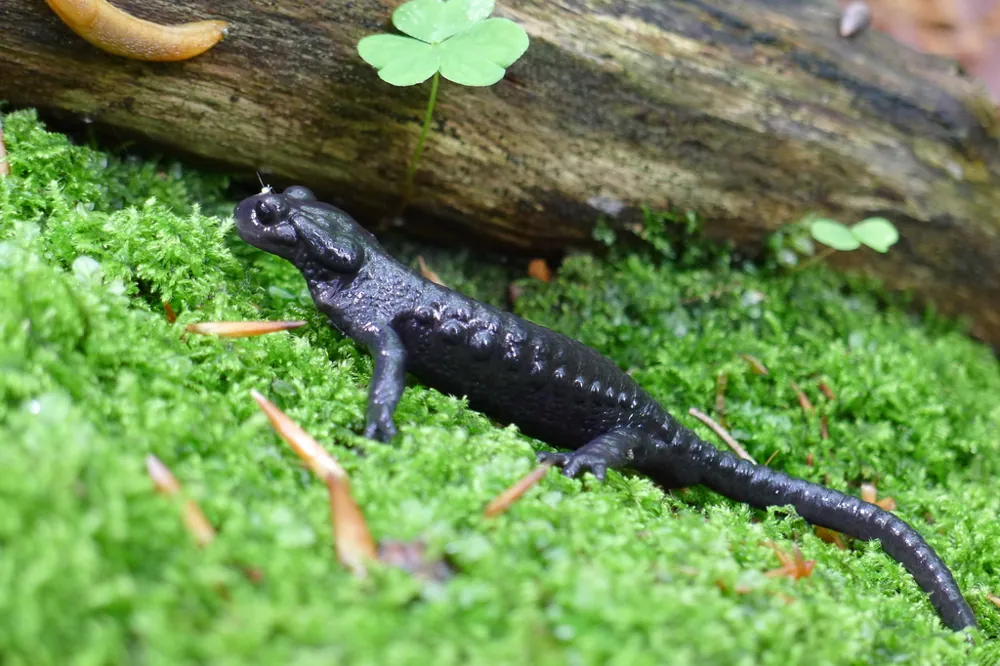
The alpine salamander is a dark, slow-moving amphibian that lives high in the mountains of Europe. It spends its whole life on land, sheltering under stones, logs and in rock crevices. It produces toxic compounds from its skin, which help protect it from predators.1
 Comment le reconnaître
- Usually small and dark brown or black1
- Some forms have yellow, golden or white spots or marks on the back and head1
- Males have swollen, visible cloacae and are slimmer than females1
- Elongated head shape, with glands behind and beside the eyes1
- Between 11 and 13 grooves along each side of the body, and a double row of glands down the back1
Souvent confondu avec : Lanza's alpine salamander (Salamandra lanzai) is a similar species that lives in one small area of the western Alps. The Corsican fire salamander (Salamandra corsica) is the alpine salamander's closest related species.1
Puissance du poison
Sa peau est toxique. Il est dangereux de le toucher, de le lécher ou de le manger.
Que fait son poison ?
Alpine salamanders produce toxic compounds from their skin. These compounds may protect them from predators and from microbes.1
À quel point est-il dangereux pour l'homme ?
Danger pour l'homme: LégerComme une piqûre d'abeille ou moins. Pratiquement inoffensif pour l'homme.Que fait-il quand il a peur ?
Their yellow markings are thought to be a warning colour that deters predators, and the pure black colouring may also warn some predators off.1
 Si quelqu'un l'a touché ou mangé
- Si quelqu'un en a touché un : lave-toi bien les mains et ne touche pas tes yeux ni ta bouche. Si un enfant ou un animal en a léché ou mangé un : appelle le centre antipoison ou ton numéro d'urgence.
Appelle toujours d'abord ton numéro d'urgence (112, 000, 911). Ce sont des conseils généraux de premiers secours, pas un avis médical. Les bases des premiers secours
 Reste en sécurité
- Ne touche, n'attrape et n'embête jamais un animal sauvage, même petit, et même s'il a l'air endormi ou mort.
- Laisse-lui de la place. Si tu en croises un, reste calme, recule doucement et laisse-le passer son chemin.
- Si tu l'as touché ou mangé : ne frotte pas tes yeux ni ta bouche, lave-toi les mains et va voir un médecin.
Il ne t'en veut pas. Son poison ne sert qu'à ce que personne ne le mange. Plus d'infos pour rester en sécurité
Où dans le monde ?
Quelle taille fait-il ?
Quelle longueur fait-il ?
 aussi long que 5 briques de construction en ligne
Quelle taille fait Alpine salamander comparé à TOI ?
Juste des calculs dans ton navigateur. Rien n'est enregistré ni envoyé nulle part.
À quelle vitesse va-t-il ?


Faits
Alpine salamanders are fully terrestrial, so they never need water to breed. Unlike many salamanders, their young do not develop as larvae in water.1
Young snakes, especially juvenile European adders, are a notable predator. In some locations, alpine salamanders make up just under half of these snakes' diet.1
They mark their territory with faecal pellets. Their scent tells other salamanders whether a pellet was left by a member of the same sex and species, and warns them that the site is already claimed.1
They are very stationary animals. The furthest a tracked individual was seen to travel in one summer was 12 metres.1
Their colour varies a great deal. Some populations are completely black, while others have bright yellow, white or grey spotting.1
Alpine salamanders cannot regulate their own body temperature, so losing a shelter can be extremely costly, and even fatal.1
Pour les experts en venin
- Nom scientifique
- Salamandra atra
- Groupe
- Grenouilles toxiques, crapauds et tritons
- Famille
- Salamandridae2
- Ordre
- Caudata
- Continents
- Europe
- Petits
- They give birth to live young. Their larvae do not develop in water, because the whole life cycle takes place on land.1
- Durée de vie
- environ 10 ans1
- Comment il se porte dans la nature
- Least Concern (IUCN Red List), although their numbers are decreasing and the subspecies S. a. aurorae is declining more quickly1
- Danger pour l'homme
- 1 / 5: Léger3
D'où viennent les faits
- Alpine salamander (Wikipedia (CC BY-SA 4.0))
- Salamandra atra (iNaturalist): noms et classification.
- Venom Wiki: le niveau de danger, la taille typique et la vitesse estimée sont les nôtres. Regarde comment on les calcule : Comment on évalue le danger.
Chaque fait sur cette page a un numéro qui renvoie à sa source. Si on s'est trompés, désolés, on est des fans d'animaux, pas une revue scientifique. Dis-le-nous à [email protected] et on corrigera.
 Le scorpion a faim ! Venom Wiki est le projet d'une seule personne : gratuit, sans pub et sans traceurs. Un petit pourboire aide à le garder en ligne.Nourris le scorpion
Plus du même groupe: Grenouilles toxiques, crapauds et tritons
 Fire salamanderGrenouilles toxiques, crapauds et tritonsFait juste malNe pas toucher
 Common toadGrenouilles toxiques, crapauds et tritonsFait juste malNe pas toucher
 European fire-bellied toadGrenouilles toxiques, crapauds et tritonsInoffensif
 Iberian ribbed newtGrenouilles toxiques, crapauds et tritonsInoffensif
 Natterjack toadGrenouilles toxiques, crapauds et tritonsInoffensif
 European green toadGrenouilles toxiques, crapauds et tritonsInoffensif
Vit aussi en: Europe
 Common European adderVipèresNécessite un médecin
 Spanish flyAutres animaux vénéneuxNécessite un médecinNe pas toucher
 Common waspAbeilles, guêpes et frelonsFait juste mal
 European hornetAbeilles, guêpes et frelonsFait juste mal
 Western honey beeAbeilles, guêpes et frelonsFait juste mal
 Blunt-nosed viperVipèresPeut tuer