
 Afrique
 Asie
Asie Europe
 Amérique du Sud
 Australie et Océanie
 Antarctique
 Océan Pacifique
 Océan Atlantique
 Océan Indien
 Océan Arctique
 Mer Méditerranée
 Mer Rouge
 Mer des Caraïbes
 Mer de Corail
 Mer de Chine méridionale
 Mer des Philippines
 Mer d'Andaman
 Mer du Nord
 Mer de Timor et d'Arafura
 Golfe du Bengale
 Golfe de Californie
Portuguese man o' war
 Tentacules urticants
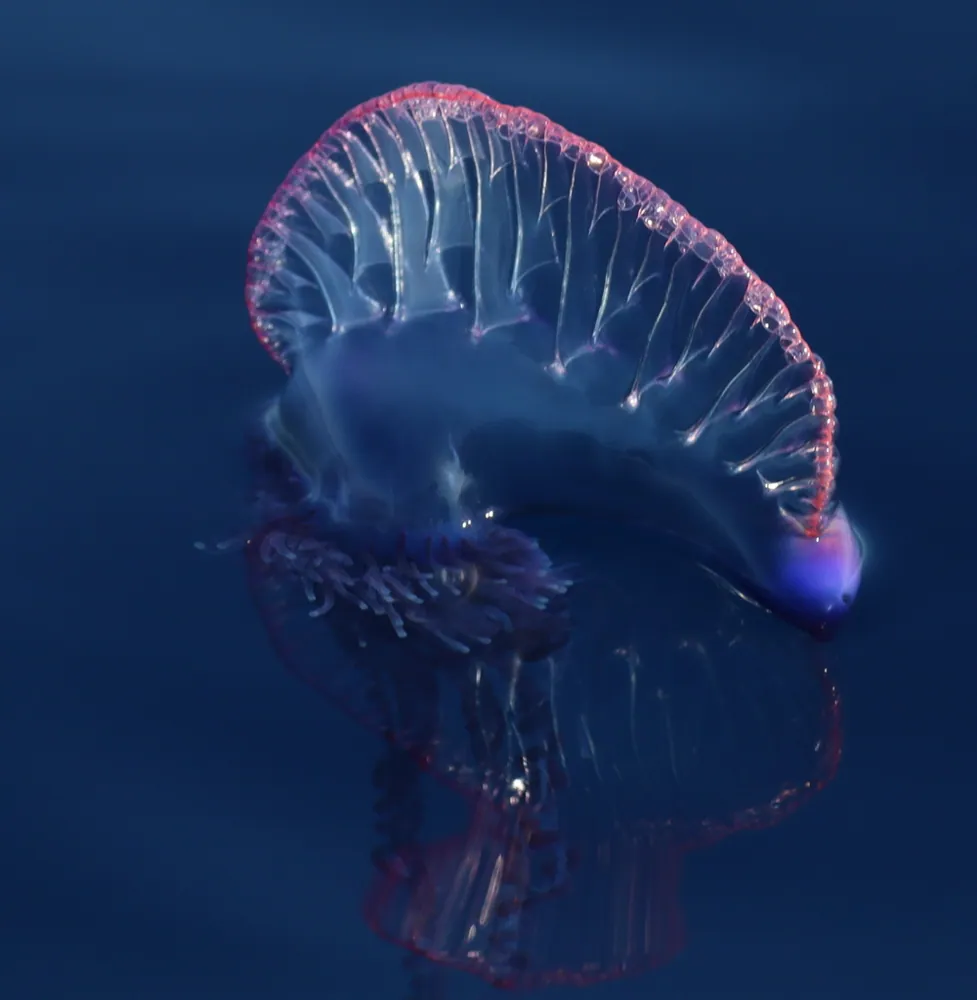
The Portuguese man o' war looks like a jellyfish, but it is actually a colony of many tiny linked animals that work together as one. It drifts on the surface of the Atlantic, Indian and Pacific oceans, and its long tentacles sting prey. Its sting is painful to people, and in some cases it can kill them.1



 Comment le reconnaître
- A gas-filled bladder called the pneumatophore floats on the surface and acts as a sail.1
- Long tentacles, which can reach over 30 m, hang below the surface.1
- The float can be up to 30 cm long, 13 cm wide and 15 cm tall.1
- Groups can be large, sometimes over 1,000 animals.1
- The sail may be left- or right-handed, depending on the way the wind catches it.1
Souvent confondu avec : It superficially resembles a jellyfish, but it is a siphonophore, a colonial animal made of many smaller units called zooids.1
Puissance du venin
Des milliers de minuscules cellules urticantes se déclenchent quand quelque chose les touche.
Que fait son venin ?
Its tentacles carry nematocysts, tiny coiled, thread-like stingers that inject venom on contact. The venom can paralyse small fish and other prey. The sting is powerful enough to kill fish, crustaceans and, in some cases, humans.1
À quel point est-il dangereux pour l'homme ?
Danger pour l'homme: GraveUne piqûre nécessite un médecin. Les décès sont très rares.Its stings are painful and it is well known to beachgoers. In some cases the sting can kill humans. Large groups can also reduce fish populations and damage fishing supplies.1
Que fait-il quand il a peur ?
When attacked at the surface, it can deflate its pneumatophore and temporarily submerge.1
 S'il pique
- Sors de l'eau et enlève les tentacules restés collés (avec des gants ou un tissu).
- Pour les cuboméduses tropicales : verse du vinaigre sur les piqûres pendant au moins 30 secondes, appelle les secours et sois prêt à faire un massage cardiaque. Pour les physalies et la plupart des autres : rince à l'eau de mer, puis à l'eau chaude contre la douleur.
Appelle toujours d'abord ton numéro d'urgence (112, 000, 911). Ce sont des conseils généraux de premiers secours, pas un avis médical. Les bases des premiers secours
 Reste en sécurité
- Ne touche, n'attrape et n'embête jamais un animal sauvage, même petit, et même s'il a l'air endormi ou mort.
- Laisse-lui de la place. Si tu en croises un, reste calme, recule doucement et laisse-le passer son chemin.
- S'il te pique : reste calme, ne bouge pas, appelle ton numéro d'urgence (112, 000, 911) ou va vite à l'hôpital. Souviens-toi de quoi il avait l'air, une photo aide.
Il ne t'en veut pas. Il utilise son venin pour attraper sa nourriture ou se protéger, et il préfère de loin se cacher. Plus d'infos pour rester en sécurité
Où dans le monde ?
Quelle taille fait-il ?
Quelle longueur fait-il ?
 aussi long que 5 briques de construction en ligne
 pourrait nager la longueur d'une grande piscine (50 m) en 180 secondes
Quelle taille fait Portuguese man o' war comparé à TOI ?
Juste des calculs dans ton navigateur. Rien n'est enregistré ni envoyé nulle part.
À quelle vitesse va-t-il ?

Faits
It is not a single animal. It is a colony of zooids, all genetically identical, that work together like organs in one body.1
The blanket octopus is immune to its venom and uses broken tentacles as weapons.1
Its float can produce carbon monoxide, which makes up as much as 13% of the gas inside it.1
The loggerhead sea turtle eats it regularly, because its thick skin protects it from the stings.1
The man-of-war fish can live among its tentacles and feeds on them, while avoiding being stung.1
Démêle le vrai du faux
Idée reçue : It is a jellyfish.
Vérité : It only looks like a jellyfish. It is a siphonophore, a colony of many linked zooids.1
Pour les experts en venin
- Nom scientifique
- Physalia physalis
- Groupe
- Méduses et piqueurs marins
- Famille
- Physaliidae2
- Ordre
- Siphonophorae
- Continents
- Océan Atlantique, Océan Pacifique, Océan Indien, Mer Méditerranée, Mer des Caraïbes, Golfe du Mexique, Les océans
- Petits
- Each colony is either male or female, and eggs or sperm are released into the water, where a fertilised egg develops into a planula (a free-swimming larva) that grows into a new colony.1
- Danger pour l'homme
- 3 / 5: Grave3
D'où viennent les faits
- Portuguese man o' war (Wikipedia (CC BY-SA 4.0))
- Physalia physalis (iNaturalist): noms et classification.
- Venom Wiki: le niveau de danger, la taille typique et la vitesse estimée sont les nôtres. Regarde comment on les calcule : Comment on évalue le danger.
Chaque fait sur cette page a un numéro qui renvoie à sa source. Si on s'est trompés, désolés, on est des fans d'animaux, pas une revue scientifique. Dis-le-nous à [email protected] et on corrigera.
 Le scorpion a faim ! Venom Wiki est le projet d'une seule personne : gratuit, sans pub et sans traceurs. Un petit pourboire aide à le garder en ligne.Nourris le scorpion
Plus du même groupe: Méduses et piqueurs marins
 Guêpe de merMéduses et piqueurs marinsMortelNe pas toucher
 Irukandji jellyfishMéduses et piqueurs marinsPeut tuerNe pas toucher
 Lion's mane jellyfishMéduses et piqueurs marinsFait juste malNe pas toucher
 Moon jellyfishMéduses et piqueurs marinsInoffensif
 Common kingslayerMéduses et piqueurs marinsPeut tuerNe pas toucher
 Hell's fire anemoneMéduses et piqueurs marinsNécessite un médecinNe pas toucher
Vit aussi en: Océan Atlantique
 Hawksbill sea turtleAutres animaux vénéneuxPeut tuer
 Blue sea dragonCônes et pieuvresFait juste mal
 Greenland sharkAutres animaux vénéneuxFait juste mal
 Common octopusCônes et pieuvresInoffensif
 Common stingrayPoissons venimeuxNécessite un médecin
 Greater weeverPoissons venimeuxNécessite un médecinNe pas toucher