
 Afrique
 Asie
Asie Europe
 Amérique du Sud
 Australie et Océanie
 Antarctique
 Océan Pacifique
 Océan Atlantique
 Océan Indien
 Océan Arctique
 Mer Méditerranée
 Mer Rouge
 Mer des Caraïbes
 Mer de Corail
 Mer de Chine méridionale
 Mer des Philippines
 Mer d'Andaman
 Mer du Nord
 Mer de Timor et d'Arafura
 Golfe du Bengale
 Golfe de Californie
Tiny clinging box jellyfish
 Tentacules urticants
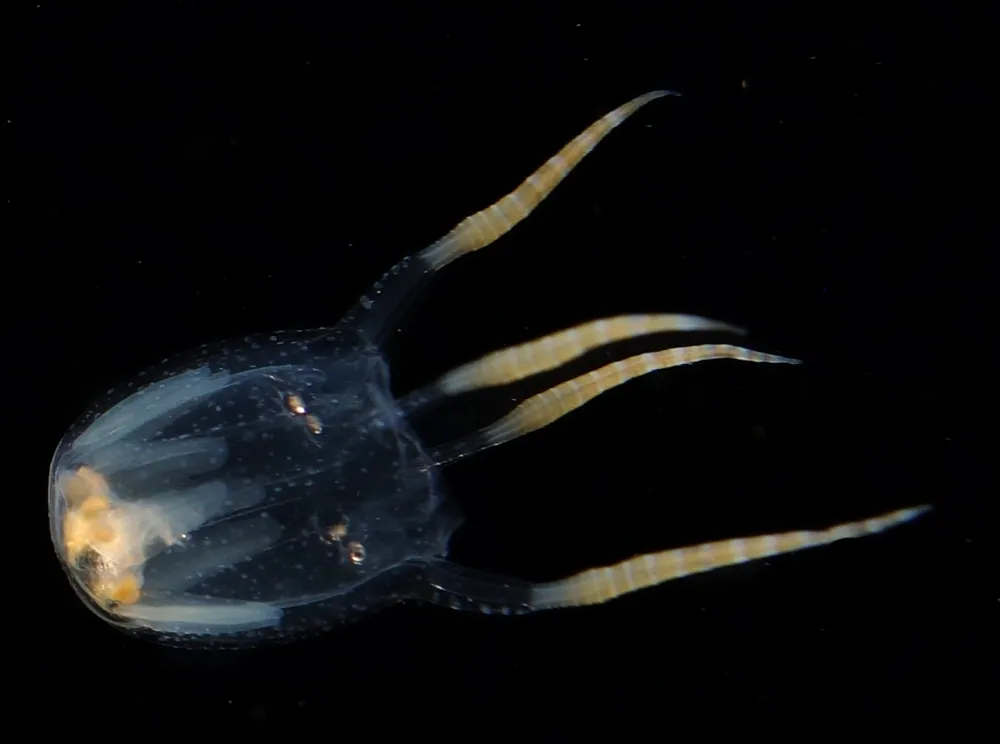
Copula sivickisi is a tiny box jellyfish, about 1 cm across, that lives in shallow warm seas. It is the only species in its genus and is active only at night. It is unusual among box jellyfish because it has a mating ritual and fertilises its eggs inside the body.1



 Comment le reconnaître
- The bell is boxy in shape, unlike the umbrella shape of true jellyfish.1
- It has four slender tentacles hanging from the rim, each banded with orange.1
- The eight gonads (reproductive organs) can be seen through the transparent bell. In males they are orange, and in females they are white-speckled.1
- Mature females have orange-brown markings around the edge of the bell.1
- It is most active at night and hides during the day, folding its tentacles inside the bell and flattening itself.1
Puissance du venin
Des milliers de minuscules cellules urticantes se déclenchent quand quelque chose les touche.
À quel point est-il dangereux pour l'homme ?
Danger pour l'homme: LégerComme une piqûre d'abeille ou moins. Pratiquement inoffensif pour l'homme.Que fait-il quand il a peur ?
When disturbed by day it hides, folding its tentacles inside the bell and flattening itself against the seabed.1
 S'il pique
- Sors de l'eau et enlève les tentacules restés collés (avec des gants ou un tissu).
- Pour les cuboméduses tropicales : verse du vinaigre sur les piqûres pendant au moins 30 secondes, appelle les secours et sois prêt à faire un massage cardiaque. Pour les physalies et la plupart des autres : rince à l'eau de mer, puis à l'eau chaude contre la douleur.
Appelle toujours d'abord ton numéro d'urgence (112, 000, 911). Ce sont des conseils généraux de premiers secours, pas un avis médical. Les bases des premiers secours
 Reste en sécurité
- Ne touche, n'attrape et n'embête jamais un animal sauvage, même petit, et même s'il a l'air endormi ou mort.
- Laisse-lui de la place. Si tu en croises un, reste calme, recule doucement et laisse-le passer son chemin.
- S'il te pique : reste calme, ne bouge pas, appelle ton numéro d'urgence (112, 000, 911) ou va vite à l'hôpital. Souviens-toi de quoi il avait l'air, une photo aide.
Il ne t'en veut pas. Il utilise son venin pour attraper sa nourriture ou se protéger, et il préfère de loin se cacher. Plus d'infos pour rester en sécurité
Où dans le monde ?
Quelle taille fait-il ?
Quelle longueur fait-il ?
 assez petit pour tenir sur ton ongle
Quelle taille fait Tiny clinging box jellyfish comparé à TOI ?
Juste des calculs dans ton navigateur. Rien n'est enregistré ni envoyé nulle part.
À quelle vitesse va-t-il ?


Faits
It has twenty-four eyes, grouped on four stalked structures called rhopalia on the rim of the bell.1
Unlike most box jellyfish, it has an elaborate mating ritual. A male grabs a female by one tentacle and pulls her around while they entwine.1
A female has been seen mating with several males, up to eight times in a two-hour period.1
It is attracted to light, and it chooses a spot on the seabed soon after dawn, spending a few minutes selecting a good location before settling there.1
Its average maximum swimming speed is 4.9 cm per second, which is faster than the currents near the surface of the shallow waters where it lives.1
The male passes a red bundle of sperm (a spermatophore) to one of the female's tentacles, which pushes it into her manubrium, the tube hanging from the underside of the bell.1
Pour les experts en venin
- Nom scientifique
- Copula sivickisi
- Groupe
- Méduses et piqueurs marins
- Famille
- Tripedaliidae2
- Ordre
- Carybdeida
- Continents
- Océan Pacifique, Océan Atlantique, Mer de Timor et d'Arafura, Les océans
- Petits
- Eggs are fertilised inside the female's bell. About two or three days later she releases a mucous strand of embryos into the sea, and these develop into polyps.1
- Danger pour l'homme
- 1 / 5: Léger3
D'où viennent les faits
- Copula sivickisi (Wikipedia (CC BY-SA 4.0))
- Copula sivickisi (iNaturalist): noms et classification.
- Venom Wiki: le niveau de danger, la taille typique et la vitesse estimée sont les nôtres. Regarde comment on les calcule : Comment on évalue le danger.
Chaque fait sur cette page a un numéro qui renvoie à sa source. Si on s'est trompés, désolés, on est des fans d'animaux, pas une revue scientifique. Dis-le-nous à [email protected] et on corrigera.
 Le scorpion a faim ! Venom Wiki est le projet d'une seule personne : gratuit, sans pub et sans traceurs. Un petit pourboire aide à le garder en ligne.Nourris le scorpion
Plus du même groupe: Méduses et piqueurs marins
 Guêpe de merMéduses et piqueurs marinsMortelNe pas toucher
 Irukandji jellyfishMéduses et piqueurs marinsPeut tuerNe pas toucher
 Portuguese man o' warMéduses et piqueurs marinsNécessite un médecinNe pas toucher
 Lion's mane jellyfishMéduses et piqueurs marinsFait juste malNe pas toucher
 Moon jellyfishMéduses et piqueurs marinsInoffensif
 Common kingslayerMéduses et piqueurs marinsPeut tuerNe pas toucher
 Cône géographe
 Grand poulpe à anneaux bleus
 Fugu tigre
 Poulpe à anneaux bleus du Sud
 Hawksbill sea turtle
 Reef stonefish