
 Afrique
 Asie
Asie Europe
 Amérique du Sud
 Australie et Océanie
 Antarctique
 Océan Pacifique
 Océan Atlantique
 Océan Indien
 Océan Arctique
 Mer Méditerranée
 Mer Rouge
 Mer des Caraïbes
 Mer de Corail
 Mer de Chine méridionale
 Mer des Philippines
 Mer d'Andaman
 Mer du Nord
 Mer de Timor et d'Arafura
 Golfe du Bengale
 Golfe de Californie
Toxic zoanthid
 Poison dans la peau
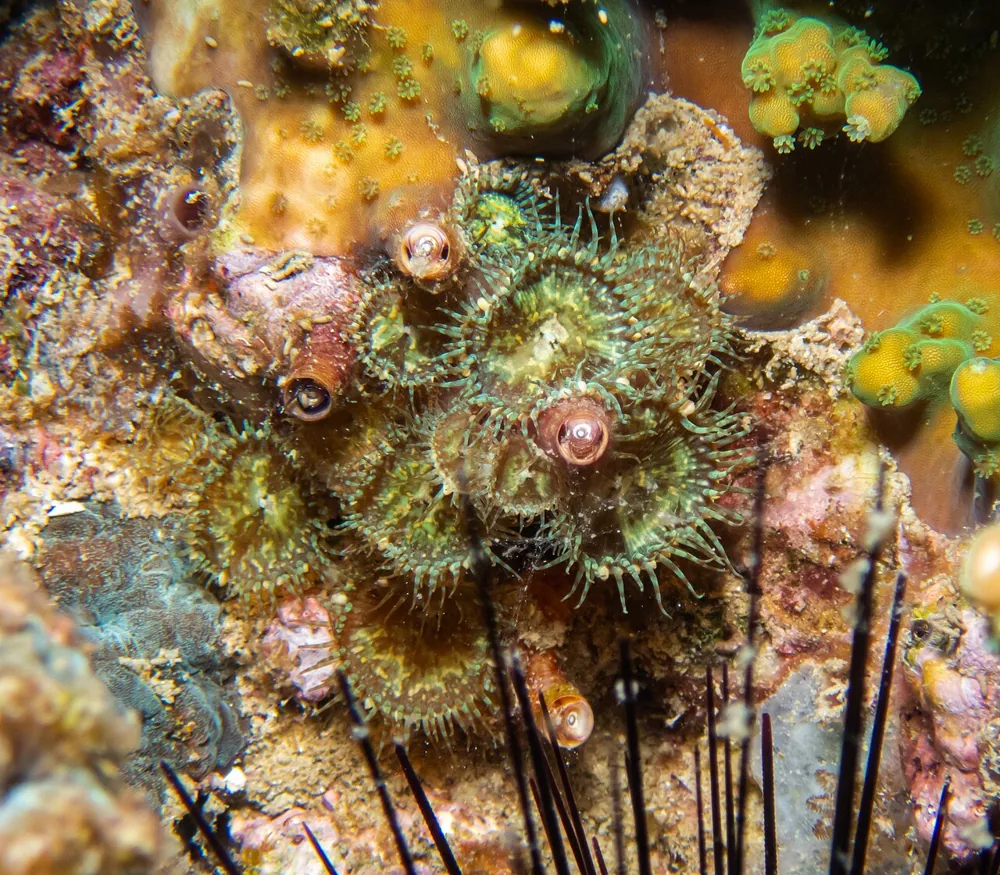
Palythoa toxica is a small, crust-like sea animal, called a zoanthid, that grows on rocks. It lives in Hawaii and is special because it is the species from which the very poisonous substance palytoxin was first discovered and isolated.1
 Comment le reconnaître
- It grows as a flat, encrusting layer over rock.1
- It has a firm, tough outer covering.1
- Its polyps are partly sunk into a cushiony mat that spreads across the rock and contains sand grains and bits of debris.1
- Each polyp has a broad mouth disc with a fringe of tentacles.1
- Its colour varies but is usually cream, grey or pale brown.1
Puissance du poison
Sa peau est toxique. Il est dangereux de le toucher, de le lécher ou de le manger.
Que fait son poison ?
It is not venomous in the sense of injecting venom with a bite or sting. It contains palytoxin, one of the most poisonous substances known.1
À quel point est-il dangereux pour l'homme ?
Danger pour l'homme: Très dangereuxIl peut tuer une personne qui n'est pas soignée.Palytoxin is one of the most poisonous substances known, and people have been poisoned by handling this animal in reef aquariums.1
 Si quelqu'un l'a touché ou mangé
- Si quelqu'un l'a mangé ou a des symptômes après en avoir mangé : appelle tout de suite ton numéro d'urgence ou le centre antipoison.
Appelle toujours d'abord ton numéro d'urgence (112, 000, 911). Ce sont des conseils généraux de premiers secours, pas un avis médical. Les bases des premiers secours
 Reste en sécurité
- Ne touche, n'attrape et n'embête jamais un animal sauvage, même petit, et même s'il a l'air endormi ou mort.
- Laisse-lui de la place. Si tu en croises un, reste calme, recule doucement et laisse-le passer son chemin.
- Si tu l'as touché ou mangé : ne frotte pas tes yeux ni ta bouche, lave-toi les mains et va voir un médecin.
Il ne t'en veut pas. Son poison ne sert qu'à ce que personne ne le mange. Plus d'infos pour rester en sécurité
Où dans le monde ?
Quelle taille fait-il ?
Quelle longueur fait-il ?
 plus court que ton petit doigt
Quelle taille fait Toxic zoanthid comparé à TOI ?
Juste des calculs dans ton navigateur. Rien n'est enregistré ni envoyé nulle part.
À quelle vitesse va-t-il ?


Faits
Early Hawaiians used this animal to poison the tips of their weapons, and a legend says warriors could break a taboo and dip their spear tips into its pool when under severe threat.1
In 1961 researchers took specimens from the pool despite local advice, and the laboratories of the Hawaiian Institute of Marine Biology on Coconut Island were destroyed by fire on that same day.1
Palythoa toxica is the species in which palytoxin was first discovered and first isolated.1
Unlike a related species, P. toxica is equally toxic all year round rather than changing with the seasons.1
Palytoxin has also been found in other Palythoa species, some algae, and certain crabs and fish, and it has been suggested that a dinoflagellate in the genus Ostreopsis produces the toxin.1
D'où viennent les faits
- Palythoa toxica (Wikipedia (CC BY-SA 4.0))
- Palythoa toxica (iNaturalist): noms et classification.
- Venom Wiki: le niveau de danger, la taille typique et la vitesse estimée sont les nôtres. Regarde comment on les calcule : Comment on évalue le danger.
Chaque fait sur cette page a un numéro qui renvoie à sa source. Si on s'est trompés, désolés, on est des fans d'animaux, pas une revue scientifique. Dis-le-nous à [email protected] et on corrigera.
 Le scorpion a faim ! Venom Wiki est le projet d'une seule personne : gratuit, sans pub et sans traceurs. Un petit pourboire aide à le garder en ligne.Nourris le scorpion
Plus du même groupe: Autres animaux vénéneux
 Fugu tigre
 Hawksbill sea turtle
 Greenland shark
 Silver-cheeked toadfish
 Blackspotted puffer
 White-spotted puffer
Vit aussi en: Océan Pacifique
 Guêpe de merMéduses et piqueurs marinsMortelNe pas toucher
 Cône géographeCônes et pieuvresMortel
 Grand poulpe à anneaux bleusCônes et pieuvresMortel
 Poulpe à anneaux bleus du SudCônes et pieuvresMortel
 Irukandji jellyfishMéduses et piqueurs marinsPeut tuerNe pas toucher
 Reef stonefishPoissons venimeuxPeut tuerNe pas toucher