
 África
 Asia
Asia Europa
 América do Sur
 Australia e Oceanía
 Antártida
 Océano Pacífico
 Océano Atlántico
 Océano Índico
 Océano Glacial Ártico
 Mar Mediterráneo
 Mar Vermello
 Mar Caribe
 Mar do Coral
 Mar da China Meridional
 Mar de Filipinas
 Mar de Andamán
 Mar do Norte
 Mar de Timor e de Arafura
 Golfo de Bengala
 Golfo de California
Clinging jellyfish
 Tentáculos que pican
The clinging jellyfish is a small jellyfish, with a bell only 1 to 3 cm across. It lives in shallow coastal waters across much of the Northern Hemisphere. Its sting can be strong in some areas, so it is worth knowing what it looks like.1



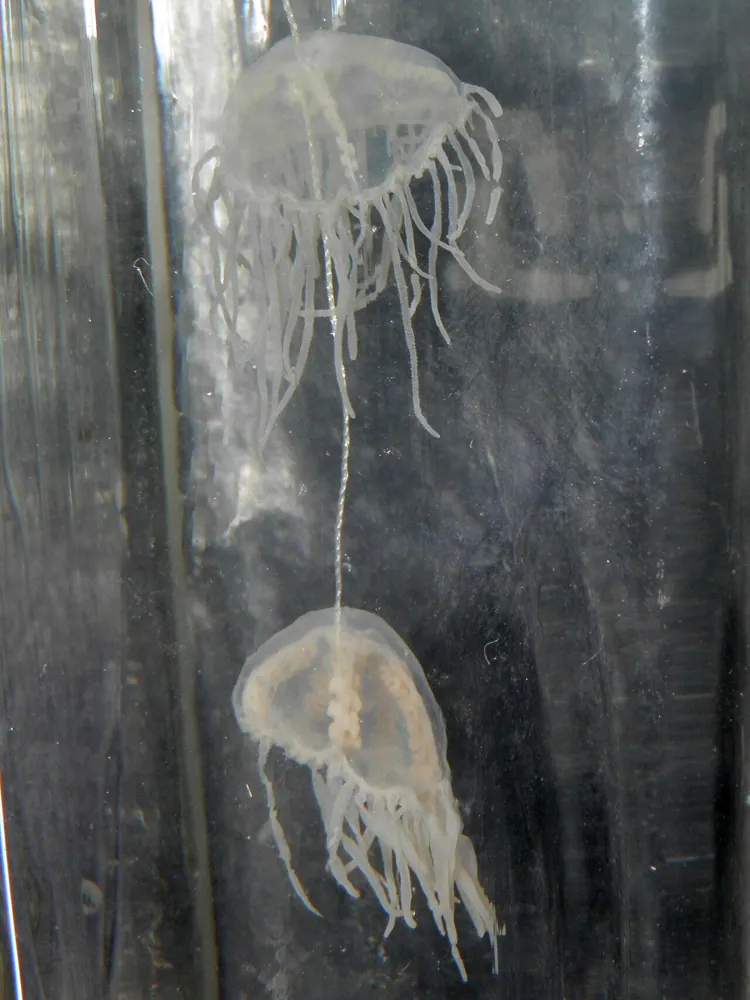
 Como recoñecelo
- Has a transparent bell lined with about 60 to 80 tentacles1
- Gonads are orange, red or violet in females and yellow-brown in males1
- The tan manubrium (mouth structure) hangs down in the middle of the bell1
- Bell is usually 1 to 3 cm across; a tentacle can be twice the bell's diameter when fully extended1
Poder da pezoña
Miles de pequenas células urticantes disparan cando algo as toca.
Que fai a súa pezoña?
Its sting can cause pain, a swollen throat, chest tightness, muscle cramps, neuropsychiatric changes (effects on mood, thinking or behaviour) and anaphylactic shock, a severe allergic reaction.1
Que perigoso é para as persoas?
Perigo para as persoas: GraveUnha picadura precisa un médico. As mortes son moi raras.In much of its range the sting is strong enough to cause serious symptoms. Stinging incidents have been reported from East Asia, Europe and the Atlantic coast of the United States. Off North America's northeast Pacific coast, its sting cannot be felt and it is considered harmless to people.1
 Se pica
- Sae da auga e quita os tentáculos que queden (con luvas ou cun pano).
- Para as cubomedusas tropicais: bota vinagre nas picaduras durante polo menos 30 segundos, pide axuda e prepárate para facer a RCP. Para as carabelas portuguesas e a maioría das outras: aclara con auga de mar e despois con auga quente para a dor.
Chama sempre primeiro ao teu número de emerxencias (112, 000, 911). Isto son consellos xerais de primeiros auxilios, non consello médico. Primeiros auxilios básicos
 Mantente a salvo
- Nunca toques, collas nin molestes un animal salvaxe, aínda que sexa pequeno e aínda que pareza durmido ou morto.
- Déixalle espazo. Se atopas un, mantén a calma, recúa amodo e déixao ir polo seu camiño.
- Se un te pica: mantén a calma, non te movas, chama ao teu número de emerxencias (112, 000, 911) ou vai rápido a un hospital. Lembra como era, unha foto axuda.
Non vai a por ti. Usa a súa pezoña para cazar comida ou para defenderse, e prefire con moito agocharse. Máis sobre como estar a salvo
En que lugar do mundo?
Que tamaño ten?
Canto mide?
 mide máis ou menos coma un clip
Que tamaño ten Clinging jellyfish comparado CONTIGO?
Só son contas no teu navegador. Non se garda nin se envía nada a ningures.
Que rápido é?


Datos
Some scientists think the clinging jellyfish may be a group of closely related species, because its sting and body shape vary from place to place.1
The jellyfish appear once the water warms to about 17 to 18 °C, so they follow a yearly pattern and sometimes appear in large numbers at once.1
The medusa (jellyfish) stage usually lasts no more than three months, but the polyp stage can last for years.1
Polyps can split into several new polyps by budding.1
In Europe, the species is non-native and has been found in the Mediterranean and along the Atlantic coast from Portugal to Norway and Sweden.1
Desmontamitos
Mito: The clinging jellyfish is harmless everywhere.
Verdade: Its sting is harmless off the northeast Pacific coast of North America, but it can be strong and dangerous in East Asia, Europe and the Atlantic coast of the United States.1
Para expertos en pezoñas
- Nome científico
- Gonionemus vertens
- Grupo
- Medusas e outros picadores do mar
- Familia
- Olindiidae2
- Orde
- Limnomedusae
- Continentes
- Océano Pacífico, Océano Atlántico, Os océanos
- Crías
- Medusae release tens of thousands of eggs and sperm into the sea. The fertilised young become planula larvae, which settle on the seabed as tiny polyps.1
- Perigo para as persoas
- 3 / 5: Grave3
De onde veñen os datos
- Gonionemus vertens (Wikipedia (CC BY-SA 4.0))
- Gonionemus vertens (iNaturalist): nomes e clasificación.
- Venom Wiki: o nivel de perigo, o tamaño típico e a velocidade estimada son nosos. Mira como os calculamos: Como valoramos o perigo.
Cada dato desta páxina ten un número que leva á súa fonte. Se nos equivocamos nalgo, sentímolo, somos fans dos animais, non unha revista científica. Dínolo en [email protected] e arranxarémolo.
 O escorpión ten fame! Venom Wiki é un proxecto dunha soa persoa: gratis, sen anuncios e sen rastrexadores. Unha pequena propina axuda a mantelo en liña.Dálle de comer ao escorpión
Máis do mesmo grupo: Medusas e outros picadores do mar
 Australian box jellyfishMedusas e outros picadores do marMortalNon tocar
 Irukandji jellyfishMedusas e outros picadores do marPode matarNon tocar
 Portuguese man o' warMedusas e outros picadores do marPrecisa un médicoNon tocar
 Lion's mane jellyfishMedusas e outros picadores do marSó doeNon tocar
 Moon jellyfishMedusas e outros picadores do marInofensivo
 Common kingslayerMedusas e outros picadores do marPode matarNon tocar
Tamén vive en: Océano Pacífico
 Geography coneCaracois cono e polbosMortal
 Greater blue-ringed octopusCaracois cono e polbosMortal
 Japanese pufferfishOutros animais velenososMortal
 Southern blue-ringed octopusCaracois cono e polbosMortal
 Hawksbill sea turtleOutros animais velenososPode matar
 Reef stonefishPeixes pezoñentosPode matarNon tocar