
 África
 Asia
Asia Europa
 América do Sur
 Australia e Oceanía
 Antártida
 Océano Pacífico
 Océano Atlántico
 Océano Índico
 Océano Glacial Ártico
 Mar Mediterráneo
 Mar Vermello
 Mar Caribe
 Mar do Coral
 Mar da China Meridional
 Mar de Filipinas
 Mar de Andamán
 Mar do Norte
 Mar de Timor e de Arafura
 Golfo de Bengala
 Golfo de California
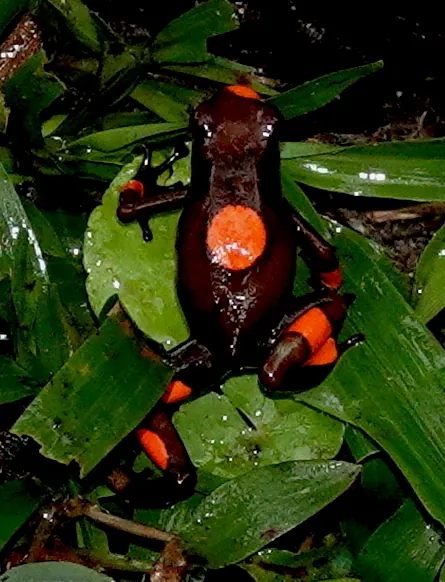
Harlequin poison frog
 Veleno na pel
The harlequin poison frog is a small, brightly marked frog that lives on the forest floor of western Colombia. Its skin carries strong toxins, so it is one of the poison dart frogs that should never be handled. It is now critically endangered because its rainforest home is being destroyed.1

 Como recoñecelo
- Background colour ranges from light to dark brown.1
- Usually has a vivid, bright spot on its back.1
- Small, with an average snout-to-vent length of about 3.3 cm.1
- Active on the forest floor, feeding on the ground after sunrise and hiding under leaf litter or on fallen logs by 16:00.1
Adoita confundirse con: Some frogs that were once classed as this species were separated into new species in 2018: Oophaga anchicayensis, Oophaga andresi and Oophaga solanensis.1
Poder do veleno
A súa pel é velenosa. É perigoso tocalo, lambelo ou comelo.
Que fai o seu veleno?
The frog produces histrionicotoxins, which are cardiotoxins, meaning they affect the heart. These compounds act as potent blockers of nicotinic acetylcholine receptors, the sites that receive nerve signals at muscle and nerve junctions. They also affect sodium and potassium channels, though much less strongly.1
Que perigoso é para as persoas?
Perigo para as persoas: GraveSe alguén o toca ou o come, hai que ir ao médico. As mortes son moi raras.The frog's toxins can be dangerous. Wild-caught frogs may be toxic and dangerous to handle, and they often have a much higher fatality rate in captivity.1
 Se alguén o tocou ou o comeu
- Se alguén tocou un: lava ben as mans e non toques os ollos nin a boca. Se un neno ou unha mascota lambeu ou comeu un: chama ao centro de toxicoloxía ou ao teu número de emerxencias.
Chama sempre primeiro ao teu número de emerxencias (112, 000, 911). Isto son consellos xerais de primeiros auxilios, non consello médico. Primeiros auxilios básicos
 Mantente a salvo
- Nunca toques, collas nin molestes un animal salvaxe, aínda que sexa pequeno e aínda que pareza durmido ou morto.
- Déixalle espazo. Se atopas un, mantén a calma, recúa amodo e déixao ir polo seu camiño.
- Se o tocaches ou o comiches: non esfregues os ollos nin a boca, lava as mans e busca axuda médica.
Non vai a por ti. O seu veleno só está aí para que ninguén o coma. Máis sobre como estar a salvo
En que lugar do mundo?
Que tamaño ten?
Canto mide?
 mide máis ou menos coma un clip
 podería percorrer 100 metros en 97 segundos (o humano máis rápido precisa 9,6)
Que tamaño ten Harlequin poison frog comparado CONTIGO?
Só son contas no teu navegador. Non se garda nin se envía nada a ningures.
Que rápido é?


Datos
The tadpoles cannot feed on their own. They are obligate egg-feeders and will starve without the unfertilised eggs their mother provides.1
A parent carries the tadpoles to tiny water pools, often found in the axil of a bromeliad plant, where they develop.1
Histrionicotoxins are hard to make in a lab. Synthesising them has been the subject of many different attempts.1
Harlequin poison frogs are among the most difficult poison dart frogs to raise in captivity.1
Adults are active on the ground during the day and retreat to refuge by mid-afternoon.1
Para expertos en pezoñas
- Nome científico
- Oophaga histrionica
- Grupo
- Ras velenosas, sapos e tritóns
- Familia
- Dendrobatidae2
- Orde
- Anura
- Continentes
- América do Sur
- Crías
- The female lays eggs among leaf litter. A parent carries the newly hatched tadpoles to a small water pool, often in a bromeliad, and the mother later lays unfertilised eggs for the tadpoles to eat.1
- Como lle vai na natureza
- Critically Endangered1
- Perigo para as persoas
- 3 / 5: Grave3
De onde veñen os datos
- Harlequin poison frog (Wikipedia (CC BY-SA 4.0))
- Oophaga histrionica (iNaturalist): nomes e clasificación.
- Venom Wiki: o nivel de perigo, o tamaño típico e a velocidade estimada son nosos. Mira como os calculamos: Como valoramos o perigo.
Cada dato desta páxina ten un número que leva á súa fonte. Se nos equivocamos nalgo, sentímolo, somos fans dos animais, non unha revista científica. Dínolo en [email protected] e arranxarémolo.
 O escorpión ten fame! Venom Wiki é un proxecto dunha soa persoa: gratis, sen anuncios e sen rastrexadores. Unha pequena propina axuda a mantelo en liña.Dálle de comer ao escorpión
Máis do mesmo grupo: Ras velenosas, sapos e tritóns
 Golden poison frogRas velenosas, sapos e tritónsMortalNon tocar
 Cane toadRas velenosas, sapos e tritónsPrecisa un médicoNon tocar
 Dyeing poison dart frogRas velenosas, sapos e tritónsSó doeNon tocar
 Black-legged poison frogRas velenosas, sapos e tritónsPode matarNon tocar
 Bruno's casque-headed frogRas velenosas, sapos e tritónsPrecisa un médicoNon tocar
 Giant leaf frogRas velenosas, sapos e tritónsSó doeNon tocar
 Terciopelo
 Brazilian wandering spider
 Eyelash viper
 Golden lancehead
 South American bushmaster
 Peruvian giant centipede